Palacio-Mancheno Paolo E, Larriera Adriana I, Doty Stephen B, Cardoso Luis, Fritton Susannah P
Department of Biomedical Engineering, City College of New York, New York, NY, USA.
J Bone Miner Res. 2014 Jan;29(1):142-50. doi: 10.1002/jbmr.2012.
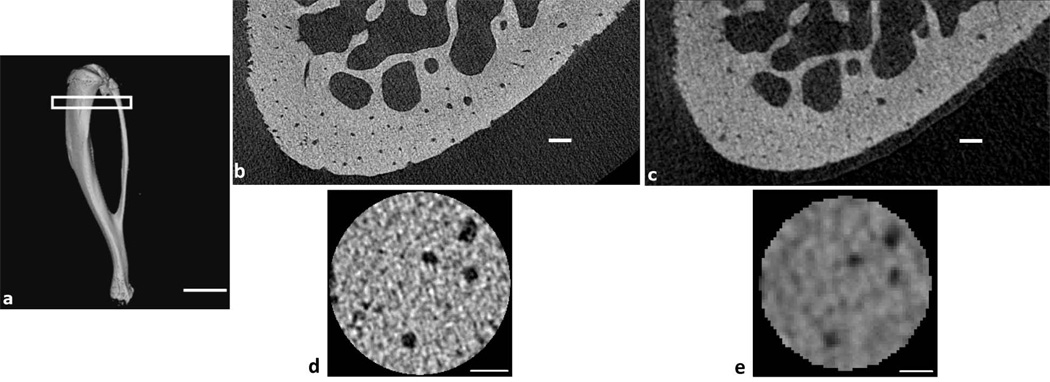
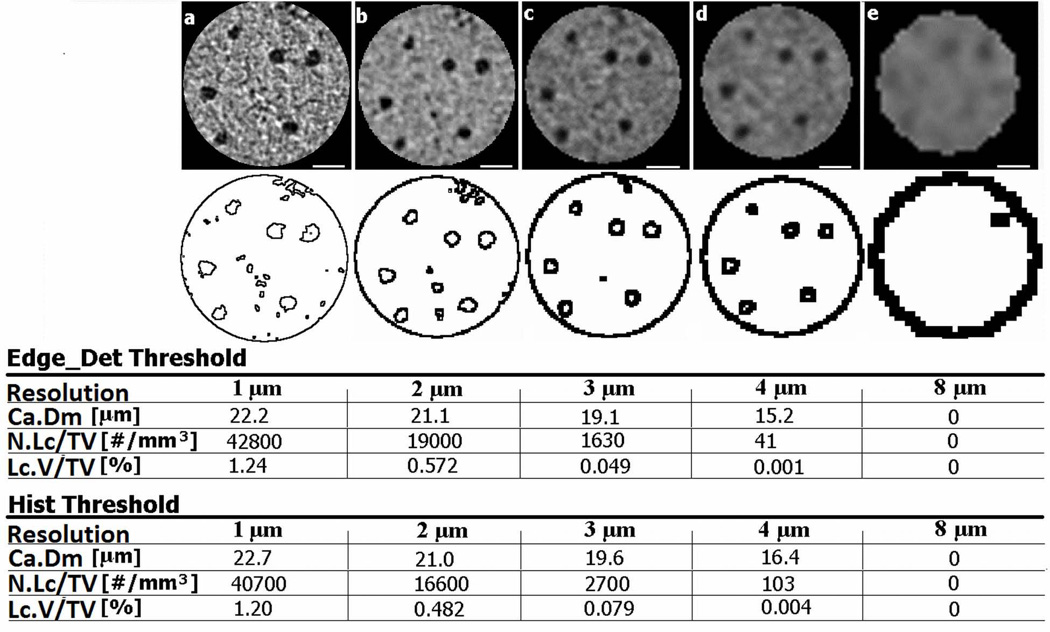
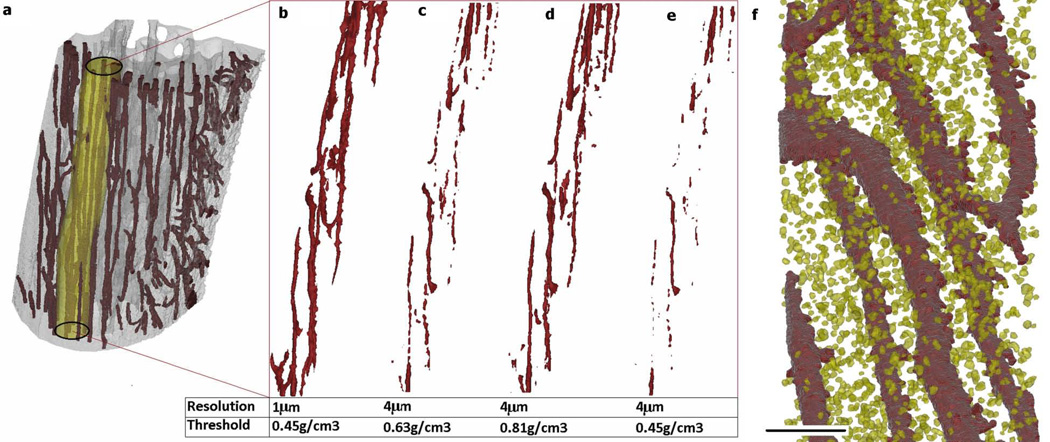
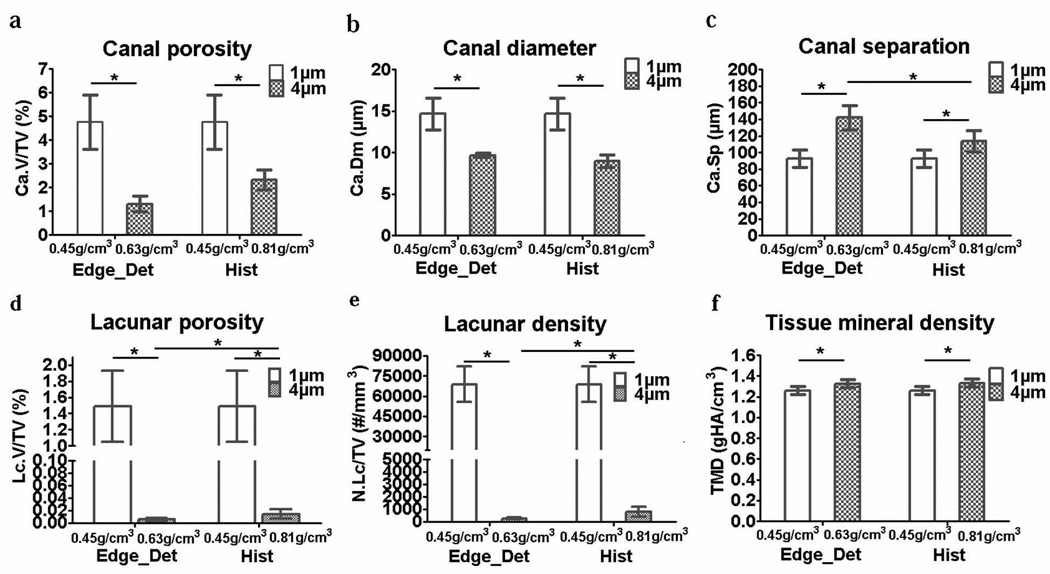
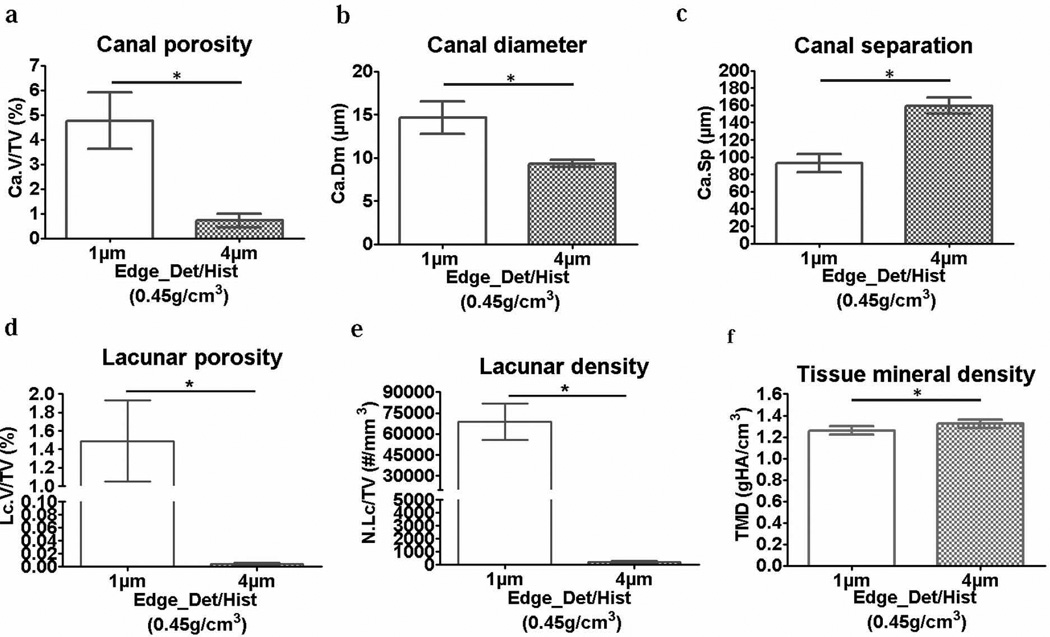
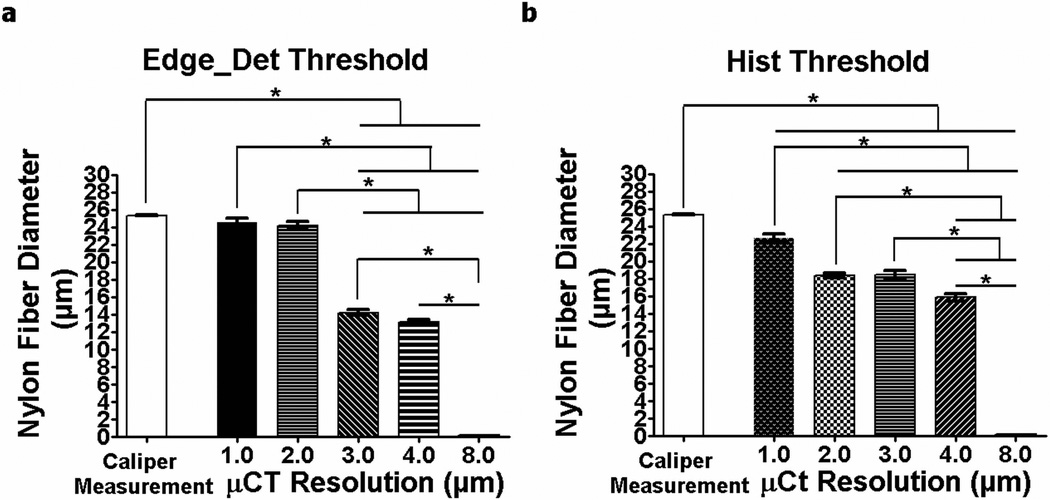
Current micro-computed tomography (µCT) systems allow scanning bone at resolutions capable of three-dimensional (3D) characterization of intracortical vascular porosity and osteocyte lacunae. However, the scanning and reconstruction parameters along with the image segmentation method affect the accuracy of the measurements. In this study, the effects of scanning resolution and image threshold method in quantifying small features of cortical bone (vascular porosity, vascular canal diameter and separation, lacunar porosity and density, and tissue mineral density) were analyzed. Cortical bone from the tibia of Sprague-Dawley rats was scanned at 1-µm and 4-µm resolution, reconstructions were density-calibrated, and volumes of interest were segmented using approaches based on edge-detection or histogram analysis. In 1-µm resolution scans, the osteocyte lacunar spaces could be visualized, and it was possible to separate the lacunar porosity from the vascular porosity. At 4-µm resolution, the vascular porosity and vascular canal diameter were underestimated, and osteocyte lacunae were not effectively detected, whereas the vascular canal separation and tissue mineral density were overestimated compared to 1-µm resolution. Resolution had a much greater effect on the measurements than did threshold method, showing partial volume effects at resolutions coarser than 2 µm in two separate analyses, one of which assessed the effect of resolution on an object of known size with similar architecture to a vascular pore. Although there was little difference when using the edge-detection versus histogram-based threshold approaches, edge-detection was somewhat more effective in delineating canal architecture at finer resolutions (1-2 µm). In addition, use of a high-resolution (1 µm) density-based threshold on lower resolution (4 µm) density-calibrated images was not effective in improving the lower-resolution measurements. In conclusion, if measuring cortical vascular microarchitecture, especially in small animals, a µCT resolution of 1 to 2 µm is appropriate, whereas a resolution of at least 1 µm is necessary when assessing osteocyte lacunar porosity.
当前的微型计算机断层扫描(µCT)系统能够以三维(3D)方式对皮质内血管孔隙率和骨细胞陷窝进行表征的分辨率来扫描骨骼。然而,扫描和重建参数以及图像分割方法会影响测量的准确性。在本研究中,分析了扫描分辨率和图像阈值方法对量化皮质骨小特征(血管孔隙率、血管管径和间距、陷窝孔隙率和密度以及组织矿物质密度)的影响。对来自Sprague-Dawley大鼠胫骨的皮质骨以1微米和4微米的分辨率进行扫描,对重建图像进行密度校准,并使用基于边缘检测或直方图分析的方法对感兴趣区域进行分割。在1微米分辨率扫描中,可以观察到骨细胞陷窝空间,并且能够将陷窝孔隙率与血管孔隙率区分开来。在4微米分辨率下,血管孔隙率和血管管径被低估,骨细胞陷窝未被有效检测到,而与1微米分辨率相比,血管管径间距和组织矿物质密度被高估。分辨率对测量的影响比阈值方法大得多,在两项独立分析中,在大于2微米的分辨率下显示出部分容积效应,其中一项分析评估了分辨率对具有与血管孔相似结构的已知大小物体的影响。尽管使用基于边缘检测和基于直方图的阈值方法时差异不大,但在更精细的分辨率(1至2微米)下,边缘检测在描绘管道结构方面更有效。此外,在较低分辨率(4微米)的密度校准图像上使用基于高分辨率(1微米)密度的阈值并不能有效改善较低分辨率的测量结果。总之,如果要测量皮质血管微结构,尤其是在小动物中,µCT分辨率为1至2微米是合适的,而在评估骨细胞陷窝孔隙率时,至少1微米的分辨率是必要的。