Guérin Bastien, Gebhardt Matthias, Cauley Steven, Adalsteinsson Elfar, Wald Lawrence L
Martinos Center for Biomedical Imaging, Department of Radiology, Massachusetts General Hospital, Charlestown, Massachusetts, USA.
Magn Reson Med. 2014 Apr;71(4):1446-57. doi: 10.1002/mrm.24800. Epub 2013 Jun 14.
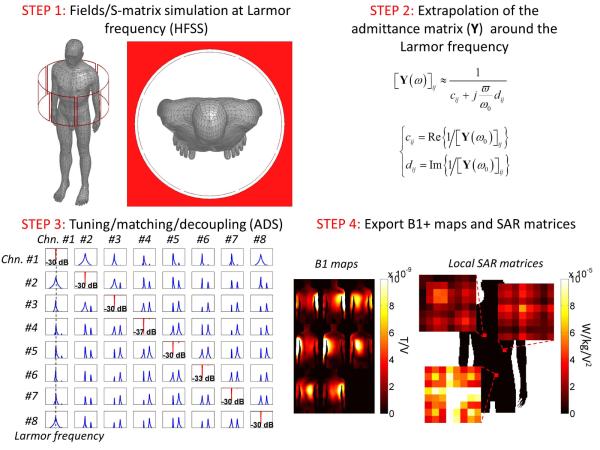
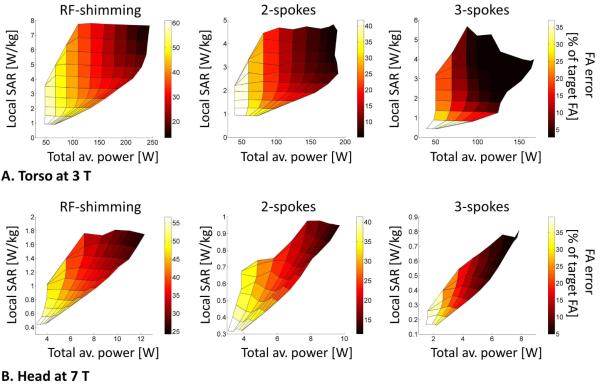
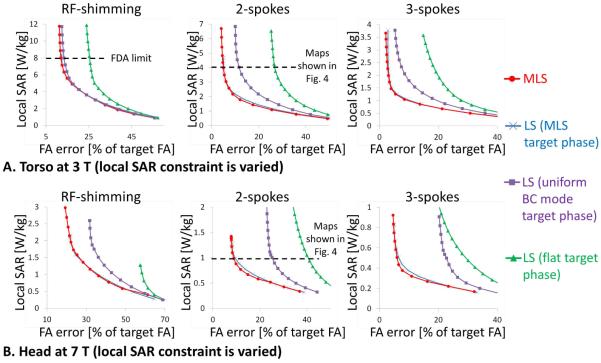
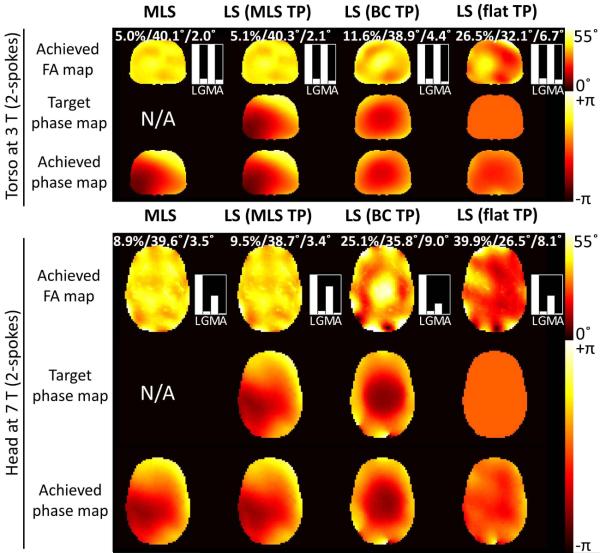
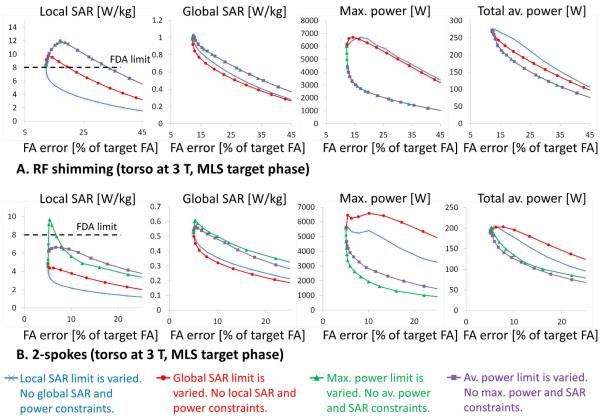
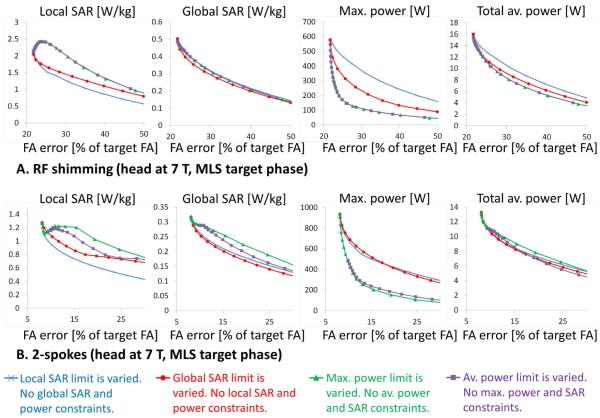
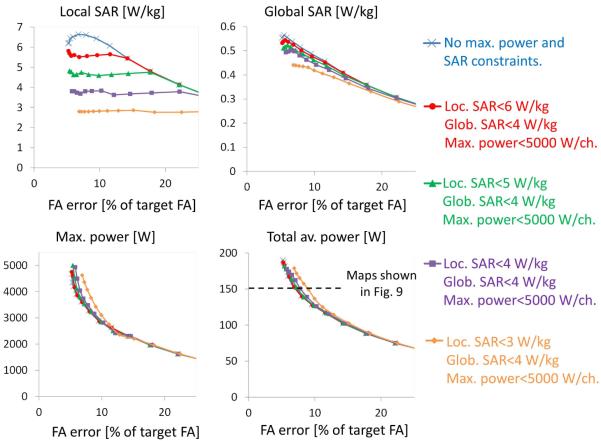
We propose a constrained optimization approach for designing parallel transmit (pTx) pulses satisfying all regulatory and hardware limits. We study the trade-offs between excitation accuracy, local and global specific absorption rate (SAR), and maximum and average power for small flip-angle pTx (eight channels) spokes pulses in the torso at 3 T and in the head at 7 T.
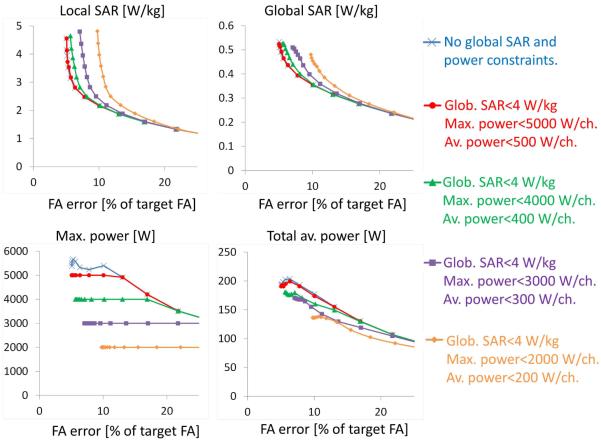
We compare the trade-offs between the above-mentioned quantities using the L-curve method. We use a primal-dual algorithm and a compressed set of local SAR matrices to design radio-frequency (RF) pulses satisfying all regulatory (including local SAR) and hardware constraints.
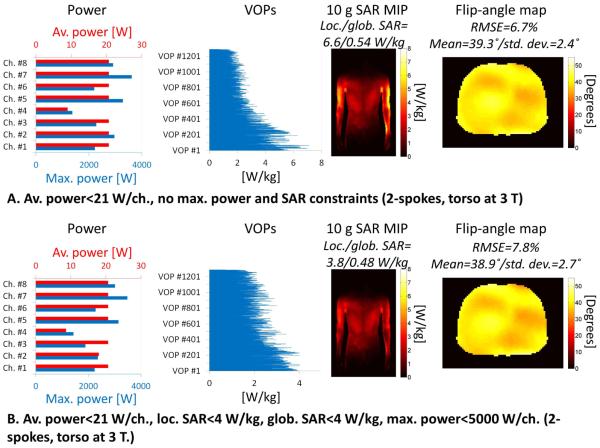
Local SAR can be substantially reduced (factor of 2 or more) by explicitly constraining it in the pulse design process compared to constraining global SAR or pulse power alone. This often comes at the price of increased pulse power.
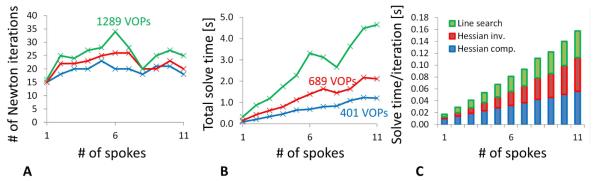
Simultaneous control of power and SAR is needed for the design of pTx pulses that are safe and can be played on the scanner. Constraining a single quantity can create large increase in the others, which can then rise above safety or hardware limits. Simultaneous constraint of local SAR and power is fast enough to be applicable in a clinical setting.
我们提出一种约束优化方法,用于设计满足所有监管和硬件限制的并行发射(pTx)脉冲。我们研究了在3T时人体躯干以及7T时头部中,小翻转角pTx(八通道)辐条脉冲的激发精度、局部和整体比吸收率(SAR)以及最大功率和平均功率之间的权衡。
我们使用L曲线法比较上述各量之间的权衡。我们使用原始对偶算法和一组压缩的局部SAR矩阵来设计满足所有监管(包括局部SAR)和硬件约束的射频(RF)脉冲。
与仅约束整体SAR或脉冲功率相比,在脉冲设计过程中明确约束局部SAR,可使其大幅降低(降低2倍或更多)。这通常是以增加脉冲功率为代价的。
设计安全且可在扫描仪上播放的pTx脉冲需要同时控制功率和SAR。仅约束单一量可能会导致其他量大幅增加,进而超过安全或硬件限制。同时约束局部SAR和功率的速度足够快,可应用于临床环境。