Santa Fe Institute, Santa Fe, New Mexico, United States of America.
PLoS Biol. 2013;11(6):e1001579. doi: 10.1371/journal.pbio.1001579. Epub 2013 Jun 11.
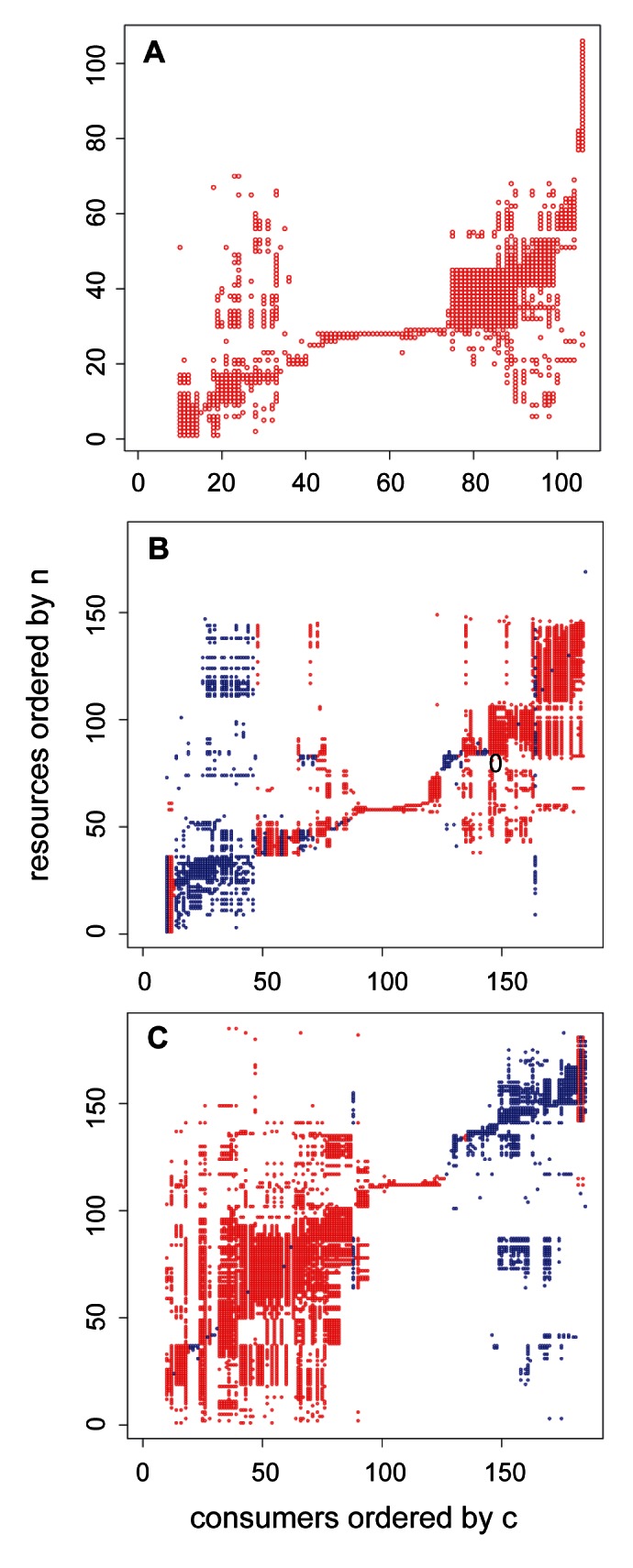
Comparative research on food web structure has revealed generalities in trophic organization, produced simple models, and allowed assessment of robustness to species loss. These studies have mostly focused on free-living species. Recent research has suggested that inclusion of parasites alters structure. We assess whether such changes in network structure result from unique roles and traits of parasites or from changes to diversity and complexity. We analyzed seven highly resolved food webs that include metazoan parasite data. Our analyses show that adding parasites usually increases link density and connectance (simple measures of complexity), particularly when including concomitant links (links from predators to parasites of their prey). However, we clarify prior claims that parasites "dominate" food web links. Although parasites can be involved in a majority of links, in most cases classic predation links outnumber classic parasitism links. Regarding network structure, observed changes in degree distributions, 14 commonly studied metrics, and link probabilities are consistent with scale-dependent changes in structure associated with changes in diversity and complexity. Parasite and free-living species thus have similar effects on these aspects of structure. However, two changes point to unique roles of parasites. First, adding parasites and concomitant links strongly alters the frequency of most motifs of interactions among three taxa, reflecting parasites' roles as resources for predators of their hosts, driven by trophic intimacy with their hosts. Second, compared to free-living consumers, many parasites' feeding niches appear broader and less contiguous, which may reflect complex life cycles and small body sizes. This study provides new insights about generic versus unique impacts of parasites on food web structure, extends the generality of food web theory, gives a more rigorous framework for assessing the impact of any species on trophic organization, identifies limitations of current food web models, and provides direction for future structural and dynamical models.
食物网结构的比较研究揭示了营养组织的一般性,产生了简单的模型,并允许评估对物种损失的稳健性。这些研究主要集中在自由生活的物种上。最近的研究表明,寄生虫的包含会改变结构。我们评估这种网络结构的变化是否是由于寄生虫的独特作用和特征引起的,还是由于多样性和复杂性的变化引起的。我们分析了包括后生动物寄生虫数据的七个高度解析的食物网。我们的分析表明,添加寄生虫通常会增加链路密度和连接度(简单的复杂性度量),特别是当包含伴随链路(从捕食者到猎物的寄生虫的链路)时。然而,我们澄清了寄生虫“主导”食物网链路的先前说法。尽管寄生虫可能参与大多数链路,但在大多数情况下,经典的捕食关系链路的数量超过经典的寄生关系链路。关于网络结构,观察到的度分布、14 个常用度量和链路概率的变化与与多样性和复杂性变化相关的结构的尺度相关变化一致。因此,寄生虫和自由生活的物种对结构的这些方面具有相似的影响。然而,两个变化指向寄生虫的独特作用。首先,添加寄生虫和伴随链路强烈改变了由宿主捕食者的资源驱动的三个分类群之间的大多数相互作用模式的频率,这反映了寄生虫与宿主的营养关系密切,反映了寄生虫的作用。其次,与自由生活的消费者相比,许多寄生虫的摄食生态位似乎更宽且不连续,这可能反映了复杂的生命周期和较小的体型。这项研究提供了关于寄生虫对食物网结构的一般影响和独特影响的新见解,扩展了食物网理论的普遍性,为评估任何物种对营养组织的影响提供了更严格的框架,确定了当前食物网模型的局限性,并为未来的结构和动态模型提供了方向。