Kurepin Leonid V, Dahal Keshav P, Savitch Leonid V, Singh Jas, Bode Rainer, Ivanov Alexander G, Hurry Vaughan, Hüner Norman P A
Department of Biology and the Biotron Center for Experimental Climate Change Research, Western University, London, ON N6A 5B7, Canada.
Int J Mol Sci. 2013 Jun 18;14(6):12729-63. doi: 10.3390/ijms140612729.
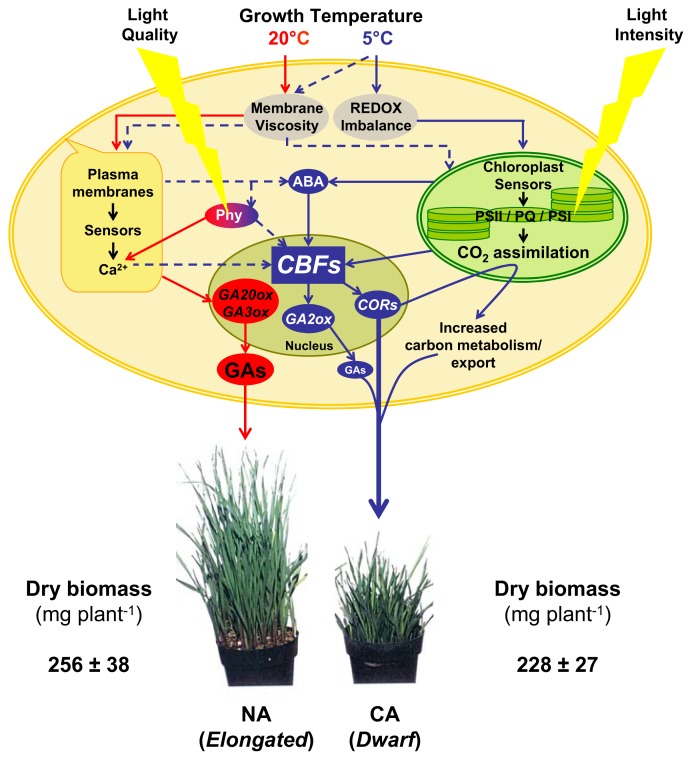
Cold acclimation of winter cereals and other winter hardy species is a prerequisite to increase subsequent freezing tolerance. Low temperatures upregulate the expression of C-repeat/dehydration-responsive element binding transcription factors (CBF/DREB1) which in turn induce the expression of COLD-REGULATED (COR) genes. We summarize evidence which indicates that the integration of these interactions is responsible for the dwarf phenotype and enhanced photosynthetic performance associated with cold-acclimated and CBF-overexpressing plants. Plants overexpressing CBFs but grown at warm temperatures mimic the cold-tolerant, dwarf, compact phenotype; increased photosynthetic performance; and biomass accumulation typically associated with cold-acclimated plants. In this review, we propose a model whereby the cold acclimation signal is perceived by plants through an integration of low temperature and changes in light intensity, as well as changes in light quality. Such integration leads to the activation of the CBF-regulon and subsequent upregulation of COR gene and GA 2-oxidase (GA2ox) expression which results in a dwarf phenotype coupled with increased freezing tolerance and enhanced photosynthetic performance. We conclude that, due to their photoautotrophic nature, plants do not rely on a single low temperature sensor, but integrate changes in light intensity, light quality, and membrane viscosity in order to establish the cold-acclimated state. CBFs appear to act as master regulators of these interconnecting sensing/signaling pathways.
冬季谷物和其他耐寒物种的冷驯化是提高后续抗冻性的先决条件。低温会上调C-重复/脱水响应元件结合转录因子(CBF/DREB1)的表达,进而诱导冷调节(COR)基因的表达。我们总结了证据,表明这些相互作用的整合导致了与冷驯化和CBF过表达植物相关的矮化表型和增强的光合性能。过表达CBF但在温暖温度下生长的植物模拟了耐寒、矮小、紧凑的表型;光合性能增强;以及通常与冷驯化植物相关的生物量积累。在这篇综述中,我们提出了一个模型,即植物通过整合低温、光强变化以及光质变化来感知冷驯化信号。这种整合导致CBF调控子的激活以及随后COR基因和GA 2-氧化酶(GA2ox)表达的上调,从而产生矮化表型,同时提高抗冻性和增强光合性能。我们得出结论,由于植物的光合自养性质,它们不依赖单一的低温传感器,而是整合光强、光质和膜粘度的变化来建立冷驯化状态。CBF似乎是这些相互连接的传感/信号通路的主要调节因子。