Lineberger Comprehensive Cancer Center, Department of Genetics, School of Pharmacy, University of North Carolina at Chapel Hill, Chapel Hill, North Carolina 27599, USA.
Clin Cancer Res. 2013 Sep 1;19(17):4889-99. doi: 10.1158/1078-0432.CCR-13-0522. Epub 2013 Jun 18.
To use genetically engineered mouse models (GEMM) and orthotopic syngeneic murine transplants (OST) to develop gene expression-based predictors of response to anticancer drugs in human tumors. These mouse models offer advantages including precise genetics and an intact microenvironment/immune system.
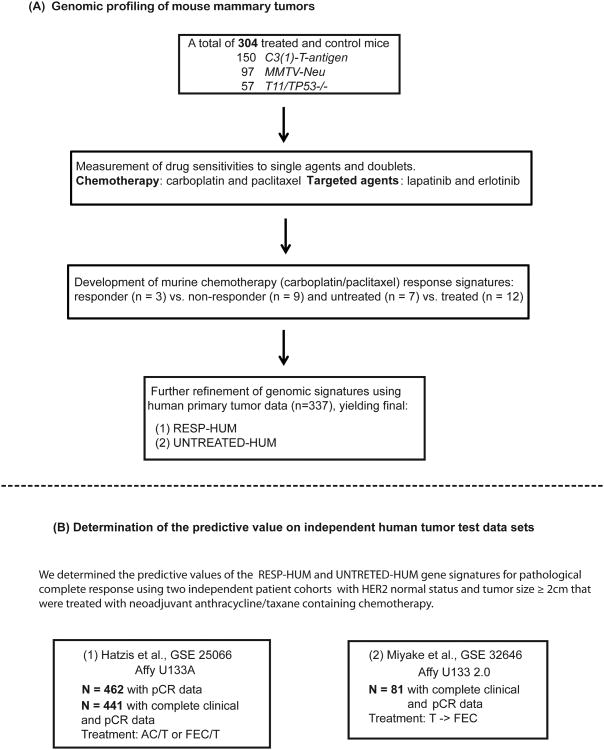
We examined the efficacy of 4 chemotherapeutic or targeted anticancer drugs, alone and in combination, using mouse models representing 3 distinct breast cancer subtypes: Basal-like (C3(1)-T-antigen GEMM), Luminal B (MMTV-Neu GEMM), and Claudin-low (T11/TP53-/- OST). We expression-profiled tumors to develop signatures that corresponded to treatment and response, and then tested their predictive potential using human patient data.
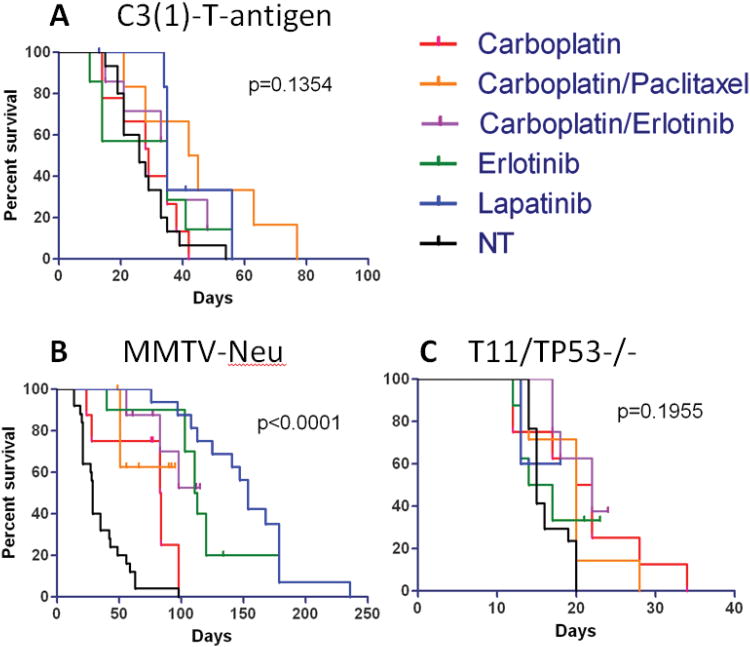
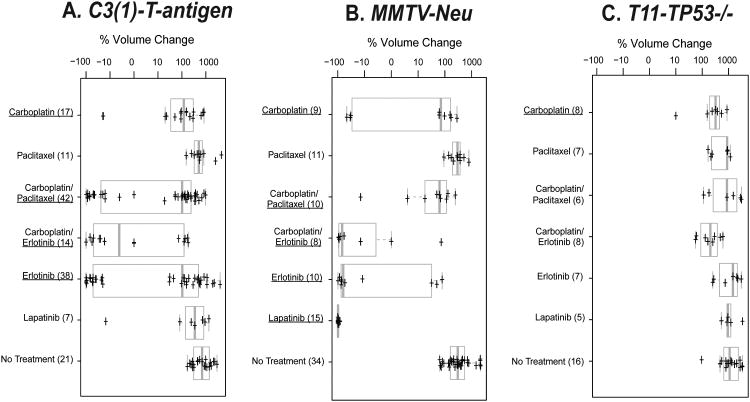
Although a single agent exhibited exceptional efficacy (i.e., lapatinib in the Neu-driven model), generally single-agent activity was modest, whereas some combination therapies were more active and life prolonging. Through analysis of RNA expression in this large set of chemotherapy-treated murine tumors, we identified a pair of gene expression signatures that predicted pathologic complete response to neoadjuvant anthracycline/taxane therapy in human patients with breast cancer.
These results show that murine-derived gene signatures can predict response even after accounting for common clinical variables and other predictive genomic signatures, suggesting that mice can be used to identify new biomarkers for human patients with cancer.
利用基因工程小鼠模型(GEMM)和同源同种异体移植小鼠模型(OST),开发基于基因表达的人类肿瘤对抗癌药物反应的预测因子。这些小鼠模型具有精确的遗传学和完整的微环境/免疫系统等优势。
我们使用代表 3 种不同乳腺癌亚型的小鼠模型(基底样型[C3(1)-T 抗原 GEMM]、管腔 B 型[MMTV-Neu GEMM]和 Claudin-low 型[T11/TP53-/- OST]),单独或联合使用 4 种化疗药物或靶向抗癌药物,研究了它们的疗效。我们对肿瘤进行了表达谱分析,以开发与治疗和反应相对应的特征,并使用人类患者数据测试了它们的预测潜力。
虽然单一药物表现出了极好的疗效(即 lapatinib 在 Neu 驱动的模型中),但一般来说单一药物的活性较为温和,而一些联合治疗方案则更为活跃且能延长生存期。通过对这一大组接受化疗的小鼠肿瘤的 RNA 表达分析,我们确定了一对基因表达特征,可以预测人类乳腺癌患者新辅助蒽环类/紫杉烷治疗的病理完全缓解。
这些结果表明,即使考虑到常见的临床变量和其他预测性基因组特征,源自小鼠的基因特征仍可预测反应,这表明小鼠可用于鉴定癌症患者的新生物标志物。