Department of Orthopaedics, Sahlgrenska University Hospital, Institute of Clinical Sciences at the Sahlgrenska Academy, University of Gothenburg, Gothenburg, Sweden.
Dermatol Pract Concept. 2013 Apr 30;3(2):41-8. doi: 10.5826/dpc.0302a05. Print 2013 Apr.
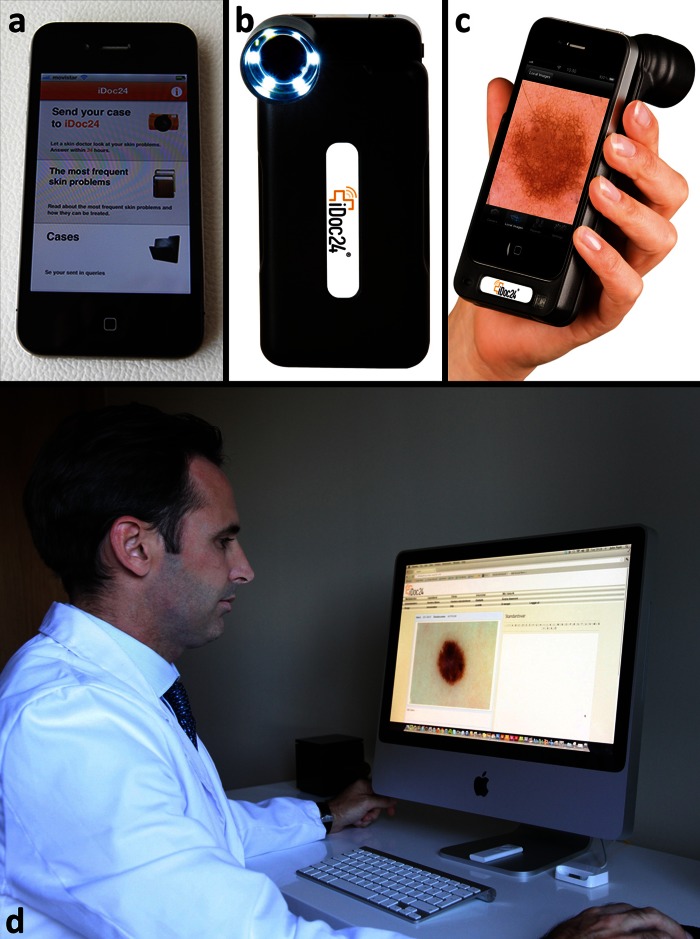
The introduction of the smartphone with high-quality, built-in digital cameras and easy-to-install software may make it more convenient to perform teledermatology. In this study we looked at the feasibility of using a smartphone (iPhone 4(®)) with an installed application especially developed for teledermatology (iDoc24(®)) and a dermoscope (FotoFinder Handyscope(®)) that is customized to attach to the smartphone to be able to carry out mobile teledermoscopy.
To study the diagnostic accuracy of this mobile teledermoscopy solution, to determine the interobserver concordance between teledermoscopists (TDs) and a dermatologist meeting the patient face-to-face (FTF), and to assess the adequacy of the TDs' management decisions and to evaluate the image quality obtained.
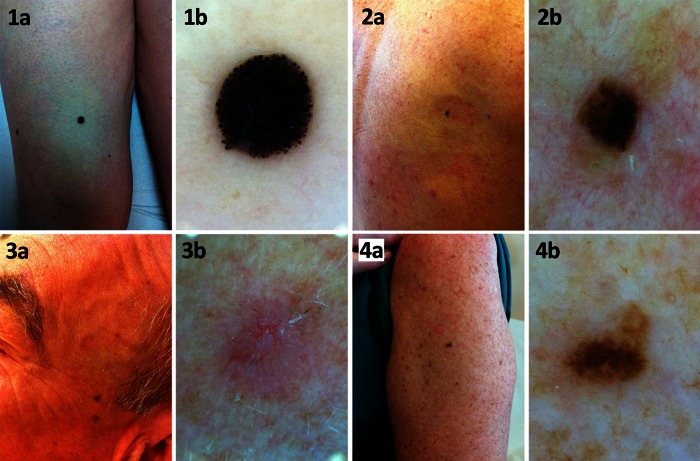
PATIENTS/METHODS: During a 16-week period, patients with one or more suspicious skin lesions deemed to need a biopsy or excision were included. The smartphone app was used to send a clinical image, a dermoscopy image and relevant clinical information to a secure Internet platform (Tele-Dermis(®)). Two TDs assessed the incoming cases, providing a specific primary diagnosis and a management decision. They also graded the image quality. The histopathological diagnosis was used as the gold standard.
Sixty-nine lesions were included. The FTF dermatologist's diagnostic accuracy was 66.7%, which was statistically higher than TD 1 (50.7%, P=0.04) but similar to TD 2 (60.9%, P=0.52). The interobserver concordances between the FTF dermatologist and the two TDs and between the respective TDs showed moderate to substantial agreement. The TDs provided adequate management decisions for 68 (98.6%) and 69 (100%) lesions, respectively. The image quality was rated as excellent or sufficient in 94% and 84% of the cases by the respective TDs.
This novel mobile teledermoscopy solution may be useful as a triage tool for patients referred to dermatologists for suspicious skin lesions.
具有高质量内置数字摄像头和易于安装软件的智能手机的出现,使得远程皮肤病学更加便捷。在本研究中,我们研究了使用智能手机(iPhone 4(®))和专门为远程皮肤病学开发的应用程序(iDoc24(®))以及一款定制的智能手机附件数码皮肤镜(FotoFinder Handyscope(®))进行移动远程皮肤镜检查的可行性。
研究这种移动远程皮肤镜检查解决方案的诊断准确性,确定远程皮肤镜检查医师(TD)与面对面见患者的皮肤科医生(FTF)之间的观察者间一致性,并评估 TD 的管理决策的充分性,以及评估获得的图像质量。
患者/方法:在 16 周的时间内,纳入了一个或多个疑似皮肤病变需要活检或切除的患者。智能手机应用程序用于将临床图像、皮肤镜图像和相关临床信息发送到安全的互联网平台(Tele-Dermis(®))。两名 TD 评估传入的病例,提供特定的初步诊断和管理决策。他们还对图像质量进行评分。组织病理学诊断作为金标准。
共纳入 69 个病变。FTF 皮肤科医生的诊断准确性为 66.7%,明显高于 TD1(50.7%,P=0.04),但与 TD2(60.9%,P=0.52)相似。FTF 皮肤科医生与两名 TD 之间以及两名 TD 之间的观察者间一致性为中度至高度一致。TD 分别为 68(98.6%)和 69(100%)个病变提供了足够的管理决策。两位 TD 分别对 94%和 84%的病例的图像质量评为优秀或良好。
这种新型的移动远程皮肤镜检查解决方案可作为转诊至皮肤科医生就诊的疑似皮肤病变患者的分诊工具。