Berlanga Fernández Sofía, Vizcaya-Moreno María Flores, Pérez-Cañaveras Rosa María
Área Básica de Salud (ABS) Sta. Eulalia Sur, Institut Català de la Salut, Hospitalet del Llobregat, Barcelona, España.
Aten Primaria. 2013 Oct;45(8):409-17. doi: 10.1016/j.aprim.2013.04.004. Epub 2013 Jun 20.
To describe needs and experiences of mothers with children under one year old, to identify the factors that hinder the transition to motherhood, and to design the content of a health promotion program to develop motherhood support group sessions.
A qualitative study with a phenomenological approach.
Eight Primary Care Centres in the province of Barcelona, between July 2011 and July 2012.
A total of 21 mothers participating in group dynamics maternity support: All of them participated in interviews and 8 in focus group.
Semi-structured interviews were used in a purposive sample. The transcriptions were analysed by structure (latent content analysis) and content (manifest content analysis), with different categories being obtained.
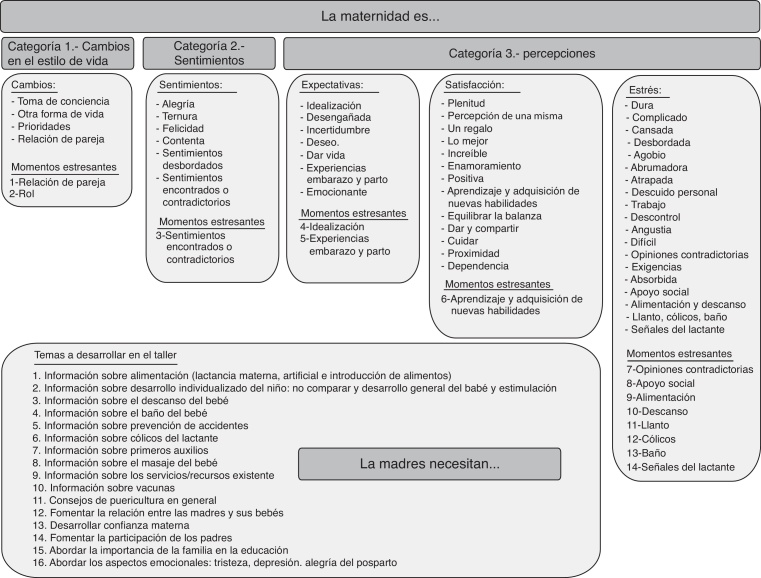
The participants in the study defined the construct of motherhood around three categories: Changes in lifestyle, feelings and perceptions. They identified as the most stressful times; «the new role», «changes in the partner relationship», «feelings», «experiences of pregnancy and childbirth», «idealisation», «lack of support», «crying», «colic», «read the signs of the child», «bath», «rest», «contradictory opinions», «learning», and «acquisition of new skills». They highlighted, as key topics for group dynamics, feeding, development, affective relationship, maternal confidence, fathers participation, family role, emotional, rest, massage, bath, accident prevention, colic, first aid, childcare, resources, and vaccines.
Dynamic groups should be contextualised according to the perceived needs of the mothers, and other family members should be allowed to participate.
描述一岁以下儿童母亲的需求和经历,确定阻碍向母亲角色转变的因素,并设计一个健康促进项目的内容,以开展母亲支持小组活动。
采用现象学方法的定性研究。
2011年7月至2012年7月期间,巴塞罗那省的八个初级保健中心。
共有21名参与群体动力学产妇支持的母亲:她们都参与了访谈,8人参与了焦点小组。
对目的抽样采用半结构化访谈。通过结构(潜在内容分析)和内容(显性内容分析)对转录内容进行分析,得出不同类别。
研究参与者围绕三个类别定义了母亲角色的概念:生活方式的变化、感受和认知。她们确定压力最大的时期为:“新角色”、“伴侣关系的变化”、“感受”、“怀孕和分娩经历”、“理想化”、“缺乏支持”、“哭泣”、“腹绞痛”、“读懂孩子的信号”、“洗澡”、“休息”、“矛盾的意见”、“学习”和“获得新技能”。她们强调,作为群体动力学的关键主题,喂养、发育、情感关系、母亲信心、父亲参与、家庭角色、情绪、休息、按摩、洗澡、事故预防、腹绞痛、急救、育儿、资源和疫苗。
应根据母亲们感知到的需求对动态小组进行情境化设置,并允许其他家庭成员参与。