Edraki Mitra, Pourpulad Hajar, Kargar Marzie, Pishva Narjes, Zare Najaf, Montaseri Hashem
Department of Pediatrics, Community Based Research Center, Shiraz University of Medical Sciences, Shiraz, Iran.
Iran J Pediatr. 2013 Jun;23(3):261-8.
Apnea is one of the most common problems in premature newborns. The present study aimed to determine the effect of olfactory stimulation by vanillin on prevention of apnea in premature newborns.
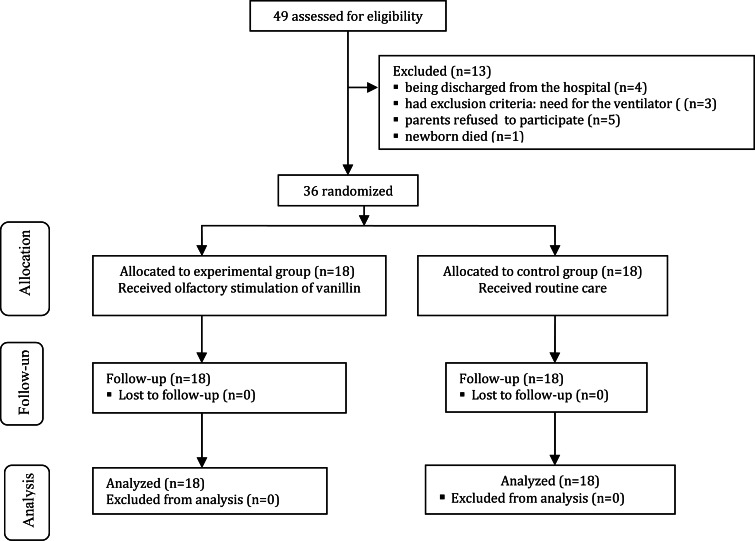
In this randomized controlled trial, 36 premature newborns with the postnatal age of 2 days and weight under 2500 grams referred to the hospitals affiliated to Shiraz University of Medical Sciences, were selected through simple random sampling and allocated into control and experimental groups. The experimental group received olfactory stimulation by saturated vanillin solution, while the control group received no interventions. The newborns of both groups were continuously monitored for presence/absence of apnea and number of episodes of apnea as well as arterial blood oxygen saturation and heart rate for 5 days. The data were analyzed by independent Student t-test and repeat measure ANCOVA.
The presence of apnea revealed to be significantly different between the two groups in the first, second, and fourth day of the study (P<0.05). The number of episodes of apnea during five days was also significantly different between the study groups (t=8.32, P<0.05). Using olfactory stimulation by vanillin caused a 3.1-fold decrease in apnea and the effect size was 0.72. Moreover, the two groups were significantly different regarding the arterial blood oxygen and heart rate during the study period (P<0.05).
This study indicated the beneficial effect of saturated vanillin solution on apnea; therefore, it may be used for prevention and treatment of apnea in premature infants. Further studies are needed to improve evidence-based practice in this regard.
呼吸暂停是早产新生儿最常见的问题之一。本研究旨在确定香草醛嗅觉刺激对预防早产新生儿呼吸暂停的效果。
在这项随机对照试验中,通过简单随机抽样选取了36名出生后2天、体重低于2500克的早产新生儿,这些新生儿转诊至设拉子医科大学附属医院,并被分为对照组和实验组。实验组接受饱和香草醛溶液的嗅觉刺激,而对照组不接受任何干预。对两组新生儿连续5天监测呼吸暂停的有无、呼吸暂停发作次数以及动脉血氧饱和度和心率。数据采用独立样本t检验和重复测量协方差分析进行分析。
在研究的第一天、第二天和第四天,两组之间呼吸暂停的存在情况有显著差异(P<0.05)。研究组之间五天内呼吸暂停发作次数也有显著差异(t=8.32,P<0.05)。使用香草醛进行嗅觉刺激使呼吸暂停减少了3.1倍,效应大小为0.72。此外,在研究期间,两组在动脉血氧和心率方面也有显著差异(P<0.05)。
本研究表明饱和香草醛溶液对呼吸暂停有有益作用;因此,它可用于预防和治疗早产婴儿的呼吸暂停。在这方面需要进一步的研究来改进循证实践。