Research Department of Epidemiology and Public Health, University College London, London, UK.
Arch Dis Child. 2013 Sep;98(9):666-71. doi: 10.1136/archdischild-2012-303199. Epub 2013 Jun 24.
To investigate the association between breast feeding and intergenerational social mobility and the possible mediating role of neurological and stress mechanisms.
Secondary analysis of data from the 1958 and the 1970 British Cohort Studies.
Longitudinal study of individuals born in Britain during 1 week in 1958 and 1970.
17 419 individuals participated in the 1958 cohort and 16 771 in the 1970 cohort. The effect of breast feeding on intergenerational social mobility from age 10/11 to age 33/34 was analysed after multiple imputations to fill in missing data and propensity score matching on a wide range of confounders measured in childhood (1958 cohort N=16 039-16 154; 1970 cohort N=16 255-16 361).
Own Registrar General's Social Class (RGSC) at 33/34 years adjusted for father's RGSC at 10/11 years, gender and their interaction.
Breastfed individuals were more likely to be upwardly mobile (1958 cohort: OR 1.24 95% CI 1.12 to 1.38; 1970 cohort: OR 1.24 95% CI 1.12 to 1.37) and less likely to be downwardly mobile (1958 cohort: OR 0.81 95% CI 0.73 to 0.90; 1970 cohort: OR 0.79 95% CI 0.71 to 0.88). In an ordinal regression model, markers of neurological development (cognitive test scores) and stress (emotional stress scores) accounted for approximately 36% of the relationship between breast feeding and social mobility.
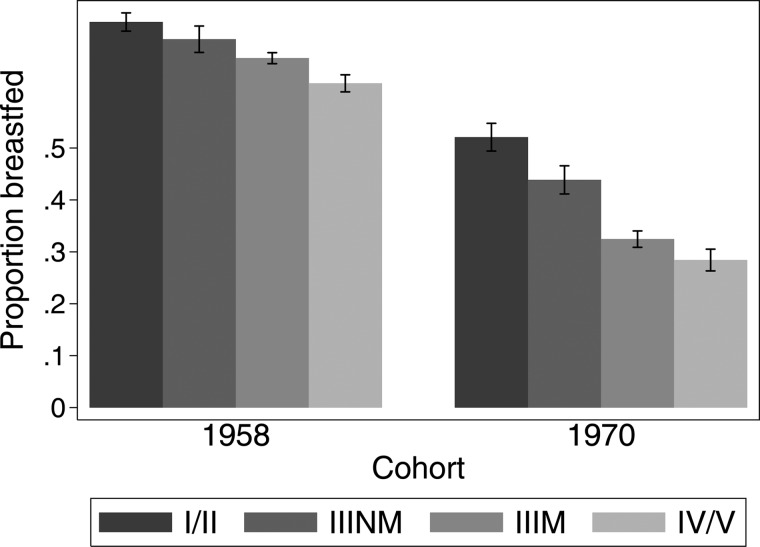
Breast feeding increased the odds of upward social mobility and decreased the odds of downward mobility. Consistent with a causal explanation, the findings were robust to matching on a large number of observable variables and effect sizes were alike for two cohorts with different social distributions of breast feeding. The effect was mediated in part through neurological and stress mechanisms.
研究母乳喂养与代际社会流动之间的关系,以及神经和应激机制可能的中介作用。
1958 年和 1970 年英国队列研究数据的二次分析。
1958 年和 1970 年在英国一周内出生的个人的纵向研究。
1958 年队列有 17419 人参加,1970 年队列有 16771 人参加。通过多项插补填补缺失数据,并对儿童时期测量的广泛混杂因素(1958 年队列 N=16039-16154;1970 年队列 N=16255-16361)进行倾向评分匹配,分析了从 10/11 岁到 33/34 岁母乳喂养对代际社会流动的影响。
33/34 岁时自己的注册总署社会阶层(RGSC),调整了 10/11 岁时父亲的 RGSC、性别及其相互作用。
母乳喂养的人更有可能向上流动(1958 年队列:OR 1.24,95%CI 1.12 至 1.38;1970 年队列:OR 1.24,95%CI 1.12 至 1.37),而不太可能向下流动(1958 年队列:OR 0.81,95%CI 0.73 至 0.90;1970 年队列:OR 0.79,95%CI 0.71 至 0.88)。在有序回归模型中,神经发育标志物(认知测试分数)和应激标志物(情绪应激分数)解释了母乳喂养与社会流动之间关系的约 36%。
母乳喂养增加了向上的社会流动机会,降低了向下流动的机会。与因果解释一致,这些发现对基于大量可观察变量的匹配具有稳健性,且两个队列的母乳喂养与社会流动的相关性相似,这两个队列的母乳喂养在社会分布上存在差异。该效应部分通过神经和应激机制介导。