MRC Centre for Causal Analyses in Translational Epidemiology, University of Bristol, Bristol, UK.
Int J Epidemiol. 2011 Jun;40(3):670-80. doi: 10.1093/ije/dyr020. Epub 2011 Feb 24.
A novel approach is explored for improving causal inference in observational studies by comparing cohorts from high-income with low- or middle-income countries (LMIC), where confounding structures differ. This is applied to assessing causal effects of breastfeeding on child blood pressure (BP), body mass index (BMI) and intelligence quotient (IQ).
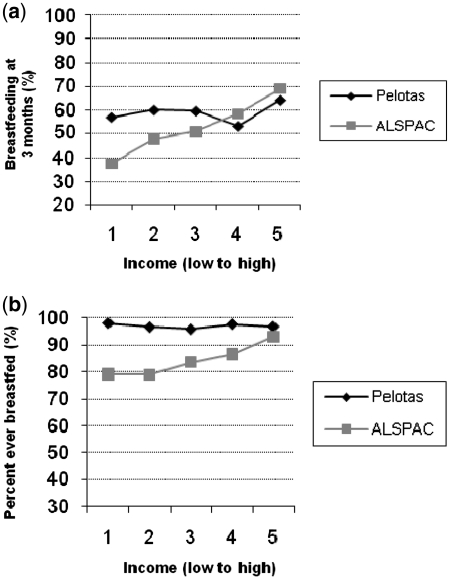
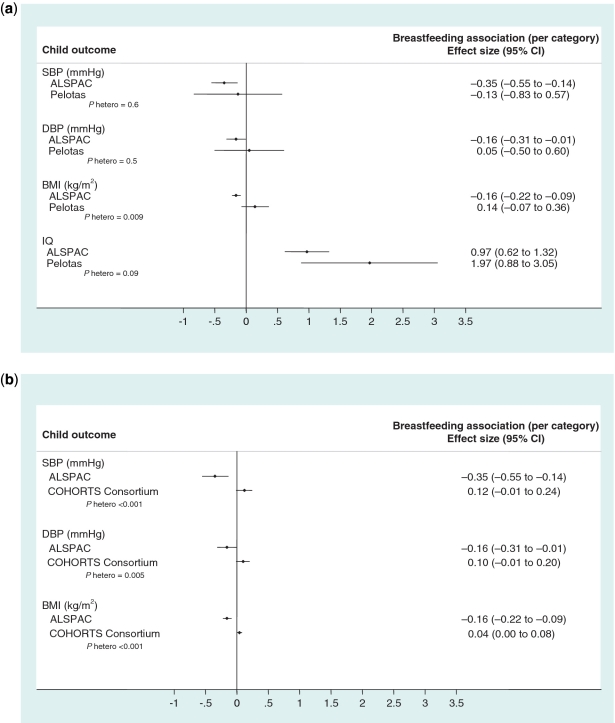
Standardized approaches for assessing the confounding structure of breastfeeding by socio-economic position were applied to the British Avon Longitudinal Study of Parents and Children (ALSPAC) (N ≃ 5000) and Brazilian Pelotas 1993 cohorts (N ≃ 1000). This was used to improve causal inference regarding associations of breastfeeding with child BP, BMI and IQ. Analyses were extended to include results from a meta-analysis of five LMICs (N ≃ 10 000) and compared with a randomized trial of breastfeeding promotion. Findings Although higher socio-economic position was strongly associated with breastfeeding in ALSPAC, there was little such patterning in Pelotas. In ALSPAC, breastfeeding was associated with lower BP, lower BMI and higher IQ, adjusted for confounders, but in the directions expected if due to socioeconomic patterning. In contrast, in Pelotas, breastfeeding was not strongly associated with BP or BMI but was associated with higher IQ. Differences in associations observed between ALSPAC and the LMIC meta-analysis were in line with those observed between ALSPAC and Pelotas, but with robust evidence of heterogeneity detected between ALSPAC and the LMIC meta-analysis associations. Trial data supported the conclusions inferred by the cross-cohort comparisons, which provided evidence for causal effects on IQ but not for BP or BMI.
While reported associations of breastfeeding with child BP and BMI are likely to reflect residual confounding, breastfeeding may have causal effects on IQ. Comparing associations between populations with differing confounding structures can be used to improve causal inference in observational studies.
本研究探索了一种新方法,通过比较高收入和低收入或中等收入国家(LMIC)的队列,来改善观察性研究中的因果推断,因为这些国家的混杂结构不同。本研究将该方法应用于评估母乳喂养对儿童血压(BP)、体重指数(BMI)和智商(IQ)的因果效应。
应用标准化方法评估社会经济地位对母乳喂养混杂结构的影响,对英国阿冯纵向研究父母和儿童(ALSPAC)(N ≃ 5000)和巴西佩洛塔斯 1993 年队列(N ≃ 1000)进行分析。这用于改善关于母乳喂养与儿童 BP、BMI 和 IQ 关联的因果推断。分析扩展到包括来自五个 LMIC 的荟萃分析结果(N ≃ 10000),并与母乳喂养促进的随机试验进行比较。
尽管在 ALSPAC 中,较高的社会经济地位与母乳喂养强烈相关,但在佩洛塔斯却很少有这种模式。在 ALSPAC 中,调整混杂因素后,母乳喂养与较低的 BP、较低的 BMI 和较高的 IQ 相关,但与由于社会经济模式导致的方向一致。相比之下,在佩洛塔斯,母乳喂养与 BP 或 BMI 相关性不强,但与较高的 IQ 相关。在 ALSPAC 与 LMIC 荟萃分析之间观察到的关联差异与在 ALSPAC 与佩洛塔斯之间观察到的差异一致,但在 ALSPAC 与 LMIC 荟萃分析之间的关联中检测到稳健的异质性证据。试验数据支持通过跨队列比较推断的结论,这些结论为 IQ 上的因果效应提供了证据,但对 BP 或 BMI 没有因果效应。
虽然报告的母乳喂养与儿童 BP 和 BMI 的关联可能反映了残余混杂,但母乳喂养可能对 IQ 有因果影响。比较具有不同混杂结构的人群之间的关联可以用于改善观察性研究中的因果推断。