Yagi Takeshi
KOKORO-Biology Group, Laboratories for Integrated Biology, Graduate School of Frontier Biosciences, Osaka University, Osaka, Japan.
J Neurogenet. 2013 Sep;27(3):97-105. doi: 10.3109/01677063.2013.801969. Epub 2013 Jun 28.
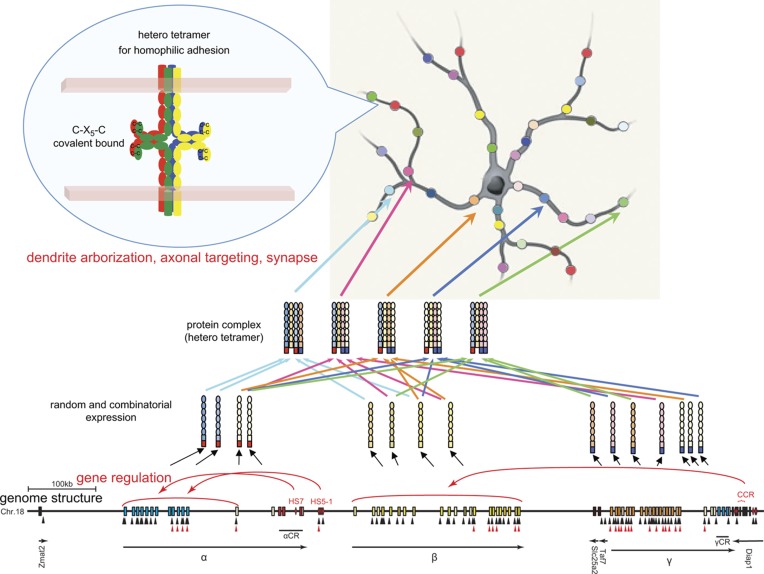
The mammalian brain is a complex multicellular system involving enormous numbers of neurons. The neuron is the basic functional unit of the brain, and neurons are organized by specialized intercellular connections into circuits with many other neurons. Physiological studies have revealed that individual neurons have remarkably selective response properties, and this individuality is a fundamental requirement for building complex and functionally diverse neural networks. Recent molecular biological studies have revealed genetic bases for neuronal individuality in the mammalian brain. For example, in the rodent olfactory epithelium, individual olfactory neurons express only one type of odorant receptor (OR) out of the over 1000 ORs encoded in the genome. The expressed OR determines the neuron's selective chemosensory response and specifies its axonal targeting to a particular olfactory glomerulus in the olfactory bulb. Neuronal diversity can also be generated in individual cells by the independent and stochastic expression of autosomal alleles, which leads to functional heterozygosity among neurons. Among the many genes that show autosomal stochastic monoallelic expression, approximately 50 members of the clustered protocadherins (Pcdhs) are stochastically expressed in individual neurons in distinct combinations. The clustered Pcdhs belong to a large subfamily of the cadherin superfamily of homophilic cell-adhesion proteins. Loss-of-function analyses show that the clustered Pcdhs have critical functions in the accuracy of axonal projections, synaptic formation, dendritic arborization, and neuronal survival. In addition, cis-tetramers, composed of heteromultimeric clustered Pcdh members, represent selective binding units for cell-cell interactions, and provide exponential numbers of possible cell-surface relationships between individual neurons. The extensive molecular diversity of neuronal cell-surface proteins affects neurons' individual properties and connectivities. The molecular features of the diverse clustered Pcdh molecules suggest that they provide a genetic basis for neuronal individuality and appropriate neuronal wiring in the brain.
哺乳动物的大脑是一个复杂的多细胞系统,包含大量神经元。神经元是大脑的基本功能单位,通过特殊的细胞间连接与许多其他神经元组成回路。生理学研究表明,单个神经元具有显著的选择性反应特性,而这种个体性是构建复杂且功能多样的神经网络的基本要求。最近的分子生物学研究揭示了哺乳动物大脑中神经元个体性的遗传基础。例如,在啮齿动物的嗅觉上皮中,单个嗅觉神经元在基因组编码的1000多种嗅觉受体(OR)中只表达一种类型的嗅觉受体。所表达的OR决定了神经元的选择性化学感应反应,并指定其轴突靶向嗅球中特定的嗅觉小球。神经元的多样性也可通过常染色体等位基因的独立和随机表达在单个细胞中产生,这导致神经元之间的功能杂合性。在许多显示常染色体随机单等位基因表达的基因中,大约50个成簇原钙黏蛋白(Pcdh)成员以不同组合在单个神经元中随机表达。成簇Pcdh属于同嗜性细胞黏附蛋白钙黏蛋白超家族的一个大亚家族。功能丧失分析表明,成簇Pcdh在轴突投射的准确性、突触形成、树突分支和神经元存活中具有关键作用。此外,由异源多聚体成簇Pcdh成员组成的顺式四聚体代表细胞间相互作用的选择性结合单位,并提供单个神经元之间指数级数量的可能细胞表面关系。神经元细胞表面蛋白的广泛分子多样性影响神经元的个体特性和连接性。多种成簇Pcdh分子的分子特征表明,它们为大脑中神经元的个体性和适当的神经元布线提供了遗传基础。