School of Electrical, Electronic and Communications Engineering, University College, Dublin, Ireland.
J Neuroeng Rehabil. 2013 Jun 28;10(1):63. doi: 10.1186/1743-0003-10-63.
There is emerging evidence that isometric Neuromuscular Electrical Stimulation (NMES) may offer a way to elicit therapeutically significant increases in whole-body oxygen uptake in order to deliver aerobic exercise to patients unable to exercise volitionally, with consequent gains in cardiovascular health. The optimal stimulation frequency to elicit a significant and sustained pulmonary oxygen uptake has not been determined. The aim of this study was to examine the frequency response of the oxygen uptake and evoked torque due to NMES of the quadriceps muscles across a range of low frequencies spanning the twitch to tetanus transition.
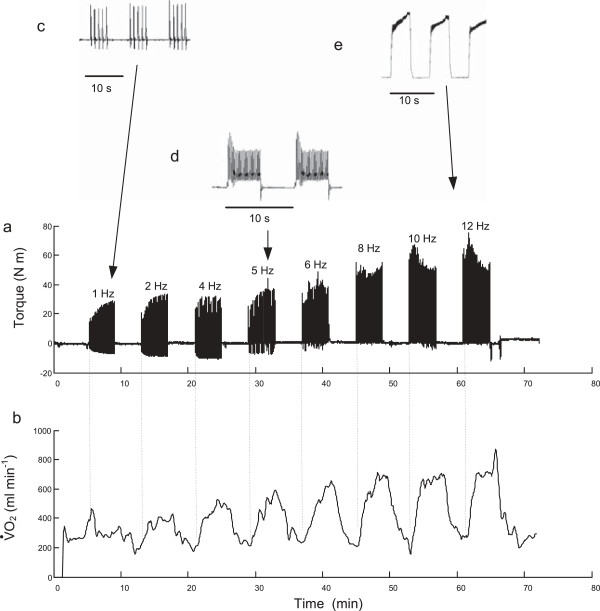
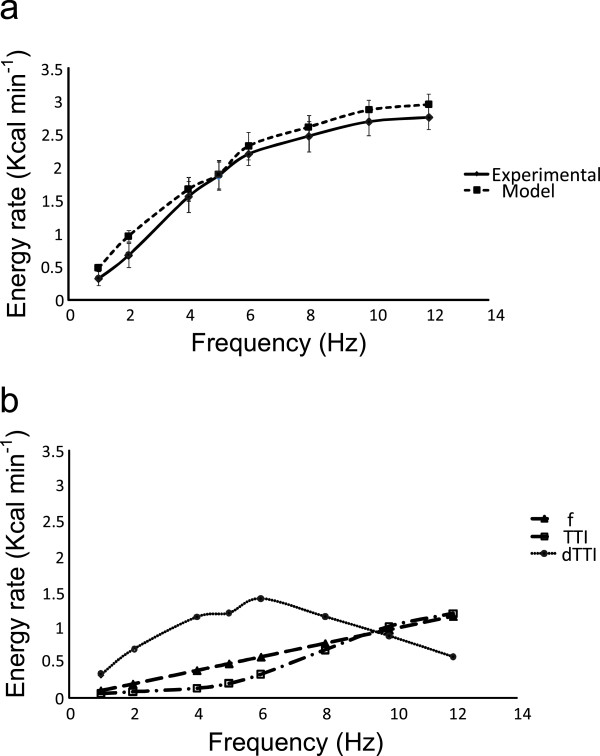
Ten healthy male subjects underwent bilateral NMES of the quadriceps muscles comprising eight 4 minute bouts of intermittent stimulation at selected frequencies in the range 1 to 12 Hz, interspersed with 4 minutes rest periods. Respiratory gases and knee extensor torque were simultaneously monitored throughout. Multiple linear regression was used to fit the resulting data to an energetic model which expressed the energy rate in terms of the pulse frequency, the torque time integral and a factor representing the accumulated force developed per unit time.
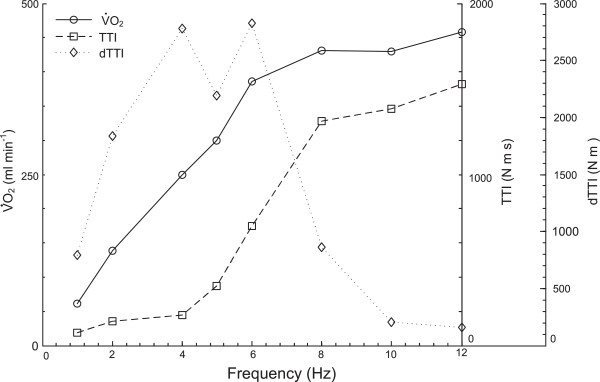
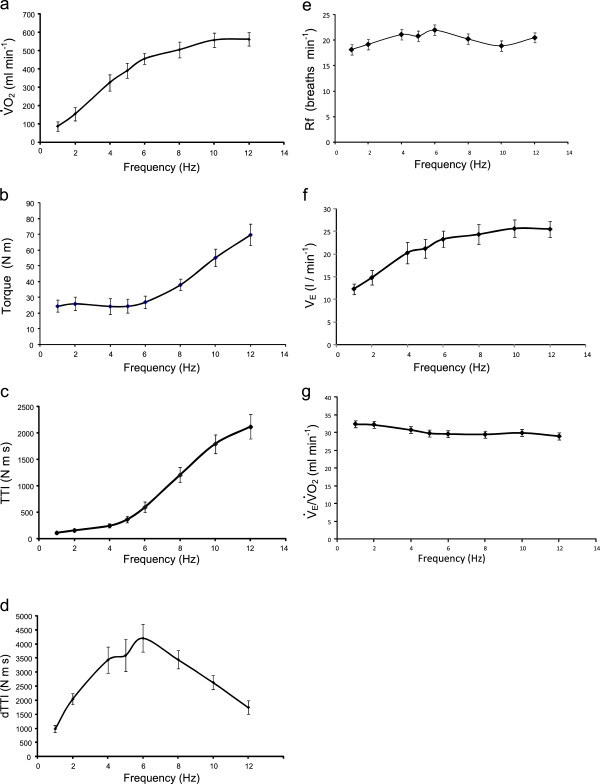
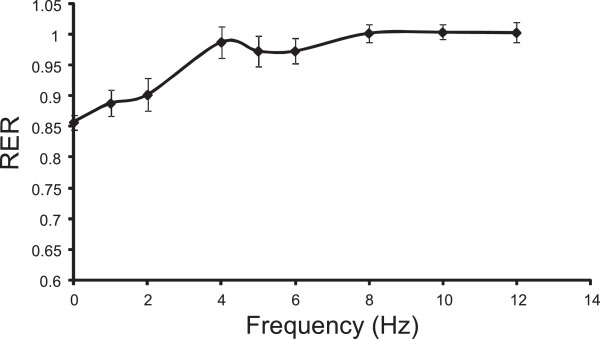
Additional oxygen uptake increased over the frequency range to a maximum of 564 (SD 114) ml min-1 at 12 Hz, and the respiratory exchange ratio was close to unity from 4 to 12 Hz. While the highest induced torque occurred at 12 Hz, the peak of the force development factor occurred at 6 Hz. The regression model accounted for 88% of the variability in the observed energetic response.
Taking into account the requirement to avoid prolonged tetanic contractions and to minimize evoked torque, the results suggest that the ideal frequency for sustainable aerobic exercise is 4 to 5 Hz, which coincided in this study with the frequency above which significant twitch force summation occurred.
有新的证据表明,等长神经肌肉电刺激(NMES)可能提供一种方法,以产生治疗上显著的全身氧摄取增加,从而为无法自愿运动的患者提供有氧运动,从而获得心血管健康的益处。目前还没有确定产生显著和持续的肺氧摄取所需的最佳刺激频率。本研究的目的是检查在从抽搐到强直过渡的低频范围内,通过 NMES 刺激股四头肌的氧摄取和诱发扭矩的频率响应。
10 名健康男性受试者接受双侧股四头肌 NMES,包括在 1 至 12 Hz 的范围内选择频率进行 8 次 4 分钟的间歇性刺激,每次刺激之间间隔 4 分钟的休息期。在整个过程中同时监测呼吸气体和膝关节伸肌扭矩。使用多元线性回归将得到的数据拟合到一个能量模型中,该模型将能量率表示为脉冲频率、扭矩时间积分和一个代表单位时间内累积力的因子。
在频率范围内,额外的氧摄取增加到 12 Hz 时的最大值 564(SD 114)ml min-1,呼吸交换比在 4 至 12 Hz 时接近 1。虽然在 12 Hz 时诱发的扭矩最大,但力发展因子的峰值出现在 6 Hz。回归模型解释了观察到的能量反应变异性的 88%。
考虑到避免长时间强直收缩和最小化诱发扭矩的要求,结果表明,可持续有氧运动的理想频率为 4 至 5 Hz,在本研究中,这一频率与显著的单次收缩力总和发生的频率一致。