Broussard Gregory W, Hatfull Graham F
Department of Biological Sciences; University of Pittsburgh; Pittsburgh, PA USA.
Bacteriophage. 2013 Jan 1;3(1):e24186. doi: 10.4161/bact.24186.
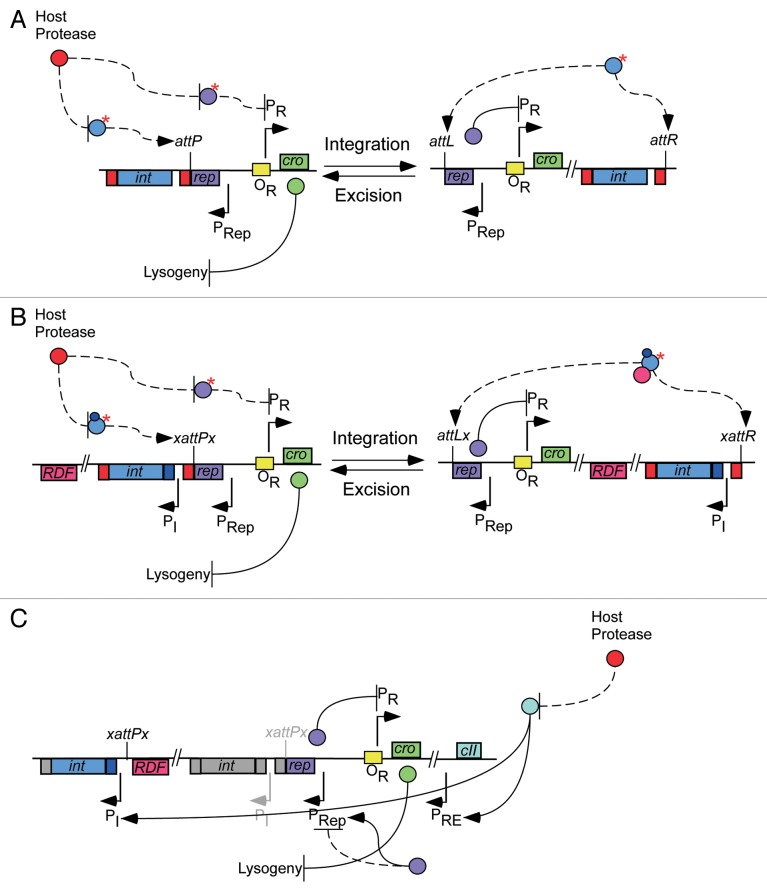
The circuitry of the phage λ genetic switch determining the outcome of lytic or lysogenic growth is well-integrated and complex, raising the question as to how it evolved. It is plausible that it arose from a simpler ancestral switch with fewer components that underwent various additions and refinements, as it adapted to vast numbers of different hosts and conditions. We have recently identified a new class of genetic switches found in mycobacteriophages and other prophages, in which immunity is dependent on integration. These switches contain only three genes (integrase, repressor and ) and represent a major departure from the λ-like circuitry, lacking many features such as , and . These small self-contained switches represent an unrealized, elegant circuitry for controlling infection outcome. In this addendum, we propose a model of possible events in the evolution of a complex λ-like switch from a simpler integration-dependent switch.
决定裂解性或溶原性生长结果的噬菌体λ遗传开关的电路整合良好且复杂,这就引发了它是如何进化的问题。它有可能起源于一个组件较少的更简单的祖先开关,随着它适应大量不同的宿主和环境,经历了各种添加和改进。我们最近在分枝杆菌噬菌体和其他原噬菌体中发现了一类新的遗传开关,其中免疫依赖于整合。这些开关仅包含三个基因(整合酶、阻遏物和),与λ样电路有很大不同,缺乏许多诸如、和等特征。这些小型独立开关代表了一种用于控制感染结果的未实现的、精巧的电路。在本附录中,我们提出了一个从更简单的整合依赖开关进化出复杂的λ样开关的可能事件模型。