Institute of Pharmacology, Heidelberg University, Im Neuenheimer Feld 366, 69120 Heidelberg, Germany.
Dis Model Mech. 2013 Jul;6(4):889-95. doi: 10.1242/dmm.011502.
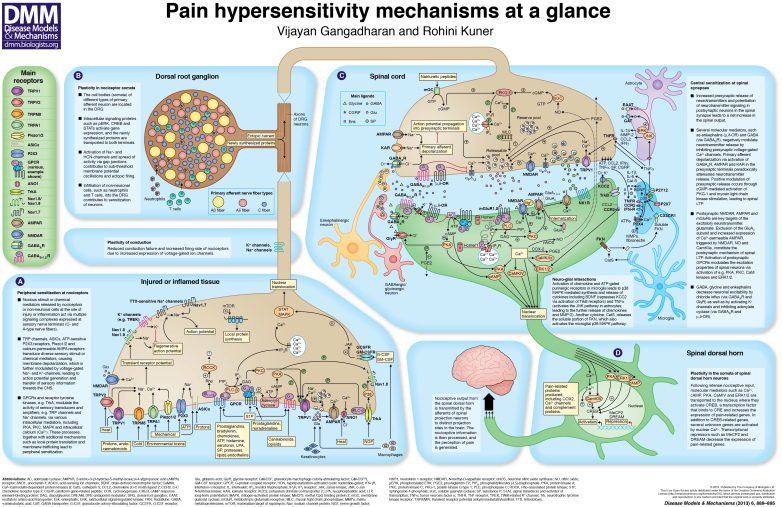
There are two basic categories of pain: physiological pain, which serves an important protective function, and pathological pain, which can have a major negative impact on quality of life in the context of human disease. Major progress has been made in understanding the molecular mechanisms that drive sensory transduction, amplification and conduction in peripheral pain-sensing neurons, communication of sensory inputs to spinal second-order neurons, and the eventual modulation of sensory signals by spinal and descending circuits. This poster article endeavors to provide an overview of how molecular and cellular mechanisms underlying nociception in a physiological context undergo plasticity in pathophysiological states, leading to pain hypersensitivity and chronic pain.
生理疼痛,它具有重要的保护功能,以及病理疼痛,它可能对人类疾病背景下的生活质量产生重大负面影响。在理解驱动外周疼痛感觉神经元中的感觉转导、放大和传导的分子机制、感觉输入向脊髓二级神经元的传递以及脊髓和下行回路对感觉信号的最终调制方面,已经取得了重大进展。本文旨在概述在生理状态下,伤害感受的分子和细胞机制如何在病理生理状态下发生可塑性变化,导致痛觉过敏和慢性疼痛。