Department of Endocrine & Breast Surgery, the First Affiliated Hospital of Chongqing Medical University, Chongqing, People's Republic of China.
BMC Cancer. 2013 Jul 6;13:334. doi: 10.1186/1471-2407-13-334.
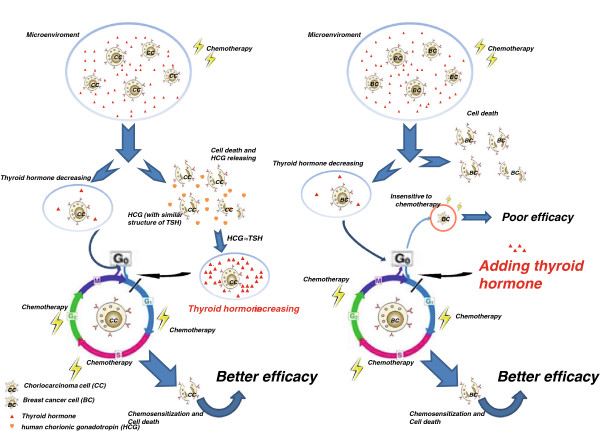
Thyroid hormones have been shown to regulate breast cancer cells growth, the absence or reduction of thyroid hormones in cells could provoke a proliferation arrest in G0-G1 or weak mitochondrial activity, which makes cells insensitive to therapies for cancers through transforming into low metabolism status. This biological phenomenon may help explain why treatment efficacy and prognosis vary among breast cancer patients having hypothyroid, hyperthyroid and normal function. Nevertheless, the abnormal thyroid function in breast cancer patients has been considered being mainly caused by thyroid diseases, few studied influence of chemotherapy on thyroid function and whether its alteration during chemotherapy can influence the respose to chemotherapy is still unclear. So, we aimed to find the alterations of thyroid function and non-thyroidal illness syndrome (NTIS) prevalence druing chemotherapy in breast cancer patients, and investigate the influence of thyroid hormones on chemotherapeutic efficacy.
Thyroid hormones and NTIS prevalence at initial diagnosis and during chemotherapy were analyzed in 685 breast diseases patients (369 breast cancer, 316 breast benign lesions). The influence of thyroid hormones on chemotherapeutic efficacy was evaluated by chemosensitization test, to compare chemotherapeutic efficacy between breast cancer cells with chemotherapeutics plus triiodothyronine (T3) and chemotherapeutics only.
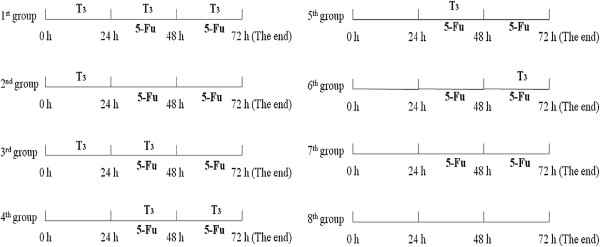
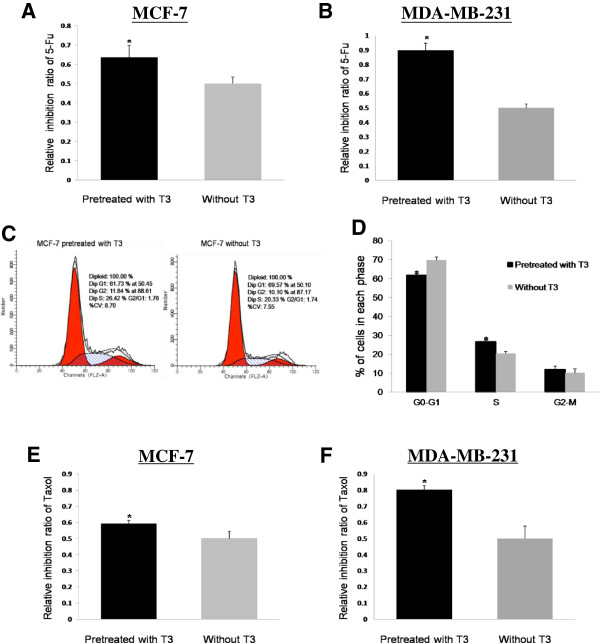
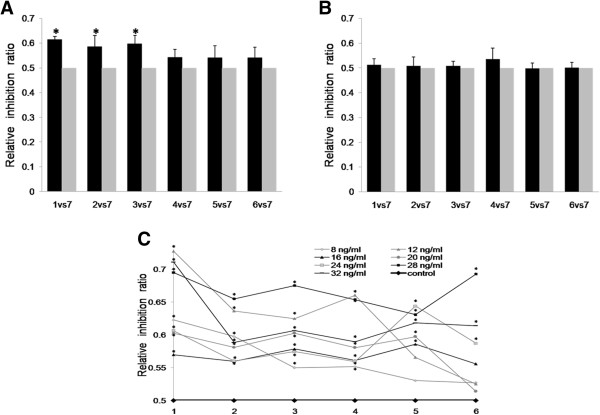
In breast cancer, NTIS prevalence at the initial diagnosis was higher and increased during chemotherapy, but declined before the next chemotherapeutic course. Thyroid hormones decreased signigicantly during chemotherapy. T3 can enhance the chemosensitivity of MCF-7 to 5-Fu and taxol, with progression from G0-G1 phase to S phase. The similar chemosensitization role of T3 were found in MDA-MB-231. We compared chemotherapeutic efficacy among groups with different usage modes of T3, finding pretreatment with lower dose of T3, using higher dose of T3 together with 5-Fu or during chemotherapy with 5-Fu were all available to achieve chemosensitization, but pretreatment with lower dose of T3 until the end of chemotherapy may be a safer and more efficient therapy.
Taken together, thyroid hormones decreasing during chemotherapy was found in lots of breast cancer patients. On the other hand, thyroid hormones can enhance the chemotherapeutic efficacy through gatherring tumor cells in actively proliferating stage, which may provide a new adjuvant therapy for breast cancer in furture, especially for those have hypothyroidism during chemotherapy.
甲状腺激素已被证明可以调节乳腺癌细胞的生长,细胞中甲状腺激素的缺失或减少可能会引发 G0-G1 期的增殖停滞或线粒体活性减弱,这使细胞对癌症治疗变得不敏感,从而转变为低代谢状态。这种生物学现象可能有助于解释为什么甲状腺功能减退、甲状腺功能亢进和功能正常的乳腺癌患者的治疗效果和预后存在差异。然而,乳腺癌患者的甲状腺功能异常一直被认为主要是由甲状腺疾病引起的,很少有研究关注化疗对甲状腺功能的影响,以及化疗期间甲状腺功能的改变是否会影响对化疗的反应。因此,我们旨在寻找乳腺癌患者在化疗过程中甲状腺功能和非甲状腺疾病综合征(NTIS)的变化,并探讨甲状腺激素对化疗疗效的影响。
分析了 685 例乳腺疾病患者(369 例乳腺癌,316 例乳腺良性病变)在初始诊断和化疗期间的甲状腺激素和 NTIS 发生率。通过化疗增敏试验评估甲状腺激素对化疗疗效的影响,比较加用三碘甲状腺原氨酸(T3)与单纯化疗对乳腺癌细胞的化疗疗效。
在乳腺癌中,初始诊断时 NTIS 的发生率较高,且在化疗过程中增加,但在下一次化疗前下降。化疗过程中甲状腺激素显著下降。T3 可增强 MCF-7 和 taxol 对 5-Fu 的化疗敏感性,使细胞从 G0-G1 期进入 S 期。在 MDA-MB-231 中也发现了 T3 的类似化疗增敏作用。我们比较了不同 T3 使用方式组之间的化疗疗效,发现低剂量 T3 预处理、高剂量 T3 与 5-Fu 联合使用或在 5-Fu 化疗期间使用均能达到化疗增敏的效果,但低剂量 T3 预处理直至化疗结束可能是一种更安全、更有效的治疗方法。
综上所述,我们发现许多乳腺癌患者在化疗过程中甲状腺激素下降。另一方面,甲状腺激素可以通过将肿瘤细胞聚集在活跃增殖期来增强化疗疗效,这可能为今后乳腺癌的辅助治疗提供一种新方法,特别是对化疗期间甲状腺功能减退的患者。