Laboratory of Epigenetics and Chromatin Dynamics, GIH Division, Department of Medicine, Biochemistry and Molecular Biology, Guggenheim 10, Mayo Clinic, 200 First Street SW, Rochester, MN 55905, USA.
Epigenetics Chromatin. 2013 Jul 5;6(1):21. doi: 10.1186/1756-8935-6-21.
Previous elegant studies performed in the fission yeast Schizosaccharomyces pombe have identified a requirement for heterochromatin protein 1 (HP1) for spindle pole formation and appropriate cell division. In mammalian cells, HP1γ has been implicated in both somatic and germ cell proliferation. High levels of HP1γ protein associate with enhanced cell proliferation and oncogenesis, while its genetic inactivation results in meiotic and mitotic failure. However, the regulation of HP1γ by kinases, critical for supporting mitotic progression, remains to be fully characterized.
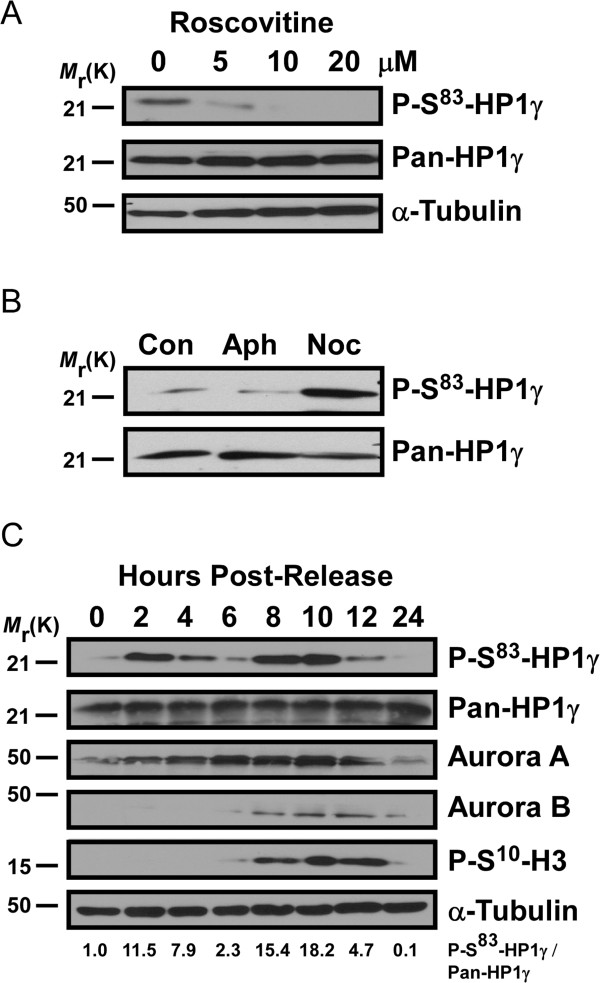
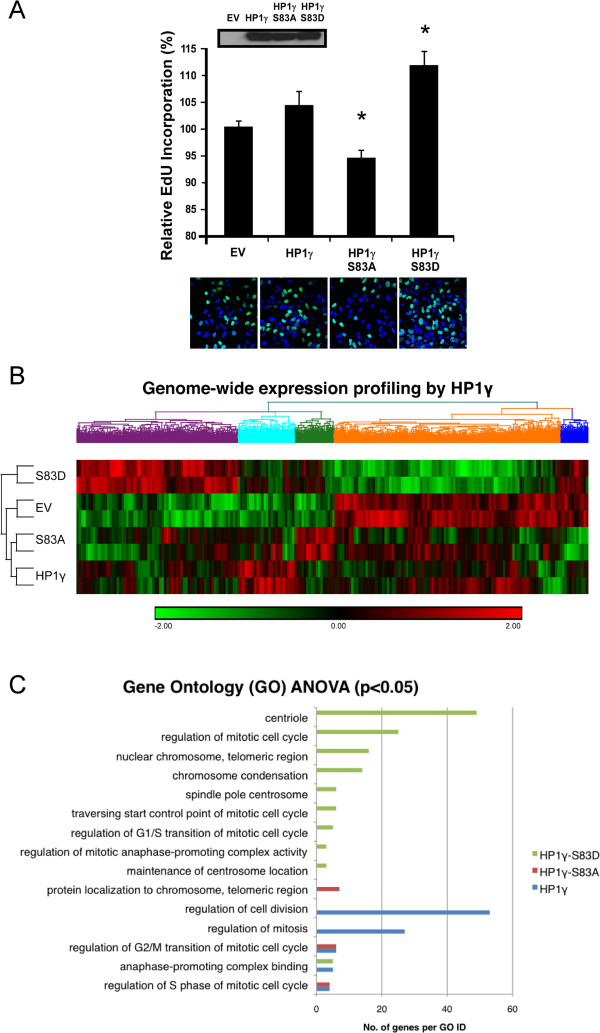
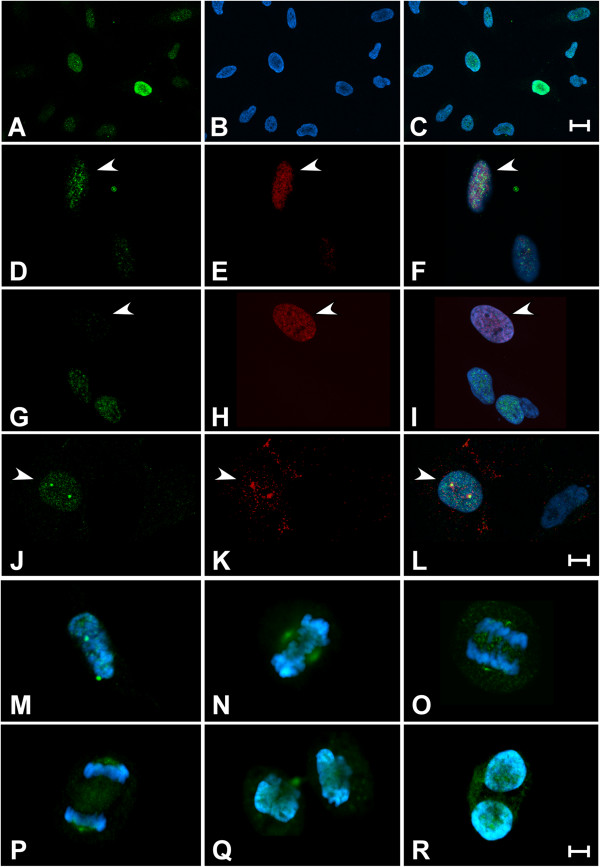
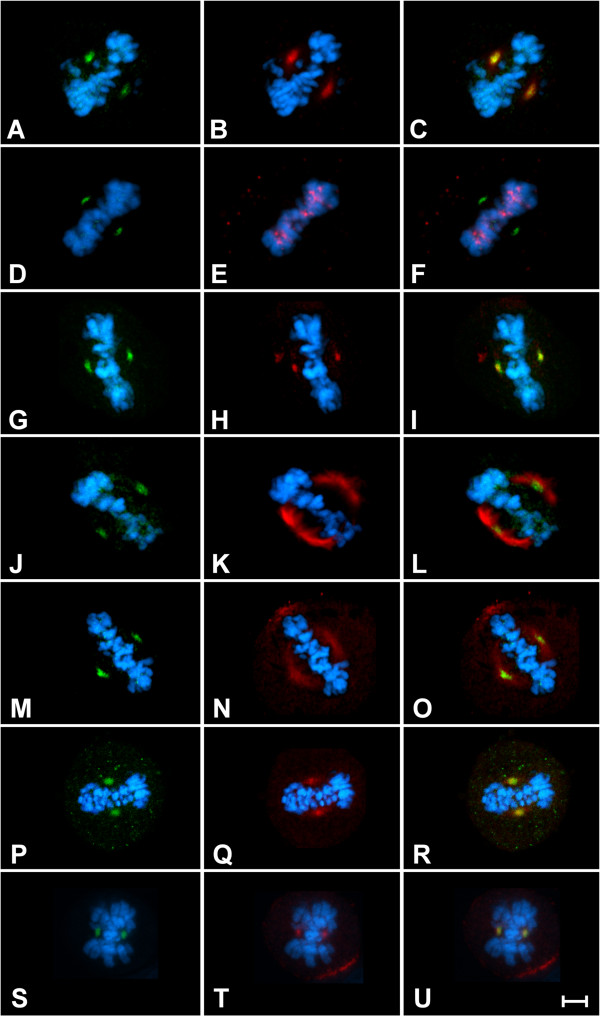
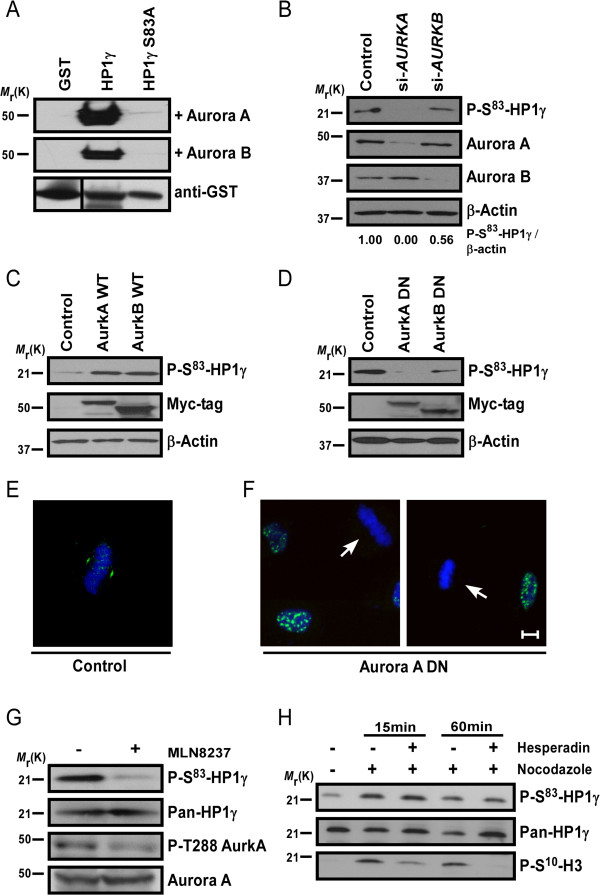
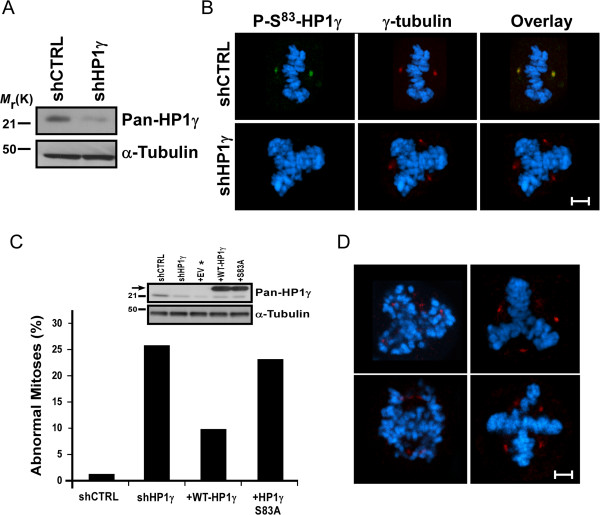
We report for the first time that during mitotic cell division, HP1γ colocalizes and is phosphorylated at serine 83 (Ser83) in G2/M phase by Aurora A. Since Aurora A regulates both cell proliferation and mitotic aberrations, we evaluated the role of HP1γ in the regulation of these phenomena using siRNA-mediated knockdown, as well as phosphomimetic and nonphosphorylatable site-directed mutants. We found that genetic downregulation of HP1γ, which decreases the levels of phosphorylation of HP1γ at Ser83 (P-Ser83-HP1γ), results in mitotic aberrations that can be rescued by reintroducing wild type HP1γ, but not the nonphosphorylatable S83A-HP1γ mutant. In addition, proliferation assays showed that the phosphomimetic S83D-HP1γ increases 5-ethynyl-2´-deoxyuridine (EdU) incorporation, whereas the nonphosphorylatable S83A-HP1γ mutant abrogates this effect. Genome-wide expression profiling revealed that the effects of these mutants on mitotic functions are congruently reflected in G2/M gene expression networks in a manner that mimics the on and off states for P-Ser83-HP1γ.
This is the first description of a mitotic Aurora A-HP1γ pathway, whose integrity is necessary for the execution of proper somatic cell division, providing insight into specific types of posttranslational modifications that associate to distinct functional outcomes of this important chromatin protein.
先前在裂殖酵母 Schizosaccharomyces pombe 中进行的精致研究表明,异染色质蛋白 1(HP1)对于纺锤体极的形成和适当的细胞分裂是必需的。在哺乳动物细胞中,HP1γ 参与体细胞核生殖细胞的增殖。高水平的 HP1γ 蛋白与增强的细胞增殖和致癌作用相关,而其基因失活导致减数分裂和有丝分裂失败。然而,对于激酶对 HP1γ 的调节,对于支持有丝分裂进展至关重要,仍然需要进行全面的描述。
我们首次报道,在有丝分裂细胞分裂过程中,HP1γ 在 G2/M 期与 Aurora A 共定位并在丝氨酸 83(Ser83)处磷酸化。由于 Aurora A 调节细胞增殖和有丝分裂异常,我们使用 siRNA 介导的敲低以及磷酸模拟和非磷酸化定点突变体评估了 HP1γ 在这些现象调节中的作用。我们发现,HP1γ 的遗传下调降低了 HP1γ 在 Ser83 处的磷酸化水平(P-Ser83-HP1γ),导致有丝分裂异常,而野生型 HP1γ 的重新引入可以挽救这些异常,但非磷酸化的 S83A-HP1γ 突变体则不能。此外,增殖实验表明,磷酸模拟 S83D-HP1γ 增加 5-乙炔基-2´-脱氧尿苷(EdU)掺入,而非磷酸化的 S83A-HP1γ 突变体则消除了这种作用。全基因组表达谱分析显示,这些突变体对有丝分裂功能的影响在 G2/M 基因表达网络中以类似于 P-Ser83-HP1γ 的开和关状态的方式一致反映。
这是第一个描述有丝分裂 Aurora A-HP1γ 途径的描述,其完整性对于适当的体细胞分裂的执行是必需的,为这种重要染色质蛋白的特定类型的翻译后修饰与不同的功能结果相关提供了深入了解。