Zhao Wen-Ting, Wang Yu-Tian, Huang Zhao-Wei, Fang Jing
Key Laboratory of Nutrition and Metabolism, Institute for Nutritional Sciences, SIBS, Chinese Academy of Sciences, Shanghai 200031;
Oncol Lett. 2013 Jun;5(6):1948-1954. doi: 10.3892/ol.2013.1269. Epub 2013 Mar 22.
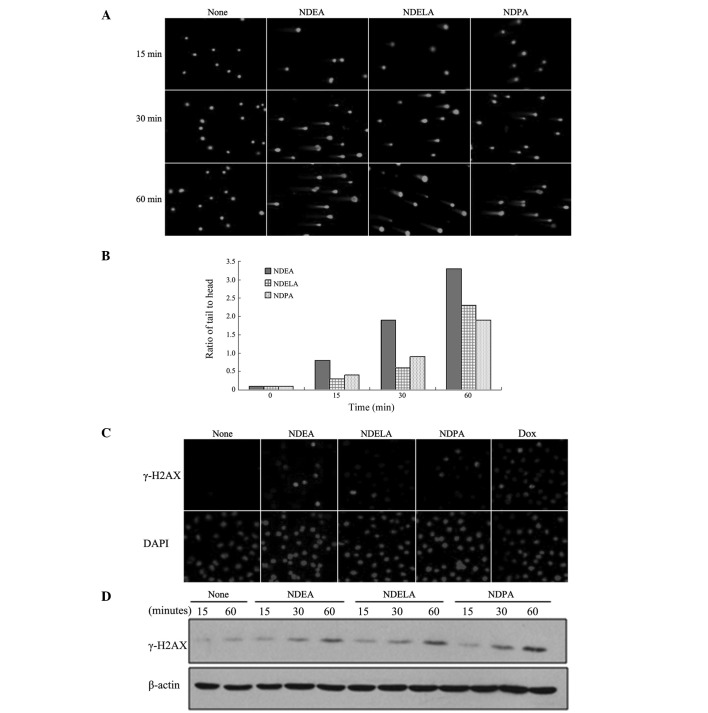
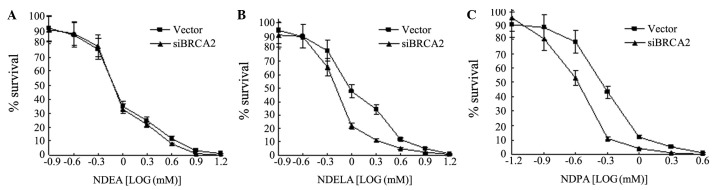
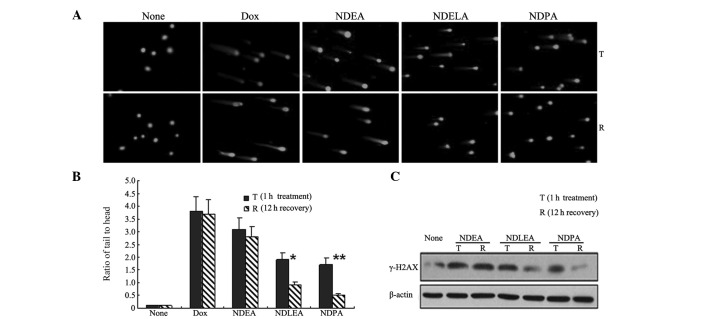
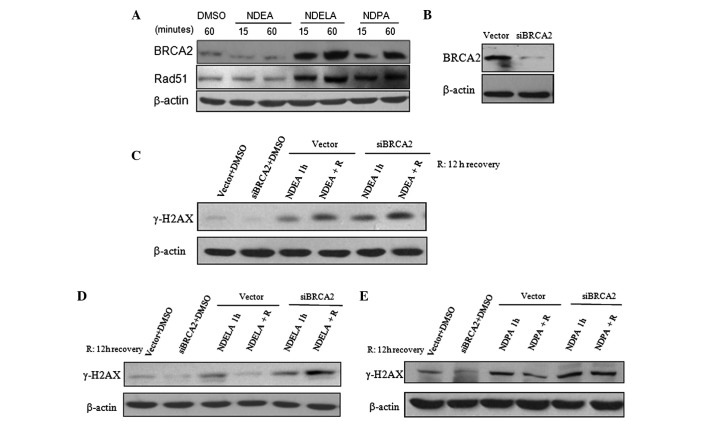
The tumor suppressor gene breast cancer susceptibility gene 2 (BRCA2) is frequently mutated or epigenetically repressed in human cancer and has a significant role in the homologous recombination (HR) of DNA double-strand breaks (DSBs). Although N-nitrosodiethylamine (NDEA), N-nitrosodiethanolamine (NDELA) and N-nitrosodipropylamine (NDPA) have similar chemical structures and are able to induce DNA damage, they have varying carcinogenic risks. We hypothesized that the DNA damage repair pathways that are induced by these N-nitroso compounds (NOCs) may differ and that this may contribute to the genotoxic-carcinogenic effect of the NOCs. The present study aimed to characterize the formation of DSBs by NDEA, NDELA and NDPA and also to investigate whether BRCA2 is involved in the DNA damage response. The NOCs were observed to time-dependently induce DSBs and the expression of γ-H2AX in gastric cancer SGC7901 cells. It was observed that the DNA damage induced by NDEA, the most potent carcinogen, was not repaired as efficiently as that caused by NDELA or NDPA. The expression of BRCA2 and RAD51 was demonstrated to be inhibited by NDEA treatment but upregulated by NDELA or NDPA treatment. Furthermore, the knock down of BRCA2 expression impaired the DNA damage repair induced by NDELA or NDPA. The cells with this knock down exhibited an increased sensitivity to NDELA or NDPA treatment, but not to NDEA. These findings suggest that a BRCA2-mediated pathway contributes to differential DSB repair and sensitivity in response to NOC exposure and that it may be associated with the genotoxic-carcinogenic potential of NOCs.
肿瘤抑制基因乳腺癌易感基因2(BRCA2)在人类癌症中经常发生突变或表观遗传抑制,并且在DNA双链断裂(DSB)的同源重组(HR)中起重要作用。尽管N-亚硝基二乙胺(NDEA)、N-亚硝基二乙醇胺(NDELA)和N-亚硝基二丙胺(NDPA)具有相似的化学结构且能够诱导DNA损伤,但它们具有不同的致癌风险。我们推测,这些N-亚硝基化合物(NOCs)诱导的DNA损伤修复途径可能不同,这可能导致NOCs的遗传毒性致癌作用。本研究旨在表征NDEA、NDELA和NDPA诱导的DSB形成,并研究BRCA2是否参与DNA损伤反应。观察到NOCs在胃癌SGC7901细胞中随时间依赖性地诱导DSB和γ-H2AX的表达。据观察,最强效致癌物NDEA诱导的DNA损伤修复效率不如NDELA或NDPA诱导的损伤。结果表明,NDEA处理可抑制BRCA2和RAD51的表达,但NDELA或NDPA处理可上调其表达。此外,敲低BRCA2表达会损害NDELA或NDPA诱导的DNA损伤修复。敲低BRCA2的细胞对NDELA或NDPA处理表现出更高的敏感性,但对NDEA不敏感。这些发现表明,BRCA2介导的途径有助于对NOC暴露的不同DSB修复和敏感性,并且可能与NOCs的遗传毒性致癌潜力有关。