Kovalenko Sergiy I, Antypenko Lyudmyla M, Bilyi Andriy K, Kholodnyak Sergiy V, Karpenko Olexandr V, Antypenko Olexii M, Mykhaylova Natalya S, Los Tetyana I, Kolomoets Olexandra S
Organic and Bioorganic Chemistry Department, Zaporizhzhya State Medical University, Mayakovsky Ave. 26, 69035, Zaporizhzhya, Ukraine.
Sci Pharm. 2013 Apr-Jun;81(2):359-91. doi: 10.3797/scipharm.1211-08. Epub 2012 Dec 23.
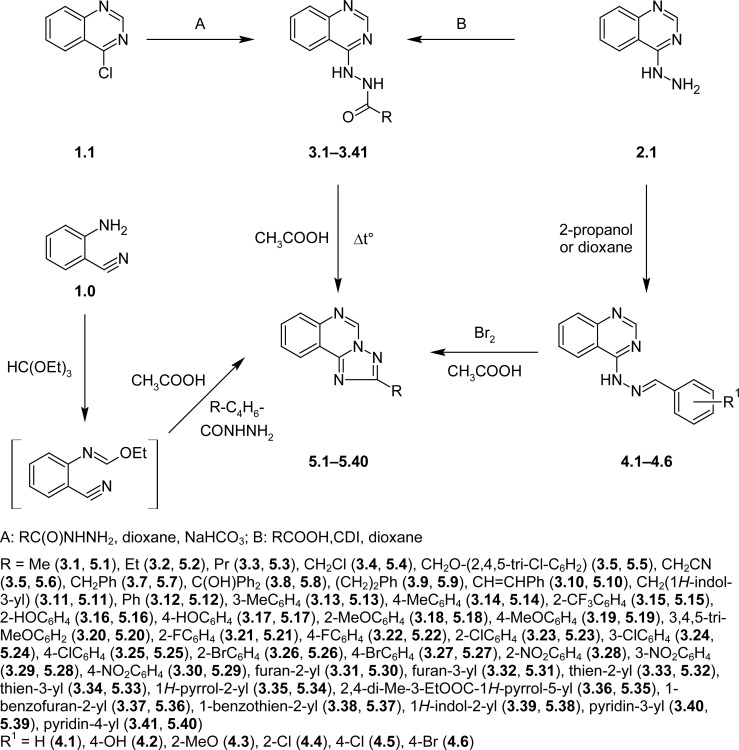
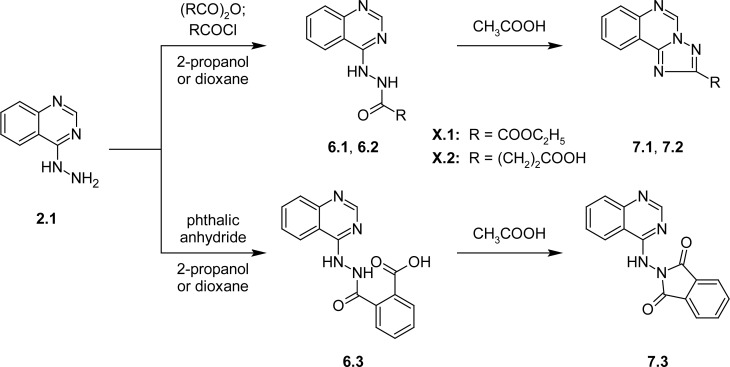
The combinatorial library of novel potential anticancer agents, namely, 2-(alkyl-, alkaryl-, aryl-, hetaryl-)[1,2,4]triazolo[1,5-c]quinazolines, was synthesized by the heterocyclization of the alkyl-, alkaryl-, aryl-, hetarylcarboxylic acid (3H-quinazoline-4-ylidene)hydrazides by oxidative heterocyclization of the 4-(arylidenehydrazino)quinazolines using bromine, and by the heterocyclization of N-(2-cyanophenyl)formimidic acid ethyl ester. The optimal method for synthesis of the s-triazolo[1,5-c]quinazolines appeared to be cyclocondensation of the corresponding carboxylic acid (3H-quinazoline-4-ylidene)hydrazides. The compounds' structures were established by (1)H, (13)C NMR, LC- and EI-MS analysis. The in vitro screening of anticancer activity determined the most active compound to be 3,4,5-trimethoxy-N'-[quinazolin-4(3H)-ylidene]benzohydrazide (3.20) in micromolar concentrations with the GI50 level (MG_MID, GI50 is 2.29). Thus, the cancer cell lines whose growth is greatly inhibited by compound 3.20 are: non-small cell lung cancer (NCI-H522, GI50=0.34), CNS (SF-295, GI50=0.95), ovarian (OVCAR-3, GI50=0.33), prostate (PC-3, GI50=0.56), and breast cancer (MCF7, GI50=0.52), leukemia (K-562, GI50=0.41; SR, GI50=0.29), and melanoma (MDA-MB-435, GI50=0.31; SK-MEL-5, GI50=0.74; UACC-62, GI50=0.32). SAR-analysis is also discussed.
通过使用溴对4-(亚芳基肼基)喹唑啉进行氧化杂环化反应,使烷基、芳烷基、芳基、杂芳基羧酸(3H-喹唑啉-4-亚基)酰肼杂环化,以及通过N-(2-氰基苯基)甲亚氨酸乙酯的杂环化反应,合成了新型潜在抗癌剂的组合文库,即2-(烷基-、芳烷基-、芳基-、杂芳基)-[1,2,4]三唑并[1,5-c]喹唑啉。合成s-三唑并[1,5-c]喹唑啉的最佳方法似乎是相应的羧酸(3H-喹唑啉-4-亚基)酰肼的环缩合反应。通过(1)H、(13)C NMR、LC和EI-MS分析确定了化合物的结构。抗癌活性的体外筛选确定最具活性的化合物为3,4,5-三甲氧基-N'-[喹唑啉-4(3H)-亚基]苯甲酰肼(3.20),其微摩尔浓度下的GI50水平(MG_MID,GI50为2.29)。因此,被化合物3.20极大抑制生长的癌细胞系有:非小细胞肺癌(NCI-H522,GI50 = 0.34)、中枢神经系统(SF-295,GI50 = 0.95)、卵巢癌(OVCAR-3,GI50 = 0.33)、前列腺癌(PC-3,GI50 = 0.56)、乳腺癌(MCF7,GI50 = 0.52)、白血病(K-562,GI50 = 0.41;SR,GI50 = 0.29)以及黑色素瘤(MDA-MB-435,GI50 = 0.31;SK-MEL-5,GI50 = 0.74;UACC-62,GI50 = 0.32)。还讨论了构效关系分析。