Department of Radiation Oncology, University Hospital Zurich, Zurich, Switzerland.
J Appl Clin Med Phys. 2013 Jul 8;14(4):4130. doi: 10.1120/jacmp.v14i4.4130.
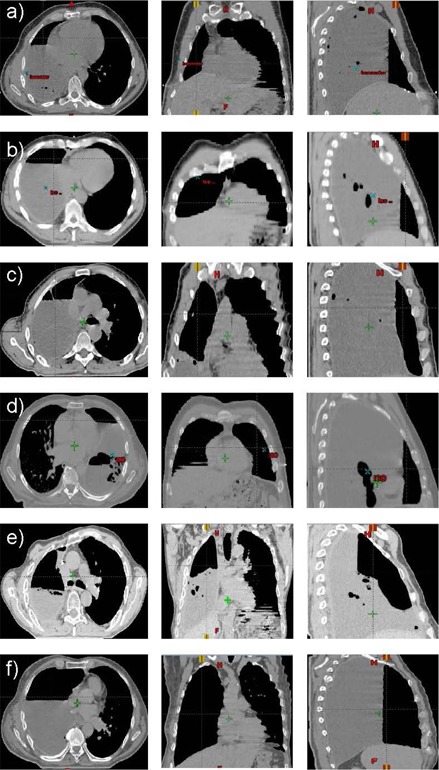
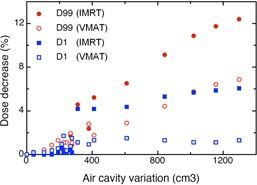
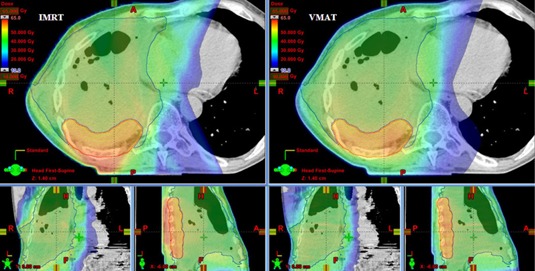
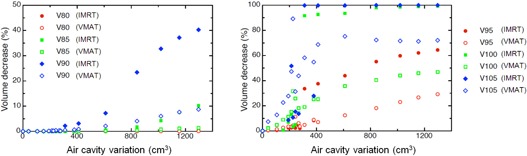
Radiotherapy reduces the local relapse rate after pleuropneumonectomy of malignant pleural mesothelioma (MPM). The optimal treatment technique with photons remains undefined. Comparative planning for intensity-modulated radiotherapy (IMRT) and volumetric-modulated arc therapy (VMAT) was performed. Six MPM patients with significant postoperative intrathoracic air cavities were planned with IMRT and VMAT. A dose comparison for the targets and organ at risks (OAR) was performed. Robustness was assessed in respect to the variation of target dose with change in volume of air cavities. VMAT reduced the dose to the contralateral lung by reducing the volume covered by 13 Gy and 20 Gy by a factor 1.8 and 2.8, in respect to IMRT (p = 0.02). Dose distribution with VMAT was the most stable technique in regard to postsurgical air cavity variation. For IMRT, V90, V95, and the minimal target dose decreased by 40%, 64%, and 12% compared to 29%, 47%, and 7% with VMAT when air cavity decreased. Two arcs compared to one arc decreased the dose to all the organs at risk (OAR) while leaving PTV dose coverage unchanged. Increasing the number of arcs from two to three did not reduce the dose to the OAR further, but increased the beam-on time by 50%. Using partial arcs decreased the beam-on time by 43%. VMAT allows a lower lung dose and is less affected by the air cavity variation than IMRT. The best VMAT plans were obtained with two partial arcs. VMAT seems currently the most suitable technique for the treatment of MPM patients when air cavities are remaining and no adaptive radiotherapy is performed.
放射治疗可降低恶性胸膜间皮瘤(MPM)剖胸肺切除术后局部复发率。光子的最佳治疗技术仍未确定。对强度调制放疗(IMRT)和容积调制弧形治疗(VMAT)进行了比较规划。对 6 例术后胸腔内有明显空气腔的 MPM 患者进行了 IMRT 和 VMAT 规划。对靶区和危及器官(OAR)的剂量进行了比较。评估了在空气腔体积变化时靶区剂量变化的稳健性。与 IMRT 相比,VMAT 通过减少 13 Gy 和 20 Gy 覆盖的体积,将对侧肺的剂量降低了 1.8 倍和 2.8 倍(p = 0.02)。在考虑到手术后空气腔变化的情况下,VMAT 的剂量分布是最稳定的技术。对于 IMRT,与 VMAT 相比,V90、V95 和最小靶区剂量分别降低了 40%、64%和 12%,而空气腔减少时分别降低了 29%、47%和 7%。与 1 个弧相比,2 个弧降低了所有危及器官(OAR)的剂量,同时保持了 PTV 剂量覆盖不变。将弧数从 2 增加到 3 不会进一步降低 OAR 的剂量,但会增加 50%的照射时间。使用部分弧会使照射时间减少 43%。VMAT 可以降低肺部剂量,并且受空气腔变化的影响小于 IMRT。使用 2 个部分弧可以获得最佳的 VMAT 计划。当存在空气腔且未进行自适应放疗时,VMAT 似乎是治疗 MPM 患者的最适合技术。