Corresponding author: Sun H. Kim,
Diabetes Care. 2013 Oct;36(10):3276-82. doi: 10.2337/dc13-0354. Epub 2013 Jul 8.
The aim was to evaluate the ability of liraglutide to augment weight loss and improve insulin resistance, cardiovascular disease (CVD) risk factors, and inflammation in a high-risk population for type 2 diabetes (T2DM) and CVD.
We randomized 68 older individuals (mean age, 58±8 years) with overweight/obesity and prediabetes to this double-blind study of liraglutide 1.8 mg versus placebo for 14 weeks. All subjects were advised to decrease calorie intake by 500 kcal/day. Peripheral insulin resistance was quantified by measuring the steady-state plasma glucose (SSPG) concentration during the insulin suppression test. Traditional CVD risk factors and inflammatory markers also were assessed.
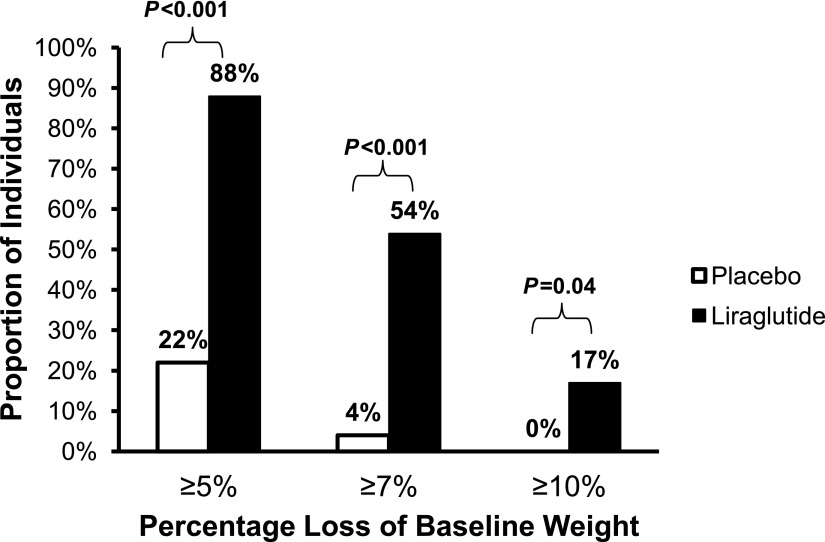
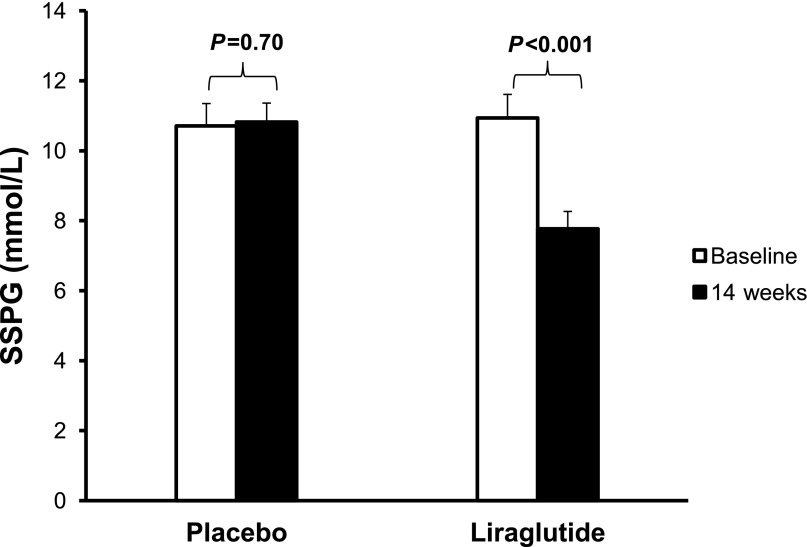
Eleven out of 35 individuals (31%) assigned to liraglutide discontinued the study compared with 6 out of 33 (18%) assigned to placebo (P=0.26). Subjects who continued to use liraglutide (n=24) lost twice as much weight as those using placebo (n=27; 6.8 vs. 3.3 kg; P<0.001). Liraglutide-treated subjects also had a significant improvement in SSPG concentration (-3.2 vs. 0.2 mmol/L; P<0.001) and significantly (P≤0.04) greater lowering of systolic blood pressure (-8.1 vs. -2.6 mmHg), fasting glucose (-0.5 vs. 0 mmol/L), and triglyceride (-0.4 vs. -0.1 mmol/L) concentration. Inflammatory markers did not differ between the two groups, but pulse increased after liraglutide treatment (6.4 vs. -0.9 bpm; P=0.001).
The addition of liraglutide to calorie restriction significantly augmented weight loss and improved insulin resistance, systolic blood pressure, glucose, and triglyceride concentration in this population at high risk for development of T2DM and CVD.
评估利拉鲁肽在 2 型糖尿病(T2DM)和心血管疾病(CVD)高危人群中增加体重减轻、改善胰岛素抵抗、心血管疾病风险因素和炎症的能力。
我们将 68 名年龄较大(平均年龄 58±8 岁)超重/肥胖和前驱糖尿病的个体随机分为两组,进行这项为期 14 周的利拉鲁肽 1.8mg 与安慰剂的双盲研究。所有患者均被建议每天减少 500 千卡热量摄入。通过胰岛素抑制试验测量稳态血糖(SSPG)浓度来量化外周胰岛素抵抗。还评估了传统的 CVD 风险因素和炎症标志物。
与安慰剂组(6 例/33 例,18%)相比,利拉鲁肽组(11 例/35 例,31%)有 11 名患者停止了研究(P=0.26)。继续使用利拉鲁肽的患者(n=24)比使用安慰剂的患者(n=27)体重减轻了两倍(6.8 公斤 vs. 3.3 公斤;P<0.001)。利拉鲁肽治疗组的 SSPG 浓度也显著降低(-3.2mmol/L vs. 0.2mmol/L;P<0.001),收缩压(-8.1mmHg vs. -2.6mmHg)、空腹血糖(-0.5mmol/L vs. 0mmol/L)和甘油三酯(-0.4mmol/L vs. -0.1mmol/L)浓度也显著降低。两组之间的炎症标志物没有差异,但利拉鲁肽治疗后脉搏增加(6.4bpm vs. -0.9bpm;P=0.001)。
在该人群中,热量限制联合利拉鲁肽治疗可显著增加体重减轻,并改善胰岛素抵抗、收缩压、血糖和甘油三酯浓度,这些人群处于发展为 T2DM 和 CVD 的高风险中。