Physical Therapy Department of the State University of Goiás, Goiânia, Goiás.
Int J Gen Med. 2013 Jun 24;6:507-13. doi: 10.2147/IJGM.S44768. Print 2013.
The prevalence of obesity is increasing in the population, particularly in women. Obesity has an impact on the musculoskeletal system, leading to knee and ankle overexertion, difficulty with balance, and functional disability. The aim of this study was to identify changes in kinematic parameters of gait in obese young women.
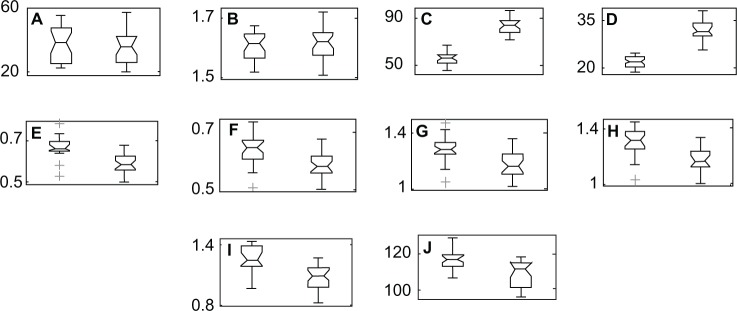
A case-control study with 24 obese women (mean age 35.20 ± 9.9 years and mean body mass index of 31.85 ± 2.94 kg/m(2)) and 24 eutrophic women (mean age of 36.33 ± 11.14 and mean body mass index of 21.82 ± 1.58 kg/m(2)). The gait of women was evaluated by the system Vicon Motus® 9.2. The linear parameters of speed, cadence, right and left step, and stride lengths were studied, as well as the angular parameters of knee and ankle.
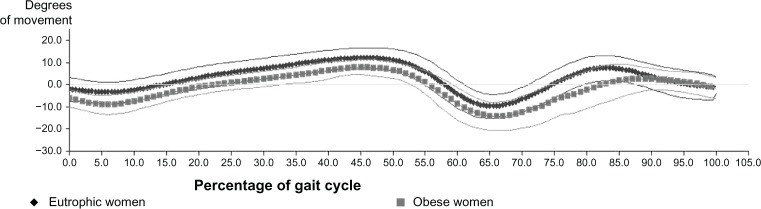
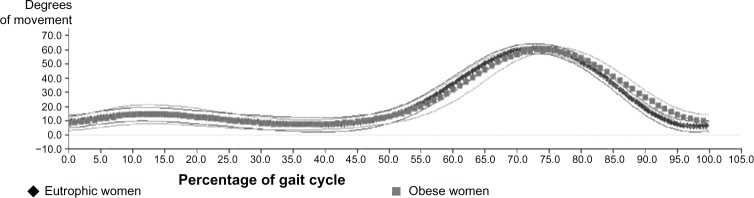
There was a decrease in linear gait parameters (P < 0.001), speed, cadence, right and left step, and stride lengths. In regard to the angular parameters of the knee and ankle, there were also differences between the analyses (P < 0.001). At the knee joint, obese women have delayed onset of the second wave of flexion, exacerbating such movement in order to compensate. In regard to the ankle, both groups showed curves of normal plantar flexion and dorsiflexion, but there was a delay in the path graph in the ankle of obese women indicating a reduced range of motion and possible over-exertion of the pretibial muscles and soleus muscles simultaneously.
The results of this study revealed that obesity is a factor that negatively influences the kinematic parameters of gait of young women.
肥胖在人群中的患病率正在增加,尤其是在女性中。肥胖对肌肉骨骼系统有影响,导致膝关节和踝关节过度劳累、平衡困难和功能障碍。本研究的目的是确定肥胖年轻女性步态运动学参数的变化。
本研究采用病例对照研究,纳入 24 名肥胖女性(平均年龄 35.20 ± 9.9 岁,平均体重指数为 31.85 ± 2.94 kg/m²)和 24 名体脂正常女性(平均年龄 36.33 ± 11.14 岁,平均体重指数为 21.82 ± 1.58 kg/m²)。使用 Vicon Motus® 9.2 系统评估女性的步态。研究了速度、步频、右步和左步以及步长的线性参数,以及膝关节和踝关节的角度参数。
线性步态参数(P < 0.001)、速度、步频、右步和左步以及步长均降低。在膝关节和踝关节的角度参数方面,两组之间也存在差异(P < 0.001)。肥胖女性的膝关节第二次弯曲起始延迟,为了代偿这种运动而加剧。在踝关节方面,两组均表现出正常的跖屈和背屈曲线,但肥胖女性的踝关节路径图延迟,表明运动范围减小,可能同时使小腿前肌和比目鱼肌过度劳累。
本研究结果表明,肥胖是影响年轻女性步态运动学参数的负面因素。