Program in Personalized and Genomic Medicine, Division of Endocrinology, Diabetes, and Nutrition, Department of Medicine, University of Maryland School of Medicine, Baltimore, Maryland, USA.
Clin Pharmacol Ther. 2013 Oct;94(4):525-32. doi: 10.1038/clpt.2013.119. Epub 2013 Jun 11.
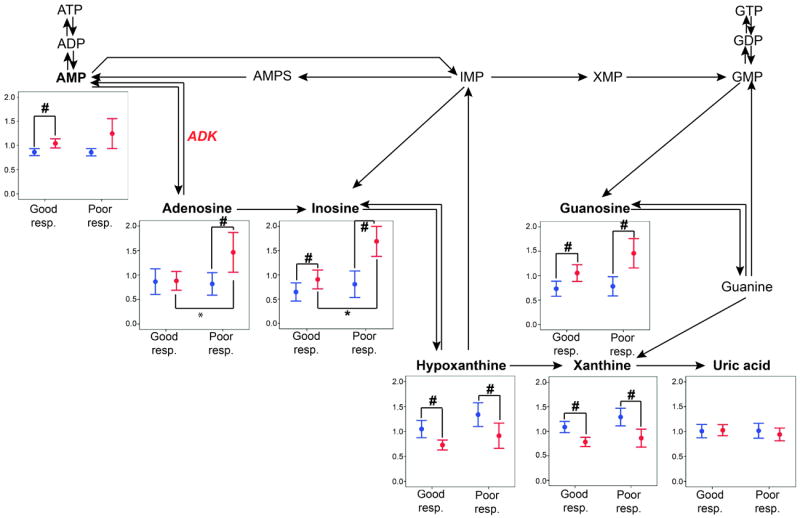
Although aspirin is a well-established antiplatelet agent, the mechanisms of aspirin resistance remain poorly understood. Metabolomics allows for measurement of hundreds of small molecules in biological samples, enabling detailed mapping of pathways involved in drug response. We defined the metabolic signature of aspirin exposure in subjects from the Heredity and Phenotype Intervention Heart Study. Many metabolites, including known aspirin catabolites, changed on exposure to aspirin, and pathway enrichment analysis identified purine metabolism as significantly affected by drug exposure. Furthermore, purines were associated with aspirin response, and poor responders had higher postaspirin adenosine and inosine levels than did good responders (n = 76; both P < 4 × 10(-3)). Using our established "pharmacometabolomics-informed pharmacogenomics" approach, we identified genetic variants in adenosine kinase associated with aspirin response. Combining metabolomics and genomics allowed for more comprehensive interrogation of mechanisms of variation in aspirin response--an important step toward personalized treatment approaches for cardiovascular disease.
虽然阿司匹林是一种成熟的抗血小板药物,但阿司匹林抵抗的机制仍知之甚少。代谢组学可以测量生物样本中的数百种小分子,从而能够详细绘制药物反应所涉及的途径图。我们在 Heredity and Phenotype Intervention Heart Study 中的研究对象中定义了阿司匹林暴露的代谢特征。许多代谢物,包括已知的阿司匹林代谢物,在暴露于阿司匹林后发生变化,通路富集分析表明嘌呤代谢受到药物暴露的显著影响。此外,嘌呤与阿司匹林的反应相关,不良反应者的阿司匹林后腺苷和肌苷水平高于良好反应者(n = 76;两者 P < 4×10(-3))。使用我们建立的“基于药代组学的药物基因组学”方法,我们在腺苷激酶中鉴定出与阿司匹林反应相关的遗传变异。代谢组学和基因组学的结合可以更全面地研究阿司匹林反应变异的机制——这是朝着心血管疾病个体化治疗方法迈出的重要一步。