Department of Pathology, College of Medicine, University of Illinois at Chicago, Chicago, IL 60612, USA.
JAMA. 2013 Jul 10;310(2):170-8. doi: 10.1001/jama.2013.7842.
Soy consumption has been suggested to reduce risk or recurrence of prostate cancer, but this has not been tested in a randomized trial with prostate cancer as the end point.
To determine whether daily consumption of a soy protein isolate supplement for 2 years reduces the rate of biochemical recurrence of prostate cancer after radical prostatectomy or delays such recurrence.
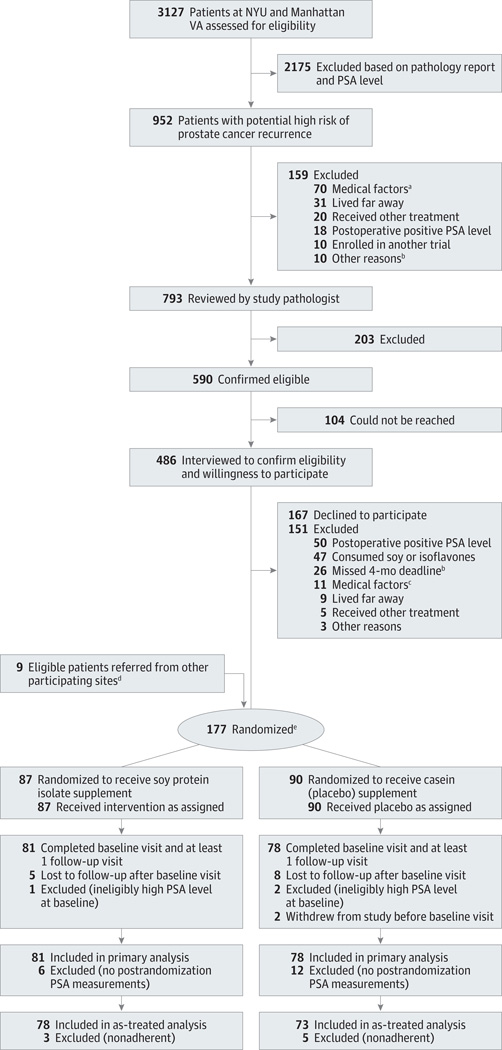
DESIGN, SETTING, AND PARTICIPANTS: Randomized, double-blind trial conducted from July 1997 to May 2010 at 7 US centers comparing daily consumption of a soy protein supplement vs placebo in 177 men at high risk of recurrence after radical prostatectomy for prostate cancer. Supplement intervention was started within 4 months after surgery and continued for up to 2 years, with prostate-specific antigen (PSA) measurements made at 2-month intervals in the first year and every 3 months thereafter.
Participants were randomized to receive a daily serving of a beverage powder containing 20 g of protein in the form of either soy protein isolate (n=87) or, as placebo, calcium caseinate (n=90).
Biochemical recurrence rate of prostate cancer (defined as development of a PSA level of ≥0.07 ng/mL) over the first 2 years following randomization and time to recurrence.
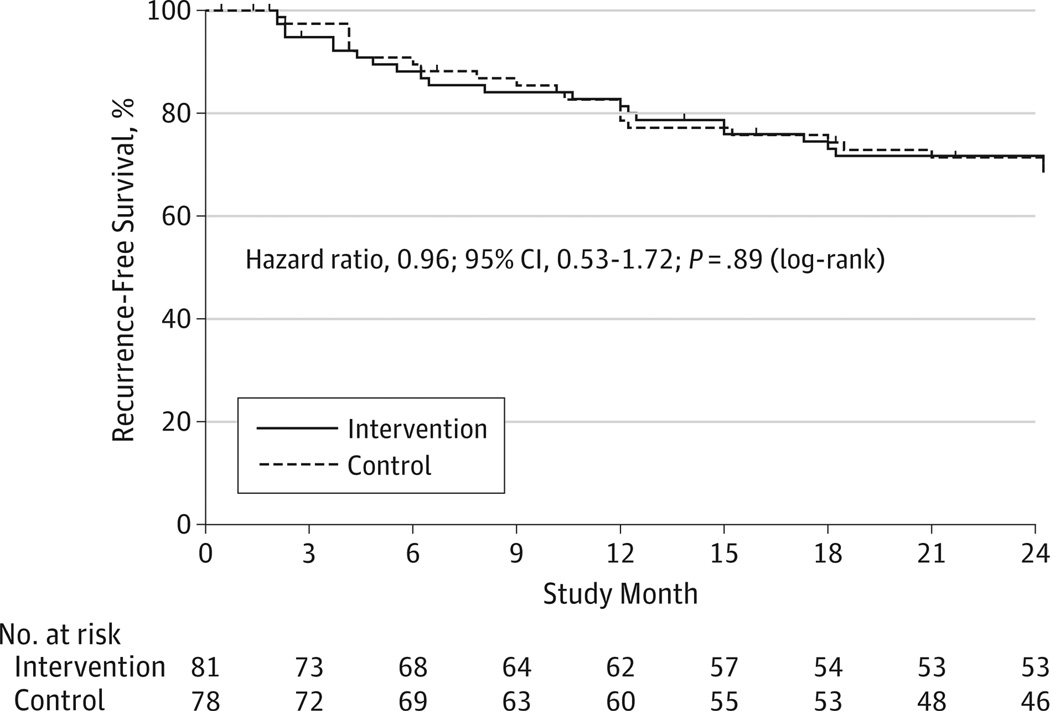
The trial was stopped early for lack of treatment effects at a planned interim analysis with 81 evaluable participants in the intervention group and 78 in the placebo group. Overall, 28.3% of participants developed biochemical recurrence within 2 years of entering the trial (close to the a priori predicted recurrence rate of 30%). Among these, 22 (27.2%) occurred in the intervention group and 23 (29.5%) in the placebo group. The resulting hazard ratio for active treatment was 0.96 (95% CI, 0.53-1.72; log-rank P = .89). Adherence was greater than 90% and there were no apparent adverse events related to supplementation.
Daily consumption of a beverage powder supplement containing soy protein isolate for 2 years following radical prostatectomy did not reduce biochemical recurrence of prostate cancer in men at high risk of PSA failure.
clinicaltrials.gov Identifier: NCT00765479.
大豆的摄入被认为可以降低前列腺癌的风险或复发,但这尚未在以前列腺癌为终点的随机试验中得到验证。
确定每天服用大豆蛋白分离物补充剂 2 年是否会降低前列腺癌根治术后生化复发的速度,或延迟这种复发。
设计、地点和参与者:这是一项在美国 7 个中心进行的随机、双盲试验,比较了 177 名前列腺癌根治术后复发风险较高的男性在 4 个月内服用大豆蛋白补充剂与安慰剂的效果。补充剂干预开始于手术后,并持续 2 年,在第一年每 2 个月测量一次前列腺特异性抗原(PSA),此后每 3 个月测量一次。
参与者被随机分配每天服用一种含有 20 克蛋白质的饮料粉,其中 87 人服用的是大豆蛋白分离物,90 人服用的是作为安慰剂的酪蛋白钙。
在随机分组后 2 年内前列腺癌的生化复发率(定义为 PSA 水平≥0.07ng/mL)以及复发时间。
在计划的中期分析中,由于缺乏治疗效果,试验提前停止,干预组有 81 名可评估参与者,安慰剂组有 78 名。总的来说,2 年内有 28.3%的参与者出现生化复发(接近事先预测的 30%复发率)。其中,干预组 22 人(27.2%),安慰剂组 23 人(29.5%)。积极治疗的风险比为 0.96(95%CI,0.53-1.72;对数秩 P=0.89)。依从性大于 90%,且无明显与补充剂相关的不良反应。
前列腺癌根治术后 2 年内每天服用含有大豆蛋白分离物的饮料粉补充剂,并未降低高危 PSA 失败男性的前列腺癌生化复发率。
clinicaltrials.gov 标识符:NCT00765479。