
RNA测序区分用VEGFR酪氨酸激酶抑制剂西地尼布治疗人肿瘤异种移植瘤所诱导的肿瘤和宿主mRNA表达变化。
RNA-Seq Differentiates Tumour and Host mRNA Expression Changes Induced by Treatment of Human Tumour Xenografts with the VEGFR Tyrosine Kinase Inhibitor Cediranib.
作者信息
Bradford James R, Farren Matthew, Powell Steve J, Runswick Sarah, Weston Susie L, Brown Helen, Delpuech Oona, Wappett Mark, Smith Neil R, Carr T Hedley, Dry Jonathan R, Gibson Neil J, Barry Simon T
机构信息
Oncology, AstraZeneca Pharmaceuticals, Alderley Park, Cheshire, United Kingdom.
出版信息
PLoS One. 2013 Jun 19;8(6):e66003. doi: 10.1371/journal.pone.0066003. Print 2013.
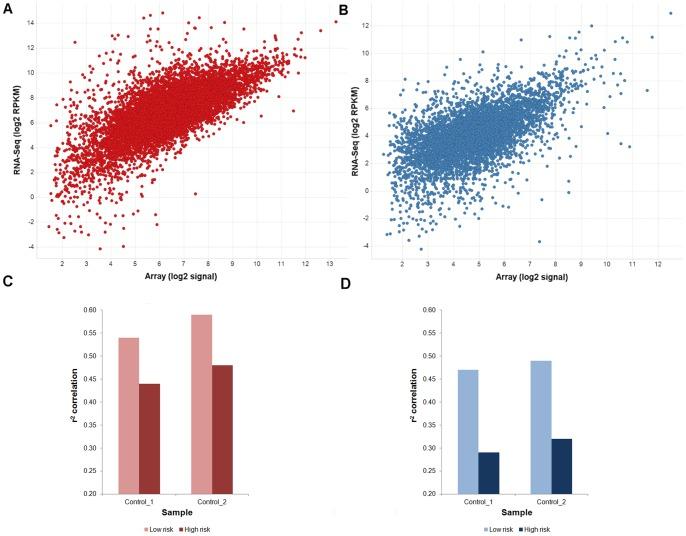
Pre-clinical models of tumour biology often rely on propagating human tumour cells in a mouse. In order to gain insight into the alignment of these models to human disease segments or investigate the effects of different therapeutics, approaches such as PCR or array based expression profiling are often employed despite suffering from biased transcript coverage, and a requirement for specialist experimental protocols to separate tumour and host signals. Here, we describe a computational strategy to profile transcript expression in both the tumour and host compartments of pre-clinical xenograft models from the same RNA sample using RNA-Seq. Key to this strategy is a species-specific mapping approach that removes the need for manipulation of the RNA population, customised sequencing protocols, or prior knowledge of the species component ratio. The method demonstrates comparable performance to species-specific RT-qPCR and a standard microarray platform, and allowed us to quantify gene expression changes in both the tumour and host tissue following treatment with cediranib, a potent vascular endothelial growth factor receptor tyrosine kinase inhibitor, including the reduction of multiple murine transcripts associated with endothelium or vessels, and an increase in genes associated with the inflammatory response in response to cediranib. In the human compartment, we observed a robust induction of hypoxia genes and a reduction in cell cycle associated transcripts. In conclusion, the study establishes that RNA-Seq can be applied to pre-clinical models to gain deeper understanding of model characteristics and compound mechanism of action, and to identify both tumour and host biomarkers.
肿瘤生物学的临床前模型通常依赖于在小鼠体内传代培养人类肿瘤细胞。为了深入了解这些模型与人类疾病阶段的一致性,或研究不同治疗方法的效果,尽管存在转录本覆盖偏差以及需要专门的实验方案来分离肿瘤和宿主信号等问题,但人们仍经常采用聚合酶链反应(PCR)或基于芯片的表达谱分析等方法。在此,我们描述了一种计算策略,可使用RNA测序(RNA-Seq)从同一RNA样本中分析临床前异种移植模型的肿瘤和宿主区室中的转录本表达。该策略的关键是一种物种特异性映射方法,该方法无需对RNA群体进行操作、定制测序方案或事先了解物种组成比例。该方法表现出与物种特异性逆转录定量聚合酶链反应(RT-qPCR)和标准微阵列平台相当的性能,并且使我们能够量化在用西地尼布(一种有效的血管内皮生长因子受体酪氨酸激酶抑制剂)治疗后肿瘤和宿主组织中的基因表达变化,包括与内皮或血管相关的多种小鼠转录本的减少,以及对西地尼布反应中与炎症反应相关基因的增加。在人类区室中,我们观察到缺氧基因的强烈诱导和细胞周期相关转录本的减少。总之,该研究表明RNA-Seq可应用于临床前模型,以更深入地了解模型特征和化合物作用机制,并识别肿瘤和宿主生物标志物。



 Zotero 插件