Alex and Simona Shnaider Laboratory in Molecular Oncology, Department of Pathology and Laboratory Medicine, Samuel Lunenfeld Research Institute, Mount Sinai Hospital, Toronto, Ontario, Canada.
PLoS One. 2013 Jun 28;8(6):e67361. doi: 10.1371/journal.pone.0067361. Print 2013.
Perturbations in cell adhesion molecules are linked to alterations in cadherin-catenin complexes and likely play major roles in invasion and metastasis; their impact on early precancerous stages remains yet unknown. We showed ALCAM overexpression in early oral lesions and its cytoplasmic accumulation in oral squamous cell carcinoma (OSCC) to be a predictor of disease progression and poor prognosis. This study tested the hypothesis that alterations in E-cadherin and β -catenin expressions are early events in oral tumorigenesis, associated with disease prognosis, and correlate with perturbations in ALCAM expression.
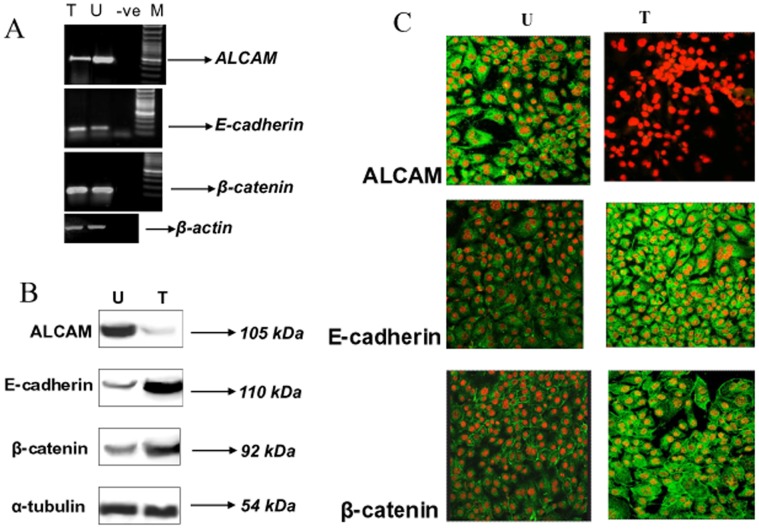
Expressions of E-cadherin and β-catenin were analyzed in the same cohort of 105 OSCCs, 76 oral lesions and 30 normal oral tissues by immunohistochemistry and correlated with clinicopathological parameters and prognosis. The effect of siRNA mediated ALCAM knockdown on E-cadherin and β -catenin was determined using western blot, confocal microscopy and RT-PCR analysis in oral cancer cells.
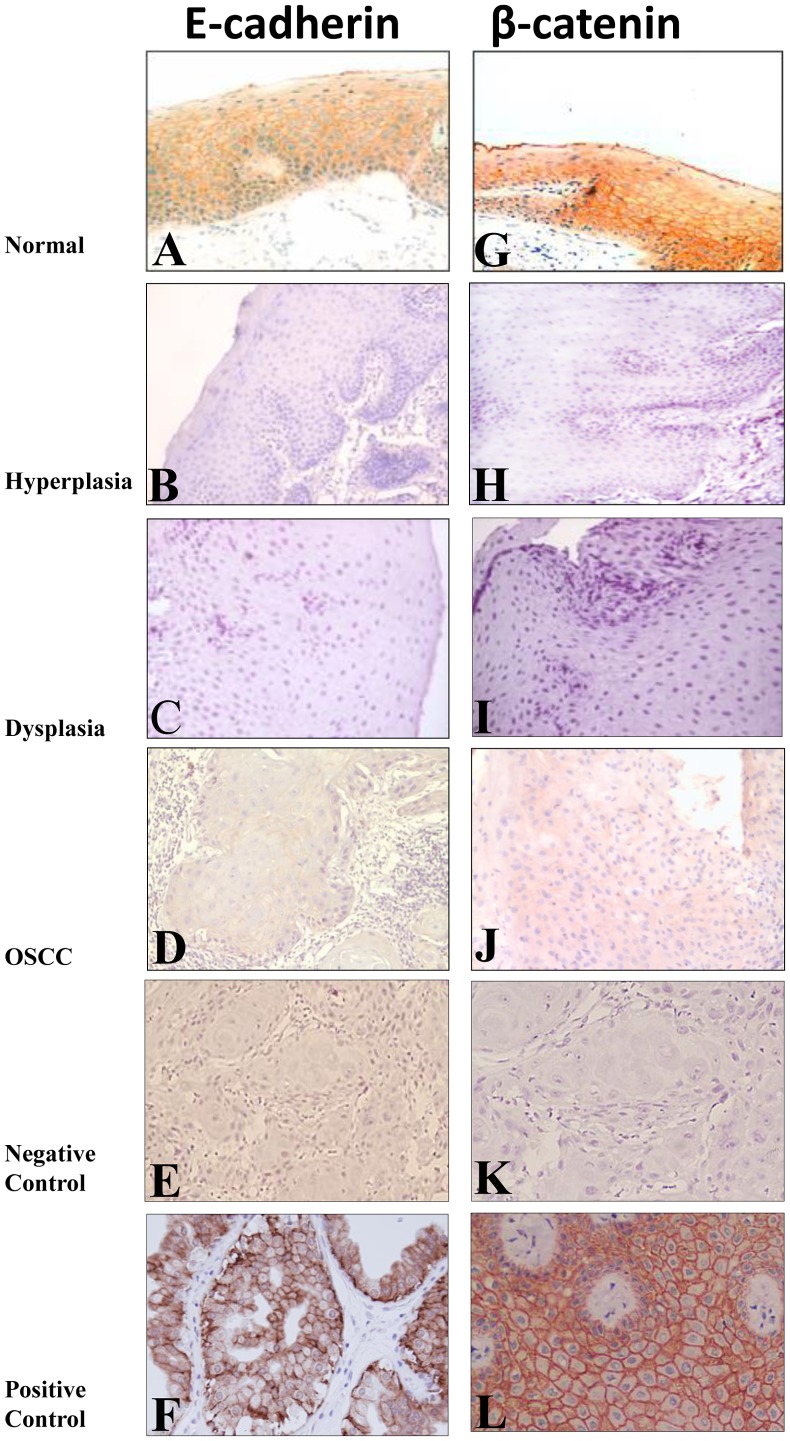
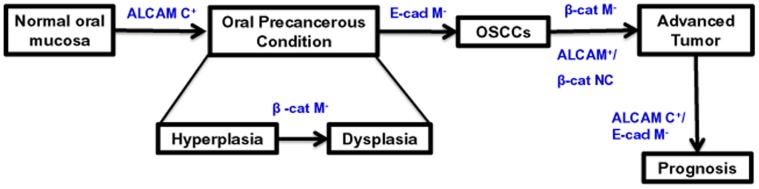
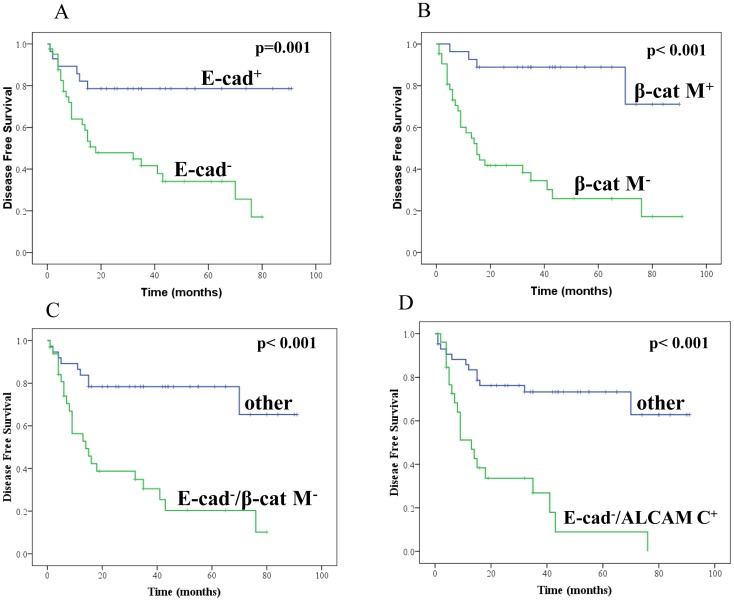
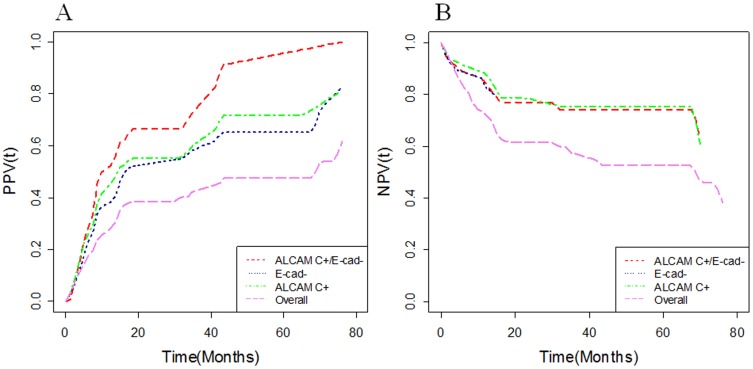
Significant loss of membranous E-cadherin and β-catenin expression was observed from normal, hyperplasia, dysplasia to OSCCs (p(trend) <0.001); and correlated with cytoplasmic ALCAM accumulation in OSCCs (p = 0.006). Multivariate analysis revealed β-catenin membrane loss and ALCAM/β-catenin(nuclear/cytoplasmic) accumulation to be significant predictors for late clinical stage (p<0.001, OR = 8.7; p = 0.006, OR = 9.9, respectively) and nodal metastasis (p = 0.003, OR = 3.8; p = 0.025, OR = 3.4 respectively). Cox's regression showed E-cadherin membrane loss/ALCAM cytoplasmic expression [p<0.001; HR = 4.8] to be independent adverse prognosticators in OSCCs. siRNA mediated silencing of ALCAM resulted in concurrent increase in E-cadherin and β-catenin both at the transcript and protein levels.
Losses of E-cadherin and β-catenin expressions are early events in oral tumorigenesis; their associations with aggressive tumor behavior and disease recurrence underscore their potential as prognostic markers. Correlation of loss of E-cadherin and β-catenin with cytoplasmic ALCAM accumulation both in vitro and in in vivo suggests that these dynamic changes in cell adhesion system may play pivotal role in oral cancer.
细胞黏附分子的改变与钙黏蛋白-连环蛋白复合物的改变有关,可能在侵袭和转移中起主要作用;但其对早期癌前阶段的影响尚不清楚。我们在早期口腔病变中发现 ALCAM 的过表达,并在口腔鳞状细胞癌(OSCC)中发现其细胞质积聚,这是疾病进展和预后不良的预测因子。本研究测试了以下假设:E-钙黏蛋白和β-连环蛋白表达的改变是口腔肿瘤发生的早期事件,与疾病预后相关,并与 ALCAM 表达的改变相关。
通过免疫组织化学分析了 105 例 OSCC、76 例口腔病变和 30 例正常口腔组织中 E-钙黏蛋白和β-连环蛋白的表达,并与临床病理参数和预后相关。通过 Western blot、共聚焦显微镜和 RT-PCR 分析,在口腔癌细胞中用 siRNA 介导的 ALCAM 敲低来确定 E-钙黏蛋白和β-连环蛋白的表达。
从正常、增生、发育不良到 OSCC,观察到膜 E-钙黏蛋白和β-连环蛋白表达显著丢失(p(趋势)<0.001);并且与 OSCC 中细胞质 ALCAM 积聚相关(p=0.006)。多变量分析显示,β-连环蛋白膜丢失和 ALCAM/β-连环蛋白(核/细胞质)积聚是晚期临床分期(p<0.001,OR=8.7;p=0.006,OR=9.9)和淋巴结转移的显著预测因子(p=0.003,OR=3.8;p=0.025,OR=3.4)。Cox 回归显示 E-钙黏蛋白膜丢失/ALCAM 细胞质表达(p<0.001;HR=4.8)是 OSCC 中独立的预后不良因素。siRNA 介导的 ALCAM 沉默导致 E-钙黏蛋白和β-连环蛋白的转录和蛋白水平同时增加。
E-钙黏蛋白和β-连环蛋白表达的丢失是口腔肿瘤发生的早期事件;它们与侵袭性肿瘤行为和疾病复发相关,强调了它们作为预后标志物的潜力。E-钙黏蛋白和β-连环蛋白的丢失与体外和体内细胞质 ALCAM 积聚的相关性表明,细胞黏附系统的这些动态变化可能在口腔癌中发挥关键作用。