Fozzatti Laura, Park Jeong Won, Zhao Li, Willingham Mark C, Cheng Sheue-Yann
Laboratory of Molecular Biology, Center for Cancer Research, National Cancer Institute, National Institutes of Health, Bethesda, Maryland, United States of America.
PLoS One. 2013 Jun 26;8(6):e67954. doi: 10.1371/journal.pone.0067954. Print 2013.
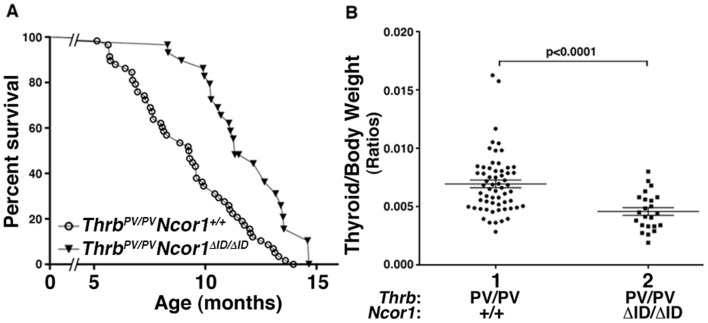
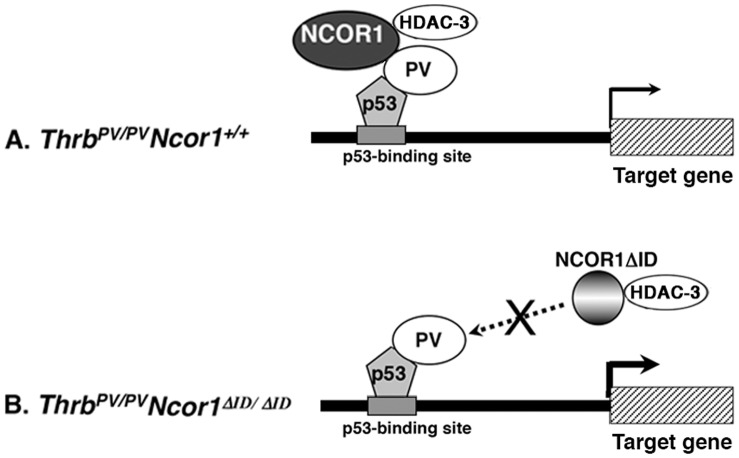
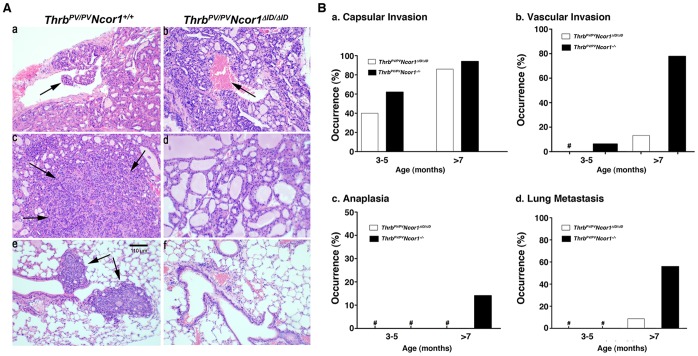
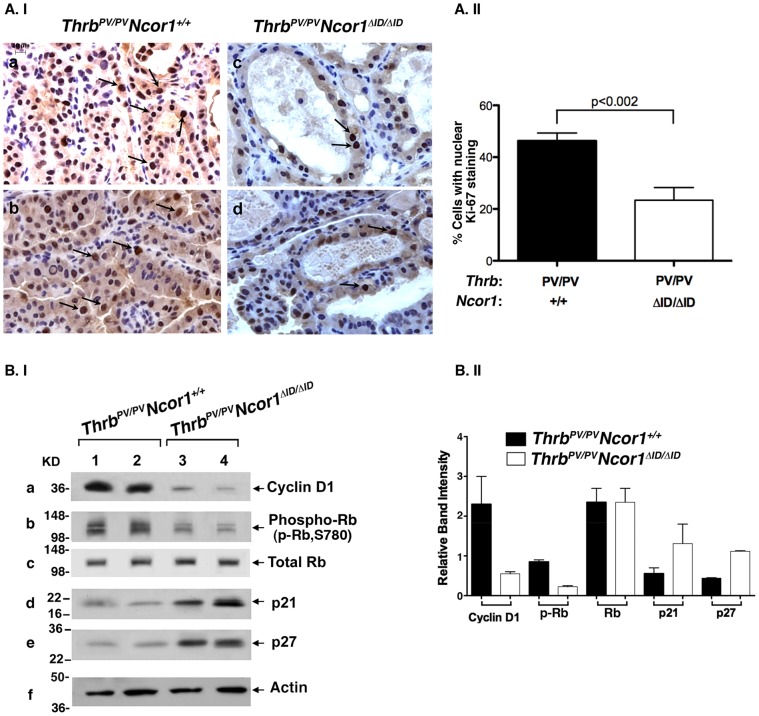
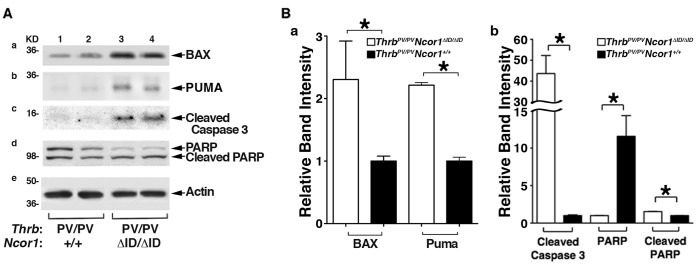
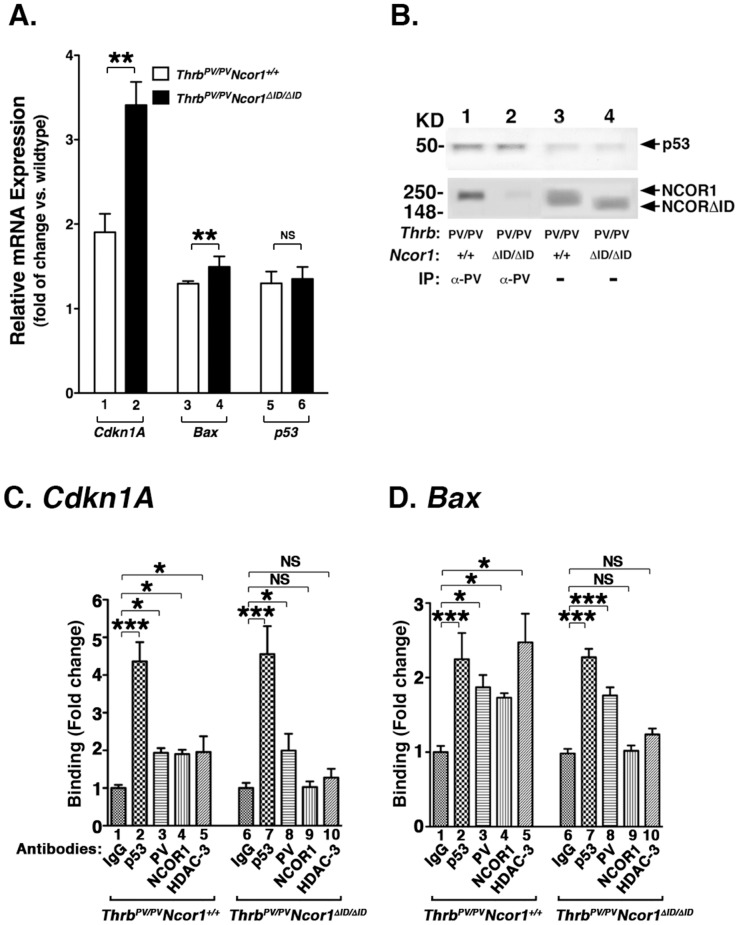
Studies have suggested that the nuclear receptor corepressor 1 (NCOR1) could play an important role in human cancers. However, the detailed molecular mechanisms by which it functions in vivo to affect cancer progression are not clear. The present study elucidated the in vivo actions of NCOR1 in carcinogenesis using a mouse model (Thrb(PV/PV) mice) that spontaneously develops thyroid cancer. Thrb(PV/PV) mice harbor a dominantly negative thyroid hormone receptor β (TRβ) mutant (denoted as PV). We adopted the loss-of-the function approach by crossing Thrb(PV) mice with mice that globally express an NCOR1 mutant protein (NCOR1ΔID) in which the receptor interaction domains have been modified so that it cannot interact with the TRβ, or PV, in mice. Remarkably, expression of NCOR1ΔID protein reduced thyroid tumor growth, markedly delayed tumor progression, and prolonged survival of Thrb(PV/PV)Ncor1 (ΔID/ΔID) mice. Tumor cell proliferation was inhibited by increased expression of cyclin-dependent kinase inhibitor 1 (p21(waf1/cip1); Cdkn1A), and apoptosis was activated by elevated expression of pro-apoptotic BCL-Associated X (Bax). Further analyses showed that p53 was recruited to the p53-binding site on the proximal promoter of the Cdkn1A and the Bax gene as a co-repressor complex with PV/NCOR1/histone deacetylas-3 (HDAC-3), leading to repression of the Cdkn1A as well as the Bax gene in thyroids of Thrb(PV/PV) mice. In thyroids of Thrb(PV/PV)Ncor1 (ΔID/ΔID) mice, the p53/PV complex could not recruit NCOR1ΔID and HDAC-3, leading to de-repression of both genes to inhibit cancer progression. The present studies provided direct evidence in vivo that NCOR1 could function as an oncogene via transcription regulation in a mouse model of thyroid cancer.
研究表明,核受体辅阻遏物1(NCOR1)可能在人类癌症中发挥重要作用。然而,其在体内影响癌症进展的详细分子机制尚不清楚。本研究利用一种自发发生甲状腺癌的小鼠模型(Thrb(PV/PV)小鼠)阐明了NCOR1在致癌过程中的体内作用。Thrb(PV/PV)小鼠携带一种显性负性甲状腺激素受体β(TRβ)突变体(称为PV)。我们采用功能丧失方法,将Thrb(PV)小鼠与在体内全局表达一种NCOR1突变蛋白(NCOR1ΔID)的小鼠杂交,该突变蛋白的受体相互作用结构域已被修饰,使其在小鼠中不能与TRβ或PV相互作用。值得注意的是,NCOR1ΔID蛋白的表达降低了甲状腺肿瘤的生长,显著延迟了肿瘤进展,并延长了Thrb(PV/PV)Ncor1(ΔID/ΔID)小鼠的生存期。细胞周期蛋白依赖性激酶抑制剂1(p21(waf1/cip1); Cdkn1A)表达增加抑制肿瘤细胞增殖,促凋亡蛋白BCL相关X蛋白(Bax)表达升高激活细胞凋亡。进一步分析表明,p53作为与PV/NCOR1/组蛋白去乙酰化酶-3(HDAC-3)的共阻遏复合物被招募到Cdkn1A和Bax基因近端启动子上的p53结合位点,导致Thrb(PV/PV)小鼠甲状腺中Cdkn1A以及Bax基因的抑制。在Thrb(PV/PV)Ncor1(ΔID/ΔID)小鼠的甲状腺中,p53/PV复合物不能招募NCOR1ΔID和HDAC-3,导致这两个基因的去抑制,从而抑制癌症进展。本研究在体内提供了直接证据,证明在甲状腺癌小鼠模型中,NCOR1可通过转录调控发挥癌基因功能。