Paul C Lauterbur Research Center for Biomedical Imaging, Institute of Biomedical and Health Engineering, Shenzhen Institutes of Advanced Technology, Chinese Academy of Sciences, Shenzhen, China.
PLoS One. 2013 Jul 2;8(7):e67809. doi: 10.1371/journal.pone.0067809. Print 2013.
Carotid intima-media thickness (IMT) and elasticity have been shown to be independent predictors of cardiovascular disease (CVD). Cardiovascular risk factors (CVRFs) includes hypertension, dyslipidemia, diabetes, overweight and smoking. The objective was to investigate whether the clustering of three or more components of CVRFs has a greater impact on carotid IMT and elasticity than individual components of CVRFs.
One hundred and seventy-three participants without clinical CVD were classified as the multiple CVRFs patients with three or more CVRFs (n = 55) and control group with two or less CVRFs (n = 118). Carotid IMT and elastic modulus were measured by B-mode ultrasound and vessel texture matching method (VTMM), respectively.
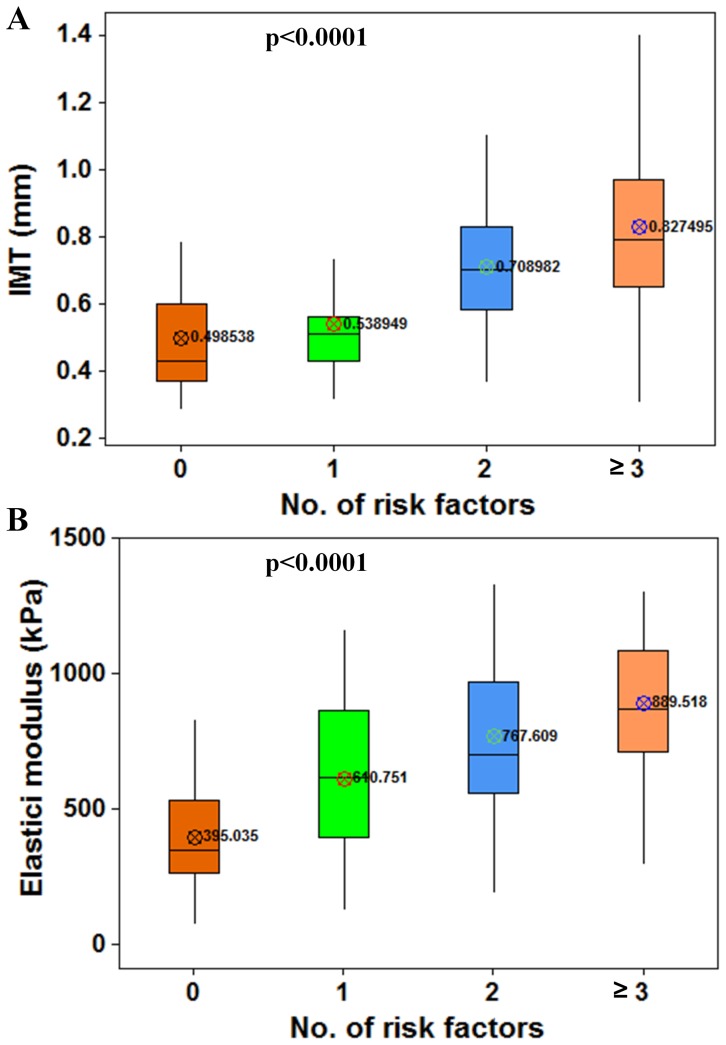
The multiple CVRFs conferred a disproportionate increase in carotid IMT (43%, p<0.0001) and elastic modulus (60%, p<0.0001), compared with control group. Multiple regression models, which included age, gender, as well as each individual component of CVRFs as continuous variables, showed that multiple CVRFs was an independent determinant of both IMT (p = 0.042) and elasticity (p = 0.008). In the analysis of variance adjusted with age, subjects with single, double, and multiple CVRFs, increased by 8.1%, 42.2%, and 66% for IMT, 54.6%, 94.3%, and 125.2% for elastic modulus, respectively, compared to subjects without CVRFs.
The clustering of multiple CVRFs has a greater impact on carotid IMT and elasticity than individual components of CVRFs. This suggests that the components of CVRFs interact to synergistically impact carotid IMT and elasticity.
颈动脉内膜-中层厚度(IMT)和弹性已被证明是心血管疾病(CVD)的独立预测因子。心血管危险因素(CVRF)包括高血压、血脂异常、糖尿病、超重和吸烟。目的是探讨三个或更多 CVRF 成分的聚集是否比 CVRF 的单个成分对颈动脉 IMT 和弹性有更大的影响。
173 名无临床 CVD 的参与者被分为具有三个或更多 CVRF(n=55)的多个 CVRF 患者和具有两个或更少 CVRF(n=118)的对照组。颈动脉 IMT 和弹性模量分别通过 B 型超声和血管纹理匹配方法(VTMM)进行测量。
与对照组相比,多个 CVRF 导致颈动脉 IMT(43%,p<0.0001)和弹性模量(60%,p<0.0001)不成比例增加。包括年龄、性别以及 CVRF 的每个单个成分作为连续变量的多元回归模型显示,多个 CVRF 是 IMT(p=0.042)和弹性(p=0.008)的独立决定因素。在调整年龄的方差分析中,具有单个、双个和多个 CVRF 的受试者 IMT 分别增加了 8.1%、42.2%和 66%,弹性模量分别增加了 54.6%、94.3%和 125.2%,与无 CVRF 的受试者相比。
多个 CVRF 的聚集对颈动脉 IMT 和弹性的影响大于 CVRF 的单个成分。这表明 CVRF 的成分相互作用,协同影响颈动脉 IMT 和弹性。