• 文献检索
  • 文档翻译
  • 深度研究
  • 学术资讯
  • Suppr Zotero 插件Zotero 插件
  • 邀请有礼
  • 套餐&价格
  • 历史记录
应用&插件
Suppr Zotero 插件Zotero 插件浏览器插件Mac 客户端Windows 客户端微信小程序
定价
高级版会员购买积分包购买API积分包
服务
文献检索文档翻译深度研究API 文档MCP 服务
关于我们
关于 Suppr公司介绍联系我们用户协议隐私条款
关注我们

Suppr 超能文献

核心技术专利:CN118964589B侵权必究
粤ICP备2023148730 号-1Suppr @ 2026

文献检索

告别复杂PubMed语法,用中文像聊天一样搜索,搜遍4000万医学文献。AI智能推荐,让科研检索更轻松。

立即免费搜索

文件翻译

保留排版,准确专业,支持PDF/Word/PPT等文件格式,支持 12+语言互译。

免费翻译文档

深度研究

AI帮你快速写综述,25分钟生成高质量综述,智能提取关键信息,辅助科研写作。

立即免费体验

学龄前儿童由于注意力任务的要求而无法完成灵长类亲社会游戏。

Preschool children fail primate prosocial game because of attentional task demands.

机构信息

Anthropological Institute and Museum, University of Zurich, Zurich, Switzerland.

出版信息

PLoS One. 2013 Jul 3;8(7):e68440. doi: 10.1371/journal.pone.0068440. Print 2013.

DOI:10.1371/journal.pone.0068440
PMID:23844201
原文链接:https://pmc.ncbi.nlm.nih.gov/articles/PMC3700944/
Abstract

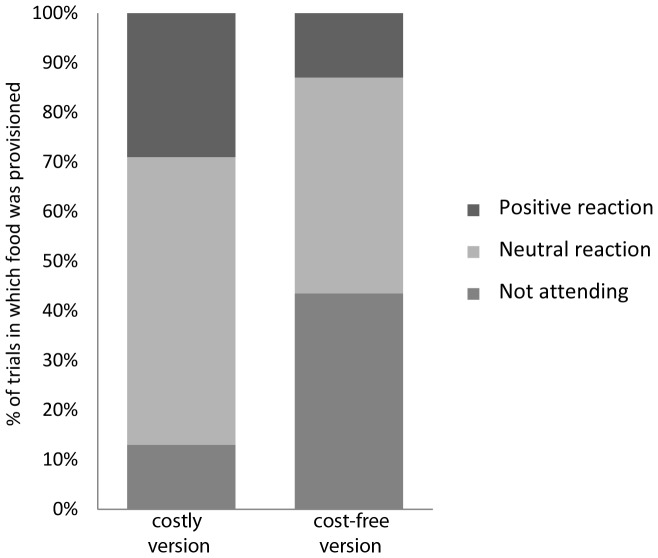
Various nonhuman primate species have been tested with prosocial games (i.e. derivates from dictator games) in order to better understand the evolutionary origin of proactive prosociality in humans. Results of these efforts are mixed, and it is difficult to disentangle true species differences from methodological artifacts. We tested 2- to 5-year-old children with a costly and a cost-free version of a prosocial game that differ with regard to the payoff distribution and are widely used with nonhuman primates. Simultaneously, we assessed the subjects' level of Theory of Mind understanding. Prosocial behavior was demonstrated with the prosocial game, and did not increase with more advanced Theory of Mind understanding. However, prosocial behavior could only be detected with the costly version of the game, whereas the children failed the cost-free version that is most commonly used with nonhuman primates. A detailed comparison of the children's behavior in the two versions of the game indicates that the failure was due to higher attentional demands of the cost-free version, rather than to a lack of prosociality per se. Our results thus show (i) that subtle differences in prosociality tasks can substantially bias the outcome and thus prevent meaningful species comparisons, and (ii) that like in nonhuman primates, prosocial behavior in human children does not require advanced Theory of Mind understanding in the present context. However, both developmental and comparative psychology accumulate increasing evidence for the multidimensionality of prosocial behaviors, suggesting that different forms of prosociality are also regulated differentially. For future efforts to understand the evolutionary origin of prosociality it is thus crucial to take this heterogeneity into account.

摘要

各种非人类灵长类动物已经通过亲社会游戏(即源自独裁者游戏的衍生物)进行了测试,以便更好地理解人类主动亲社会行为的进化起源。这些努力的结果喜忧参半,很难将真正的物种差异与方法学上的差异区分开来。我们用一种有代价和无代价的亲社会游戏测试了 2 至 5 岁的儿童,这两种游戏在收益分配上有所不同,并且广泛用于非人类灵长类动物。同时,我们评估了受试者的心理理论理解水平。亲社会行为是通过亲社会游戏表现出来的,而且不会随着心理理论理解的提高而增加。然而,只有在代价高昂的游戏版本中才能检测到亲社会行为,而儿童在非人类灵长类动物最常用的无代价版本中失败了。对儿童在两种游戏版本中的行为的详细比较表明,失败是由于无代价版本的注意力要求更高,而不是由于缺乏亲社会性本身。因此,我们的结果表明(i)亲社会行为任务中的细微差异会极大地影响结果,从而阻止有意义的物种比较,以及(ii)与非人类灵长类动物一样,在当前背景下,人类儿童的亲社会行为并不需要先进的心理理论理解。然而,发展心理学和比较心理学都积累了越来越多的证据表明,亲社会行为是多维度的,这表明不同形式的亲社会行为也受到不同的调节。因此,对于未来理解亲社会行为的进化起源的努力,将这种异质性考虑进去至关重要。
https://cdn.ncbi.nlm.nih.gov/pmc/blobs/3506/3700944/780fc92bc1cd/pone.0068440.g006.jpg
https://cdn.ncbi.nlm.nih.gov/pmc/blobs/3506/3700944/a29f2f46d929/pone.0068440.g001.jpg
https://cdn.ncbi.nlm.nih.gov/pmc/blobs/3506/3700944/c6422668490f/pone.0068440.g002.jpg
https://cdn.ncbi.nlm.nih.gov/pmc/blobs/3506/3700944/0a41434d82b3/pone.0068440.g003.jpg
https://cdn.ncbi.nlm.nih.gov/pmc/blobs/3506/3700944/66033053d436/pone.0068440.g004.jpg
https://cdn.ncbi.nlm.nih.gov/pmc/blobs/3506/3700944/26ac86f22e73/pone.0068440.g005.jpg
https://cdn.ncbi.nlm.nih.gov/pmc/blobs/3506/3700944/780fc92bc1cd/pone.0068440.g006.jpg
https://cdn.ncbi.nlm.nih.gov/pmc/blobs/3506/3700944/a29f2f46d929/pone.0068440.g001.jpg
https://cdn.ncbi.nlm.nih.gov/pmc/blobs/3506/3700944/c6422668490f/pone.0068440.g002.jpg
https://cdn.ncbi.nlm.nih.gov/pmc/blobs/3506/3700944/0a41434d82b3/pone.0068440.g003.jpg
https://cdn.ncbi.nlm.nih.gov/pmc/blobs/3506/3700944/66033053d436/pone.0068440.g004.jpg
https://cdn.ncbi.nlm.nih.gov/pmc/blobs/3506/3700944/26ac86f22e73/pone.0068440.g005.jpg
https://cdn.ncbi.nlm.nih.gov/pmc/blobs/3506/3700944/780fc92bc1cd/pone.0068440.g006.jpg

相似文献

1
Preschool children fail primate prosocial game because of attentional task demands.学龄前儿童由于注意力任务的要求而无法完成灵长类亲社会游戏。
PLoS One. 2013 Jul 3;8(7):e68440. doi: 10.1371/journal.pone.0068440. Print 2013.
2
Fostering Prosociality in Refugee Children: An Intervention With Rohingya Children.促进难民儿童的亲社会行为:对罗兴亚儿童的干预。
Monogr Soc Res Child Dev. 2024 Sep;89(1-2):7-109. doi: 10.1111/mono.12477.
3
The developmental origins of naïve psychology in infancy.婴儿期朴素心理学的发展起源。
Adv Child Dev Behav. 2009;37:55-104. doi: 10.1016/s0065-2407(09)03702-1.
4
Two and a half-year-old children are prosocial even when their partners are not.两岁半的儿童即使在没有同伴的情况下也具有亲社会行为。
J Exp Child Psychol. 2013 Oct;116(2):186-98. doi: 10.1016/j.jecp.2013.05.007. Epub 2013 Jun 22.
5
Insights into Intraspecies Variation in Primate Prosocial Behavior: Capuchins (Cebus apella) Fail to Show Prosociality on a Touchscreen Task.灵长类动物亲社会行为种内变异的研究进展:卷尾猴(Cebus apella)在触摸屏任务中未能表现出亲社会行为。
Behav Sci (Basel). 2014 Apr 10;4(2):87-101. doi: 10.3390/bs4020087. eCollection 2014 Jun.
6
Beyond good and evil: what motivations underlie children's prosocial behavior?超越善恶:儿童亲社会行为的动机是什么?
Perspect Psychol Sci. 2015 Mar;10(2):159-75. doi: 10.1177/1745691615568998.
7
Cortical thickness of the dorsolateral prefrontal cortex predicts strategic choices in economic games.背外侧前额叶皮质的皮质厚度可预测经济博弈中的策略选择。
Proc Natl Acad Sci U S A. 2016 May 17;113(20):5582-7. doi: 10.1073/pnas.1523940113. Epub 2016 May 2.
8
Do marmosets care to share? Oxytocin treatment reduces prosocial behavior toward strangers.狨猴愿意分享吗?催产素治疗会减少对陌生人的亲社会行为。
Horm Behav. 2015 May;71:83-90. doi: 10.1016/j.yhbeh.2015.04.015. Epub 2015 Apr 28.
9
Critical issues in experimental studies of prosociality in non-human species.非人类物种亲社会行为实验研究中的关键问题。
Anim Cogn. 2016 Jul;19(4):679-705. doi: 10.1007/s10071-016-0973-6. Epub 2016 Mar 21.
10
Autism does not Dictate Children's Lack of Sharing in a Prosocial Choice Test.自闭症并不影响儿童在亲社会选择测试中的分享行为。
J Autism Dev Disord. 2021 Jun;51(6):2029-2035. doi: 10.1007/s10803-020-04691-1.

引用本文的文献

1
Infants expect some degree of positive and negative reciprocity between strangers.婴儿期望与陌生人之间存在一定程度的积极和消极互惠。
Nat Commun. 2024 Sep 4;15(1):7742. doi: 10.1038/s41467-024-51982-7.
2
The proximate regulation of prosocial behaviour: towards a conceptual framework for comparative research.亲社会行为的近因调控:走向比较研究的概念框架。
Anim Cogn. 2024 Mar 2;27(1):5. doi: 10.1007/s10071-024-01846-w.
3
Adult bonobos show no prosociality in both prosocial choice task and group service paradigm.成年倭黑猩猩在亲社会选择任务和群体服务范式中均没有表现出亲社会性。

本文引用的文献

1
Examining the Diversity of Prosocial Behavior: Helping, Sharing, and Comforting in Infancy.审视亲社会行为的多样性:婴儿期的帮助、分享与安慰
Infancy. 2011 May;16(3):227-247. doi: 10.1111/j.1532-7078.2010.00041.x.
2
Chimpanzees do not take advantage of very low cost opportunities to deliver food to unrelated group members.黑猩猩不会利用成本极低的机会为非亲属群体成员提供食物。
Anim Behav. 2008 May 1;75(5):1757-1770. doi: 10.1016/j.anbehav.2007.09.036.
3
Early Development of Prosocial Behavior: Current Perspectives.亲社会行为的早期发展:当前观点
PeerJ. 2022 Feb 1;10:e12849. doi: 10.7717/peerj.12849. eCollection 2022.
4
Targeted helping and cooperation in zoo-living chimpanzees and bonobos.对圈养黑猩猩和倭黑猩猩的定向帮助与合作。
R Soc Open Sci. 2021 Mar 10;8(3):201688. doi: 10.1098/rsos.201688.
5
Assessing African grey parrots' prosocial tendencies in a token choice paradigm.在代币选择范式中评估非洲灰鹦鹉的亲社会倾向。
R Soc Open Sci. 2019 Dec 11;6(12):190696. doi: 10.1098/rsos.190696. eCollection 2019 Dec.
6
Not by the same token: A female orangutan (Pongo pygmaeus) is selectively prosocial.并非如此:一只雌性红毛猩猩(婆罗洲猩猩)具有选择性亲社会行为。
Primates. 2020 Mar;61(2):237-247. doi: 10.1007/s10329-019-00780-7. Epub 2019 Dec 7.
7
Social status and prenatal testosterone exposure assessed via second-to-fourth digit ratio affect 6-9-year-old children's prosocial choices.社会地位和通过第二到第四指比率评估的产前睾丸素暴露会影响 6-9 岁儿童的亲社会选择。
Sci Rep. 2018 Jun 15;8(1):9198. doi: 10.1038/s41598-018-27468-0.
8
Young children display an increase in prosocial donating in response to an upwards shift in generosity by a same-aged peer.年幼的孩子会在看到同龄人的慷慨程度上升时,表现出更多的亲社会捐赠行为。
Sci Rep. 2017 Jun 1;7(1):2633. doi: 10.1038/s41598-017-02858-y.
9
But is helping you worth the risk? Defining Prosocial Risk Taking in adolescence.但帮助你值得冒这个险吗?界定青少年期的亲社会冒险行为。
Dev Cogn Neurosci. 2017 Jun;25:260-271. doi: 10.1016/j.dcn.2016.11.008. Epub 2016 Dec 6.
10
Inequity aversion strategies between marmosets are influenced by partner familiarity and sex but not oxytocin.狨猴之间的不平等厌恶策略受伙伴熟悉程度和性别影响,但不受催产素影响。
Anim Behav. 2016 Apr 1;114:69-79. doi: 10.1016/j.anbehav.2016.01.025.
Infancy. 2013 Jan-Feb;18(1):1-9. doi: 10.1111/infa.12004.
4
Classifying prosocial behavior: children's responses to instrumental need, emotional distress, and material desire.对亲社会行为的分类:儿童对工具性需求、情绪困扰和物质欲望的反应。
Child Dev. 2013 Sep-Oct;84(5):1766-76. doi: 10.1111/cdev.12075. Epub 2013 Mar 5.
5
Do robots have goals? How agent cues influence action understanding in non-human primates.机器人有目标吗?主体线索如何影响非人类灵长类动物对动作的理解。
Behav Brain Res. 2013 Jun 1;246:47-54. doi: 10.1016/j.bbr.2013.01.047. Epub 2013 Feb 27.
6
Neural correlates of prosocial behavior in infancy: different neurophysiological mechanisms support the emergence of helping and comforting.婴儿期亲社会行为的神经关联:不同的神经生理机制支持帮助和安慰行为的出现。
Neuroimage. 2013 Feb 1;66:522-30. doi: 10.1016/j.neuroimage.2012.10.041. Epub 2012 Oct 26.
7
Monkeys benefit from reciprocity without the cognitive burden.猴子在没有认知负担的情况下受益于互惠。
Proc Natl Acad Sci U S A. 2012 Sep 18;109(38):15191-6. doi: 10.1073/pnas.1213173109. Epub 2012 Sep 4.
8
To share or not to share: When do toddlers respond to another's needs?分享还是不分享:幼儿何时会对他人的需求做出反应?
Infancy. 2009 Jan;14(1):117-130. doi: 10.1080/15250000802569868. Epub 2009 Jan 1.
9
Continuity from an implicit to an explicit understanding of false belief from infancy to preschool age.从婴儿期到学前阶段,对错误信念的理解从内隐到外显的连续性。
Br J Dev Psychol. 2012 Mar;30(Pt 1):172-87. doi: 10.1111/j.2044-835X.2011.02067.x. Epub 2011 Nov 10.
10
Chimpanzees' flexible targeted helping based on an understanding of conspecifics' goals.黑猩猩基于对同种目标的理解而灵活地有针对性地提供帮助。
Proc Natl Acad Sci U S A. 2012 Feb 28;109(9):3588-92. doi: 10.1073/pnas.1108517109. Epub 2012 Feb 6.