Clinical Research Center, University of Debrecen, Medical and Health Science Center, Debrecen, Hungary.
PLoS One. 2013 Jul 2;8(7):e69417. doi: 10.1371/journal.pone.0069417. Print 2013.
Clinical studies suggest that 10-50% of patients are resistant to clopidogrel therapy. ADP induced platelet aggregation, a widely used test to monitor clopidogrel therapy, is affected by aspirin and is not specific for the P2Y12 receptor inhibited by clopidogrel.
To develop a P2Y12-specific platelet aggregation test and to compare it with other methods used for monitoring clopidogrel therapy.
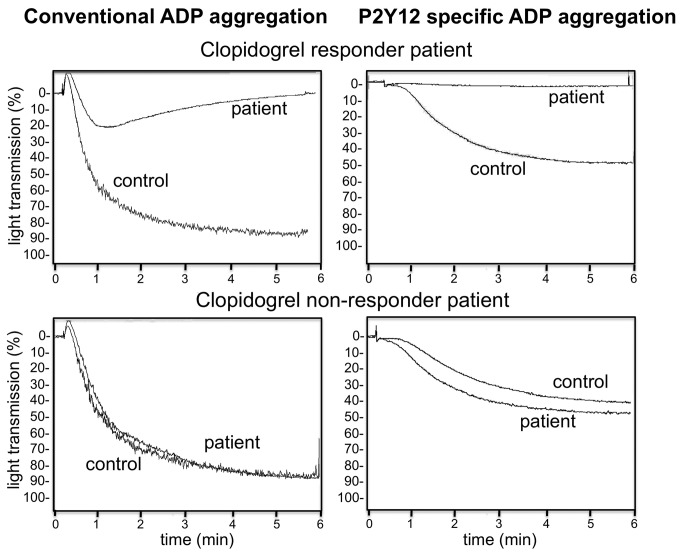
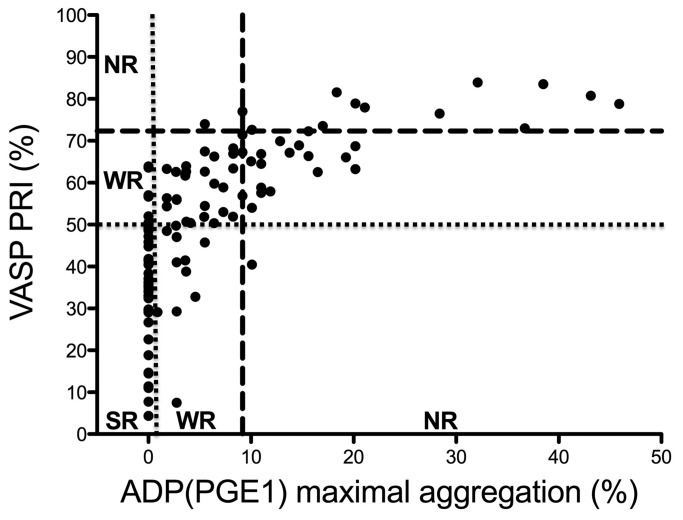
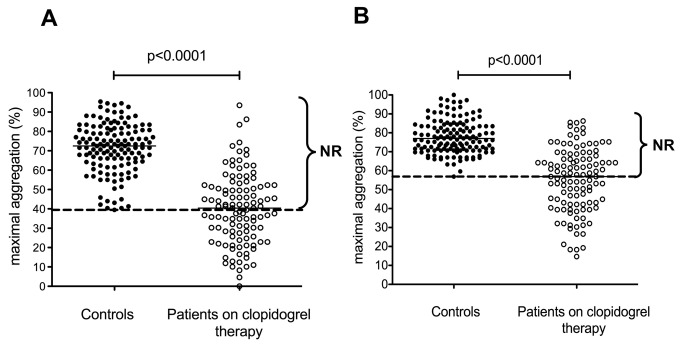
PATIENTS/METHODS: Study population included 111 patients with the history of ischemic stroke being on clopidogrel monotherapy and 140 controls. The effect of clopidogrel was tested by a newly developed ADP(PGE1) aggregation test in which prostaglandin E1 treated platelets are used. Results of conventional ADP induced platelet aggregation, VerifyNow P2Y12 assay and ADP(PGE1) aggregation were compared to those obtained by flow cytometric analysis of vasodilator stimulated phosphoprotein (VASP) phosphorylation. Reference intervals for all assays were determined according to the guidelines of Clinical Laboratory Standards Institute.
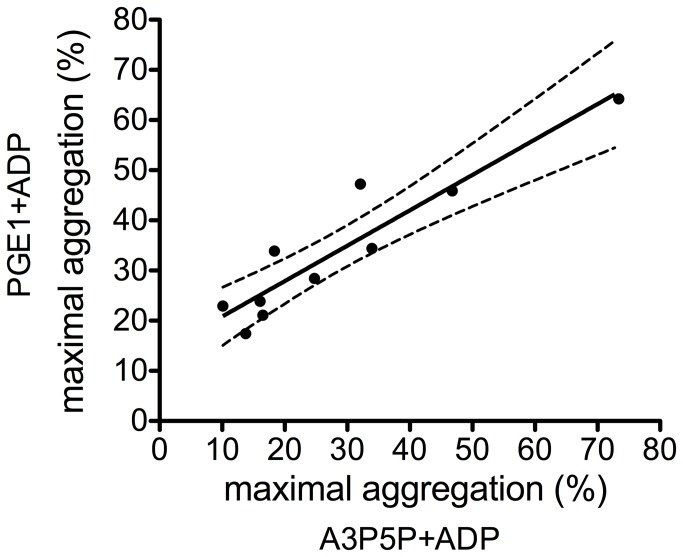
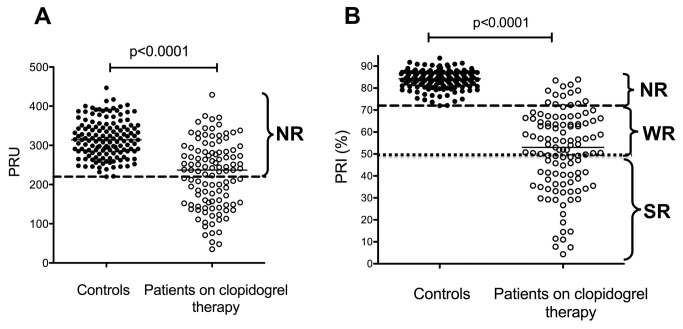
The P2Y12-specificity of ADP(PGE1) test was proven by comparing it with ADP aggregation in the presence of P2Y1 antagonist, adenosine 3', 5'-diphosphate. The method was not influenced by aspirin treatment. Approximately 50% of patients were clopidogrel resistant by conventional ADP aggregation and VerifyNow tests. The ADP(PGE1) method and the VASP phosphorylation assay identified 25.9% and 11.7% of patients as non-responders, respectively. ADP(PGE1) aggregation showed good correlation with VASP phosphorylation and had high diagnostic efficiency.
The new ADP(PGE1) method is a reliable test for monitoring P2Y12 receptor inhibition by platelet aggregation. As a subset of patients are non-responders, monitoring clopidogrel therapy by adequate methods is essential.
临床研究表明,10-50%的患者对氯吡格雷治疗有耐药性。ADP 诱导的血小板聚集是一种广泛用于监测氯吡格雷治疗的方法,但它受阿司匹林的影响,并且不能特异性地针对氯吡格雷抑制的 P2Y12 受体。
开发一种 P2Y12 特异性血小板聚集试验,并将其与其他用于监测氯吡格雷治疗的方法进行比较。
患者/方法:研究人群包括 111 例缺血性卒中病史的患者,他们正在接受氯吡格雷单药治疗,以及 140 例对照者。使用新开发的 ADP(PGE1)聚集试验检测氯吡格雷的作用,该试验中使用了前列腺素 E1 处理的血小板。常规 ADP 诱导的血小板聚集、VerifyNow P2Y12 测定和 ADP(PGE1)聚集的结果与通过流式细胞术分析血管扩张刺激磷蛋白(VASP)磷酸化获得的结果进行了比较。根据临床实验室标准协会的指南确定了所有检测方法的参考区间。
通过比较 ADP(PGE1)试验与存在 P2Y1 拮抗剂腺苷 3',5'-二磷酸的 ADP 聚集,证明了该方法的 P2Y12 特异性。该方法不受阿司匹林治疗的影响。大约 50%的患者通过常规 ADP 聚集和 VerifyNow 检测被认为是氯吡格雷耐药的。ADP(PGE1)方法和 VASP 磷酸化检测分别识别出 25.9%和 11.7%的患者为无反应者。ADP(PGE1)聚集与 VASP 磷酸化具有良好的相关性,且具有较高的诊断效率。
新的 ADP(PGE1)方法是一种可靠的监测血小板聚集抑制 P2Y12 受体的试验。由于存在部分患者无反应的情况,因此通过适当的方法监测氯吡格雷治疗至关重要。