Language and Genetics Department, Max Planck Institute for Psycholinguistics Nijmegen, Netherlands ; Donders Institute for Brain, Cognition and Behaviour, Radboud University Nijmegen Nijmegen, Netherlands.
Front Psychol. 2013 Jul 5;4:397. doi: 10.3389/fpsyg.2013.00397. eCollection 2013.
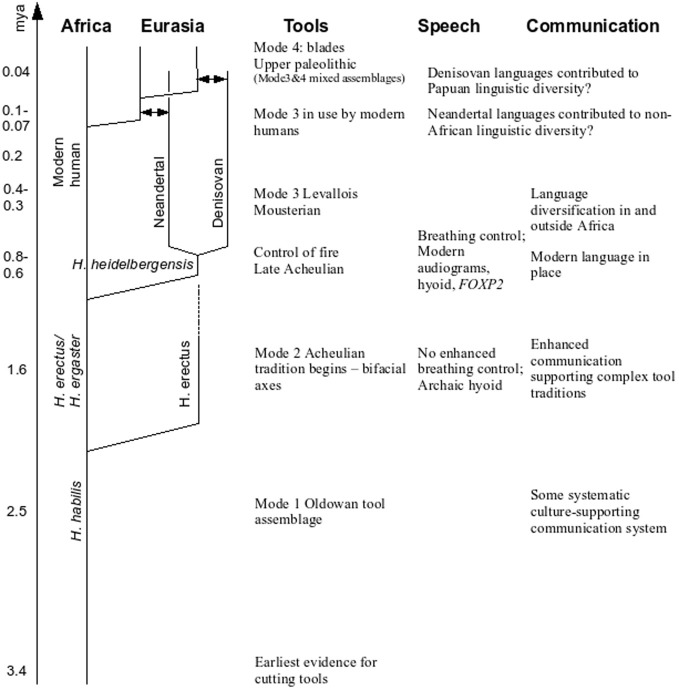
It is usually assumed that modern language is a recent phenomenon, coinciding with the emergence of modern humans themselves. Many assume as well that this is the result of a single, sudden mutation giving rise to the full "modern package." However, we argue here that recognizably modern language is likely an ancient feature of our genus pre-dating at least the common ancestor of modern humans and Neandertals about half a million years ago. To this end, we adduce a broad range of evidence from linguistics, genetics, paleontology, and archaeology clearly suggesting that Neandertals shared with us something like modern speech and language. This reassessment of the antiquity of modern language, from the usually quoted 50,000-100,000 years to half a million years, has profound consequences for our understanding of our own evolution in general and especially for the sciences of speech and language. As such, it argues against a saltationist scenario for the evolution of language, and toward a gradual process of culture-gene co-evolution extending to the present day. Another consequence is that the present-day linguistic diversity might better reflect the properties of the design space for language and not just the vagaries of history, and could also contain traces of the languages spoken by other human forms such as the Neandertals.
通常认为,现代语言是最近才出现的,与现代人本身的出现相吻合。许多人还认为,这是一次单一的、突然的突变的结果,从而产生了完整的“现代组合”。然而,我们在这里认为,可识别的现代语言很可能是我们这个属的一个古老特征,其历史可以追溯到至少 50 万年前的现代人类和尼安德特人的共同祖先之前。为此,我们从语言学、遗传学、古生物学和考古学等多个领域援引了广泛的证据,清楚地表明尼安德特人与我们共享了一些类似于现代言语和语言的东西。这种对现代语言起源的重新评估,从通常引用的 5 万至 10 万年到 50 万年,对我们一般理解自己的进化产生了深远的影响,尤其是对言语和语言科学的影响。因此,它反对语言进化的跳跃论假说,而赞成一种延伸到今天的文化基因共同进化的渐进过程。另一个后果是,当今的语言多样性可能更好地反映了语言设计空间的特性,而不仅仅是历史的偶然,并且还可能包含其他人类形式(如尼安德特人)所说语言的痕迹。