School of Natural Sciences and Psychology, Liverpool John Moores University, Liverpool, UK.
Parasit Vectors. 2013 Jul 13;6:205. doi: 10.1186/1756-3305-6-205.
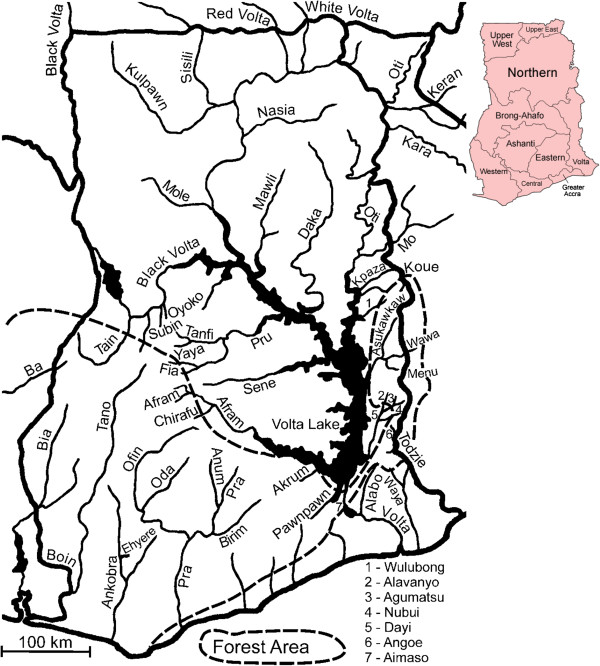
Simulium damnosum s.l., the most important vector of onchocerciasis in Africa, is a complex of sibling species that have been described on the basis of differences in their larval polytene chromosomes. These (cyto) species differ in their geographical distributions, ecologies and epidemiological roles. In Ghana, distributional changes have been recorded as a consequence of vector control and environmental change (e.g. deforestation), with potential disease consequences. We review the distribution of cytospecies in southern Ghana and report changes observed with reference to historical data collated from 1971 to 2005 and new identifications made between 2006 and 2011.
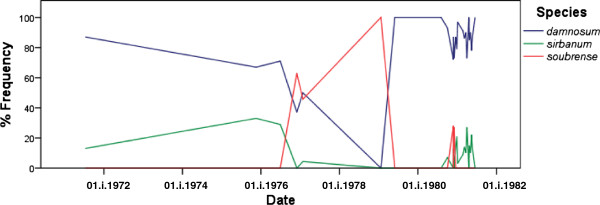
METHODS/RESULTS: Larvae were collected from riverine breeding sites, fixed in Carnoy's solution and chromosome preparations made. Cytotaxonomic identifications from 1,232 samples (including 49 new samples) were analysed. We report long-term stability in cytospecies distribution in the rivers Afram, Akrum, Pawnpawn and Pru. For the rivers Oda, Ofin and Tano we describe (for the first time) patterns of distribution. We could not detect cytospecies composition changes in the upper Pra, and the lower Pra seems to have been stable. The elimination of the Djodji form of S. sanctipauli in the Volta Region seems to have had no long-term effects on the distribution of the other cytospecies, despite an initial surge by S. yahense. There has been a recent increase in the occurrence of savannah cytospecies in the river Asukawkaw, and this might be related to continuing deforestation.
Cytospecies' distributions have not been stable from 1971 to 2011. Although there are no obvious causes for the temporary appearance and subsequent disappearance of cytospecies in a particular location, a major influence has been vector control and migration patterns, probably explaining observed changes on the Black Volta and lower Volta rivers. Deforestation was previously implicated in an increase of savannah cytospecies in southern Ghana (1975-1997). Our data had little power to support (or refute) suggestions of a continuing increase, except in the Asukawkaw river basin.
在非洲,嗜人按蚊复合体是最重要的盘尾丝虫病传播媒介,是由幼虫多线染色体差异描述的姊妹种组成。这些(细胞)种在地理分布、生态和流行病学作用上存在差异。在加纳,由于媒介控制和环境变化(例如森林砍伐),已经记录到分布变化,可能带来疾病后果。我们回顾了加纳南部细胞种的分布情况,并报告了自 1971 年至 2005 年期间收集的历史数据以及 2006 年至 2011 年期间新发现的变化。
方法/结果:从河流繁殖地采集幼虫,用 Carnoy 溶液固定,制备染色体。对 1232 个样本(包括 49 个新样本)的细胞分类学鉴定进行了分析。我们报告了 Afram、Akrum、Pawnpawn 和 Pru 河流中细胞种分布的长期稳定性。对于 Oda、Ofin 和 Tano 河流,我们首次描述了分布模式。我们无法检测到上 Pra 河细胞种组成的变化,而下 Pra 河似乎保持稳定。尽管 S. yahense 最初激增,但乔吉形式的 S. sanctipauli 在沃尔特地区的消除似乎对其他细胞种的分布没有长期影响。Asukawkaw 河流中萨凡纳细胞种的出现最近有所增加,这可能与持续的森林砍伐有关。
自 1971 年至 2011 年,细胞种的分布并不稳定。尽管在特定地点暂时出现和随后消失的细胞种没有明显的原因,但主要影响因素是媒介控制和迁徙模式,这可能解释了在黑沃尔特河和下沃尔特河观察到的变化。以前曾有人提出,森林砍伐是导致加纳南部萨凡纳细胞种增加的原因之一(1975-1997 年)。除了在 Asukawkaw 河流域外,我们的数据几乎没有能力支持(或反驳)持续增加的说法。