
基于 RADSeq 数据的埃塞俄比亚西北部盘尾丝虫病媒介(Simulium damnosum sensu lato)的细胞分类学特征描述和迁移模式估计。
Cytotaxonomic characterization and estimation of migration patterns of onchocerciasis vectors (Simulium damnosum sensu lato) in northwestern Ethiopia based on RADSeq data.
机构信息
Department of Environment and Genetics, School of Agriculture, Biomedicine and Environment, La Trobe University, Bundoora, Victoria, Australia.
School of Biological and Environmental Sciences, Liverpool John Moores University, Liverpool, United Kingdom.
出版信息
PLoS Negl Trop Dis. 2024 Jan 4;18(1):e0011868. doi: 10.1371/journal.pntd.0011868. eCollection 2024 Jan.
BACKGROUND
While much progress has been made in the control and elimination of onchocerciasis across Africa, the extent to which vector migration might confound progress towards elimination or result in re-establishment of endemism in areas where transmission has been eliminated remains unclear. In Northern Ethiopia, Metema and Metekel-two foci located near the Sudan border-exhibit continuing transmission. While progress towards elimination has been faster in Metema, there remains a problematic hotspot of transmission. Whether migration from Metekel contributes to this is currently unknown.
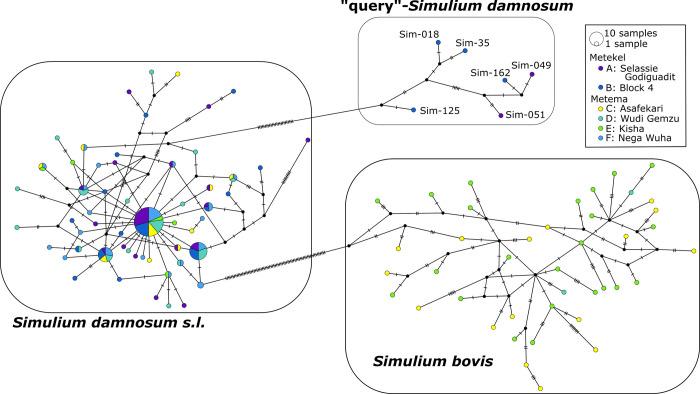
METHODOLOGY/PRINCIPLE FINDINGS: To assess the role of vector migration from Metekel into Metema, we present a population genomics study of 151 adult female vectors using 47,638 RADseq markers and mtDNA CoI sequencing. From additional cytotaxonomy data we identified a new cytoform in Metema, closely related to S. damnosum s.str, here called the Gondar form. RADseq data strongly indicate the existence of two distinctly differentiated clusters within S. damnosum s.l.: one genotypic cluster found only in Metema, and the second found predominantly in Metekel. Because blackflies from both clusters were found in sympatry (in all four collection sites in Metema), but hybrid genotypes were not detected, there may be reproductive barriers preventing interbreeding. The dominant genotype in Metema was not found in Metekel while the dominant genotype in Metekel was found in Metema, indicating that (at the time of sampling) migration is primarily unidirectional, with flies moving from Metekel to Metema. There was strong differentiation between clusters but little genetic differentiation within clusters, suggesting migration and gene flow of flies within the same genetic cluster are sufficient to prevent genetic divergence between sites.
CONCLUSIONS/SIGNIFICANCE: Our results confirm that Metekel and Metema represent different transmission foci, but also indicate a northward movement of vectors between foci that may have epidemiological importance, although its significance requires further study.
背景
尽管非洲在控制和消除盘尾丝虫病方面取得了很大进展,但媒介迁移可能会干扰消除进展或导致传播已消除的地区重新出现地方性流行的程度仍不清楚。在埃塞俄比亚北部,靠近苏丹边境的梅特马和梅特克尔-两个焦点-仍在继续传播。虽然梅特马在消除方面取得了更快的进展,但仍存在一个有问题的传播热点。梅特克尔的迁移是否对此有贡献目前尚不清楚。
方法/原理发现:为了评估媒介从梅特克尔向梅特马迁移的作用,我们使用 47638 个 RADseq 标记和 mtDNA CoI 测序对 151 只成年雌性媒介进行了种群基因组学研究。从额外的细胞分类学数据中,我们在梅特马发现了一种新的细胞形式,与 S. damnosum s.str. 密切相关,我们称之为 Gondar 形式。RADseq 数据强烈表明,在 S. damnosum s.l. 中存在两个明显分化的聚类:一个仅在梅特马发现的基因型聚类,第二个主要在梅特克尔发现。由于两个聚类中的黑蝇都存在于同域(在梅特马的四个采集点都有),但没有检测到杂交基因型,因此可能存在生殖障碍阻止杂交。在梅特马占主导地位的基因型在梅特克尔没有发现,而在梅特克尔占主导地位的基因型在梅特马发现,这表明(在采样时)迁移主要是单向的,黑蝇从梅特克尔向梅特马迁移。聚类之间存在强烈的分化,但聚类内部遗传分化很小,这表明同一遗传聚类中的黑蝇迁移和基因流足以防止种群间的遗传分化。
结论/意义:我们的研究结果证实,梅特克尔和梅特马代表不同的传播焦点,但也表明了两个焦点之间的媒介向北迁移,这可能具有流行病学意义,尽管其意义需要进一步研究。


 Zotero 插件