Neuroscience Graduate Studies Program, The Ohio State University, Columbus, OH, 43210, USA.
Exp Brain Res. 2013 Oct;230(2):153-64. doi: 10.1007/s00221-013-3639-5. Epub 2013 Jul 14.
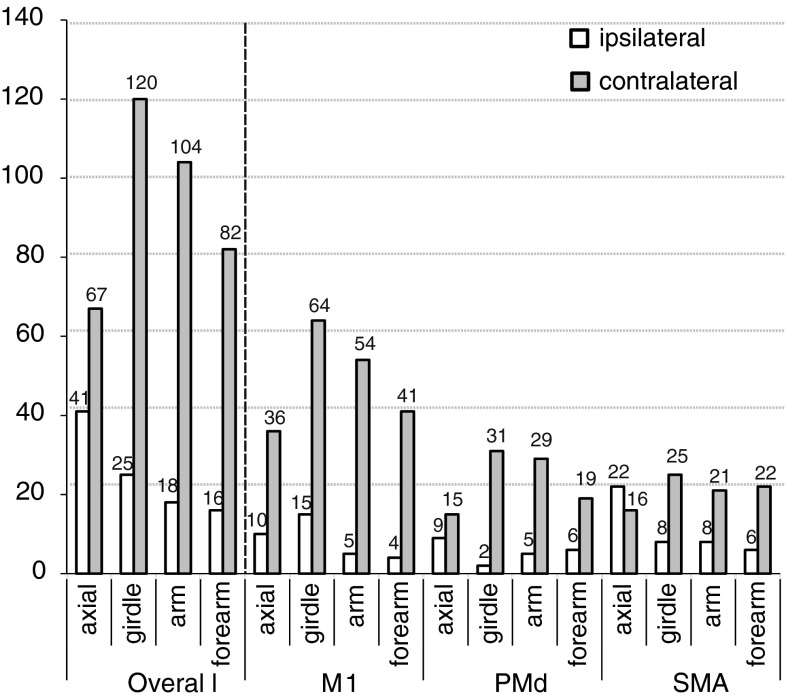
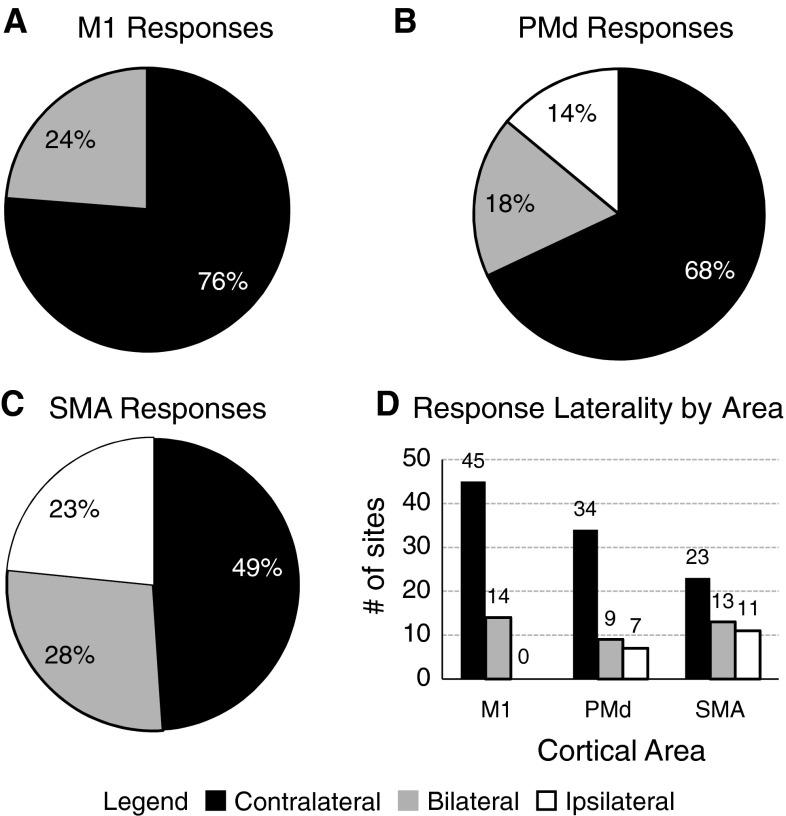
It is well established that cortical motor stimulation results in contralateral upper limb (UL) activity. Motor responses are also elicited in the ipsilateral UL, though controversy surrounds the significance of these effects. Evidence suggests that ipsilateral muscle activity is more common following the stimulation of the supplementary motor area (SMA) and dorsal premotor area (PMd), compared to the primary motor cortex (M1), but none of these studies compared effects from all three areas in the same subjects. This has limited our understanding of how these three cortical motor areas influence ipsilateral UL muscle activity. The purpose of this study was to determine the contribution of each of three cortical areas to the production of ipsilateral and contralateral UL. To maximize sensitivity and allow comparison of the effects across cortical areas, we applied the same stimulation parameters (36 pulse stimulus train at 330 Hz) to M1, SMA, and PMd in three adult M. fascicularis and recorded electromyographic (EMG) activity from muscles in the trunk and both ULs. Of all muscle responses identified, 24 % were ipsilateral to the stimulation, mostly in proximal muscles. The highest percentage of ipsilateral responses occurred following SMA stimulation. We also observed that PMd stimulation elicited more suppression responses compared with stimulation of M1 and SMA. The results indicate that ipsilateral motor areas provide a significant contribution to cortical activation of the trunk and proximal UL muscles. These understudied pathways may represent a functional substrate for future strategies to shape UL recovery following injury or stroke.
皮质运动刺激会导致对侧上肢(UL)活动,这一点已得到充分证实。同侧 UL 也会引起运动反应,但这些效应的意义仍存在争议。有证据表明,与初级运动皮层(M1)相比,刺激辅助运动区(SMA)和背侧运动前区(PMd)时更常出现同侧肌肉活动,但这些研究均未在同一受试者中比较这三个区域的效应。这限制了我们对这三个皮质运动区如何影响同侧 UL 肌肉活动的理解。本研究的目的是确定三个皮质区中每一个对同侧和对侧 UL 的产生的贡献。为了最大限度地提高敏感性并允许跨皮质区比较效应,我们在三只成年 M. fascicularis 中应用相同的刺激参数(330 Hz 时 36 脉冲刺激串)刺激 M1、SMA 和 PMd,并记录来自躯干和两侧 UL 的肌电图(EMG)活动。在确定的所有肌肉反应中,有 24%是同侧的,主要位于近端肌肉。SMA 刺激引起的同侧反应比例最高。我们还观察到,与刺激 M1 和 SMA 相比,PMd 刺激会引起更多的抑制反应。结果表明,同侧运动区对皮质激活躯干和近端 UL 肌肉提供了重要贡献。这些研究较少的途径可能代表了未来受伤或中风后塑造 UL 恢复的策略的功能基础。