Division of Infectious Diseases, Massachusetts General Hospital, Boston, Massachusetts, United States of America.
PLoS Negl Trop Dis. 2013 Jun 27;7(6):e2292. doi: 10.1371/journal.pntd.0002292. Print 2013.
In many rural areas at risk for enteric fever, there are few data on Salmonella enterica serotypes Typhi (S. Typhi) and Paratyphi (S. Paratyphi) incidence, due to limited laboratory capacity for microbiologic culture. Here, we describe an approach that permits recovery of the causative agents of enteric fever in such settings. This approach involves the use of an electricity-free incubator based upon use of phase-change materials. We compared this against conventional blood culture for detection of typhoidal Salmonella.
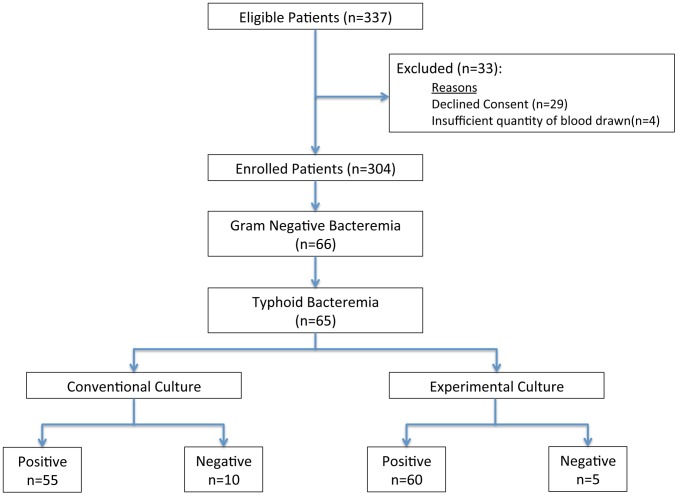
METHODOLOGY/PRINCIPAL FINDINGS: Three hundred and four patients with undifferentiated fever attending the outpatient and emergency departments of a public hospital in the Kathmandu Valley of Nepal were recruited. Conventional blood culture was compared against an electricity-free culture approach. Blood from 66 (21.7%) patients tested positive for a Gram-negative bacterium by at least one of the two methods. Sixty-five (21.4%) patients tested blood culture positive for S. Typhi (30; 9.9%) or S. Paratyphi A (35; 11.5%). From the 65 individuals with culture-confirmed enteric fever, 55 (84.6%) were identified by the conventional blood culture and 60 (92.3%) were identified by the experimental method. Median time-to-positivity was 2 days for both procedures. The experimental approach was falsely positive due to probable skin contaminants in 2 of 239 individuals (0.8%). The percentages of positive and negative agreement for diagnosis of enteric fever were 90.9% (95% CI: 80.0%-97.0%) and 96.0% (92.7%-98.1%), respectively. After initial incubation, Salmonella isolates could be readily recovered from blood culture bottles maintained at room temperature for six months.
CONCLUSIONS/SIGNIFICANCE: A simple culture approach based upon a phase-change incubator can be used to isolate agents of enteric fever. This approach could be used as a surveillance tool to assess incidence and drug resistance of the etiologic agents of enteric fever in settings without reliable local access to electricity or local diagnostic microbiology laboratories.
在许多存在肠热病风险的农村地区,由于微生物培养的实验室能力有限,有关伤寒沙门氏菌(S. Typhi)和副伤寒沙门氏菌(S. Paratyphi)血清型发病率的数据很少。在这里,我们描述了一种在这种环境下恢复肠热病病原体的方法。该方法涉及使用基于使用相变材料的无电孵化器。我们将这种方法与传统的血液培养进行了比较,以检测伤寒沙门氏菌。
方法/主要发现:从尼泊尔加德满都山谷的一家公立医院的门诊和急诊部门招募了 304 名发热未分化的患者。将传统的血液培养与无电培养方法进行了比较。通过两种方法中的至少一种方法,有 66 名(21.7%)患者的血液检测出革兰氏阴性细菌呈阳性。65 名(21.4%)患者的血液培养对 S. Typhi(30;9.9%)或 S. Paratyphi A(35;11.5%)呈阳性。在 65 名经培养确诊为肠热病的患者中,55 名(84.6%)通过常规血液培养确定,60 名(92.3%)通过实验方法确定。两种方法的中位阳性时间均为 2 天。由于 239 名个体中有 2 名(0.8%)可能存在皮肤污染物,实验方法呈假阳性。肠热病诊断的阳性和阴性一致性百分比分别为 90.9%(95%CI:80.0%-97.0%)和 96.0%(92.7%-98.1%)。初始孵育后,可从室温下保存六个月的血液培养瓶中轻松回收沙门氏菌分离株。
结论/意义:基于相变孵化器的简单培养方法可用于分离肠热病病原体。该方法可作为一种监测工具,用于评估无可靠当地电力或当地诊断微生物学实验室的地区肠热病病原体的发病率和耐药性。