Fisheries, Wildlife, and Conservation Biology, North Carolina State University, Raleigh, North Carolina, USA.
PLoS One. 2013 Jul 8;8(7):e69213. doi: 10.1371/journal.pone.0069213. Print 2013.
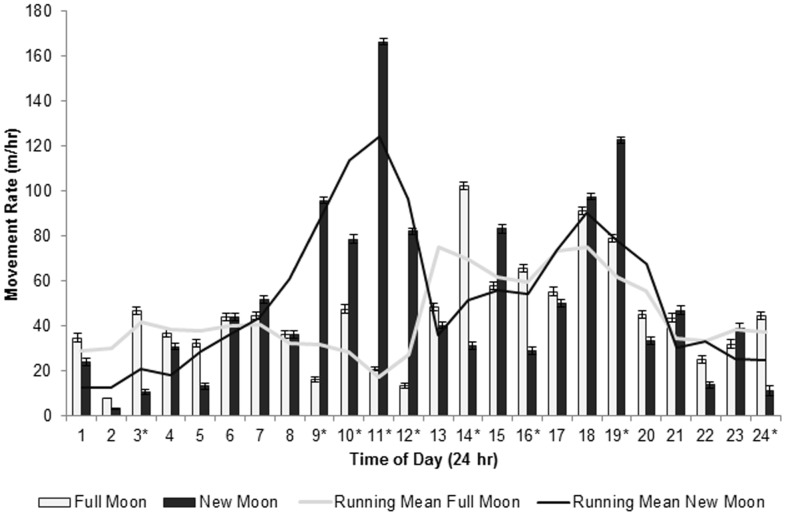
Understanding behavioral changes of prey and predators based on lunar illumination provides insight into important life history, behavioral ecology, and survival information. The objectives of this research were to determine if bobcat movement rates differed by period of day (dark, moon, crepuscular, day), lunar illumination (<10%, 10 - <50%, 50 - <90%, >90%), and moon phase (new, full). Bobcats had high movement rates during crepuscular and day periods and low movement rates during dark periods with highest nighttime rates at 10-<50% lunar illumination. Bobcats had highest movement rates during daytime when nighttime illumination was low (new moon) and higher movement rates during nighttime when lunar illumination was high (full moon). The behaviors we observed are consistent with prey availability being affected by light level and by limited vision by bobcats during darkness.
基于月相照明来理解猎物和捕食者的行为变化,可以深入了解重要的生活史、行为生态学和生存信息。本研究的目的是确定山猫的移动速度是否因一天中的时间(黑暗、月相、黄昏、白昼)、月相照明(<10%、10-<50%、50-<90%、>90%)和月相(新月、满月)而有所不同。山猫在黄昏和白天的移动速度较高,在黑暗时期的移动速度较低,夜间移动速度在 10-<50%月相照明时最高。山猫在夜间照明低(新月)的白天时移动速度最高,在夜间照明高(满月)时移动速度更高。我们观察到的行为与猎物的可获得性受到光照水平的影响以及山猫在黑暗中视力有限的情况一致。