Heurich Marco, Hilger Anton, Küchenhoff Helmut, Andrén Henrik, Bufka Luděk, Krofel Miha, Mattisson Jenny, Odden John, Persson Jens, Rauset Geir R, Schmidt Krzysztof, Linnell John D C
Bavarian Forest National Park, Department of Conservation and Research, Grafenau, Germany; Chair of Wildlife Ecology and Management, Albert Ludwig University of Freiburg, Freiburg, Germany.
Ludwig Maximilian University Munich, Statistical Consulting Unit, Department of Statistics, Munich, Germany.
PLoS One. 2014 Dec 17;9(12):e114143. doi: 10.1371/journal.pone.0114143. eCollection 2014.
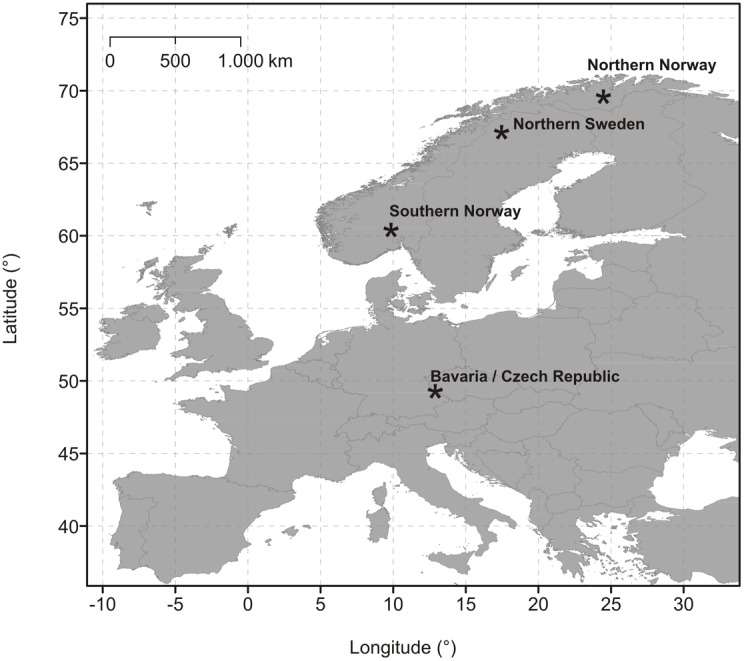
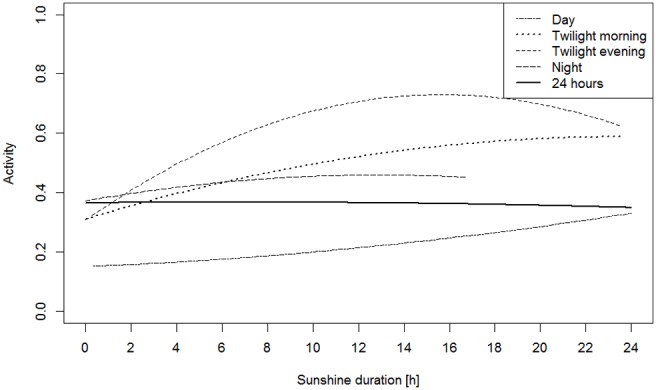
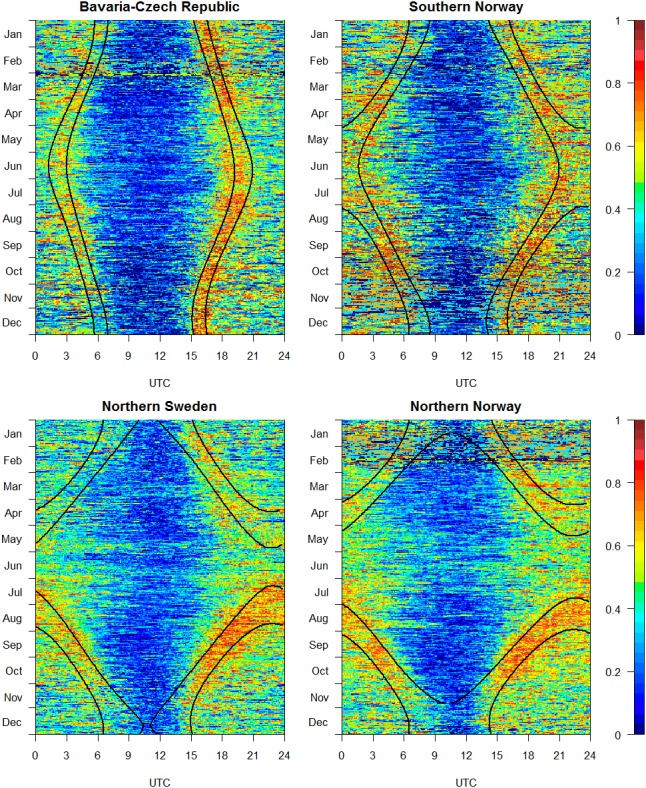
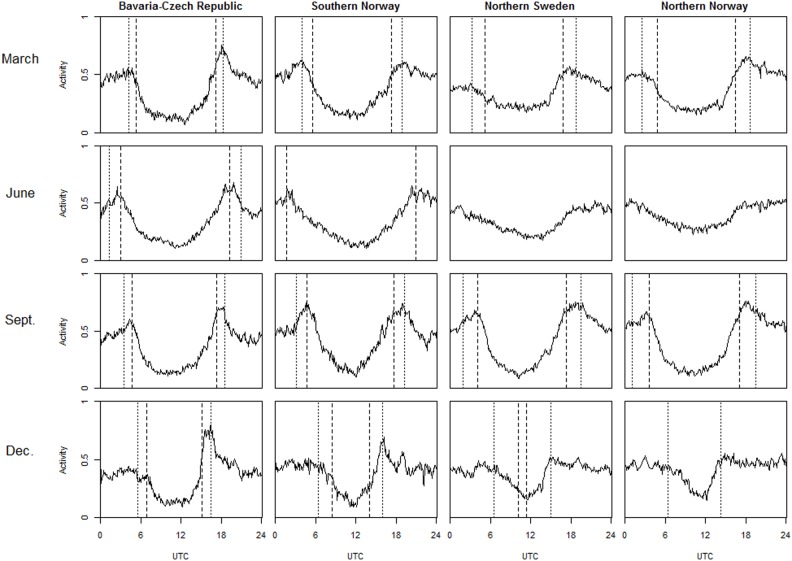
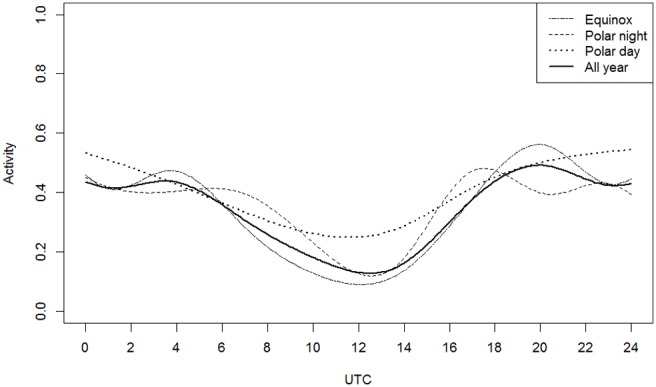
The activity patterns of most terrestrial animals are regarded as being primarily influenced by light, although other factors, such as sexual cycle and climatic conditions, can modify the underlying patterns. However, most activity studies have been limited to a single study area, which in turn limit the variability of light conditions and other factors. Here we considered a range of variables that might potentially influence the activity of a large carnivore, the Eurasian lynx, in a network of studies conducted with identical methodology in different areas spanning latitudes from 49°7'N in central Europe to 70°00'N in northern Scandinavia. The variables considered both light conditions, ranging from a day with a complete day-night cycle to polar night and polar day, as well as individual traits of the animals. We analysed activity data of 38 individual free-ranging lynx equipped with GPS-collars with acceleration sensors, covering more than 11,000 lynx days. Mixed linear additive models revealed that the lynx activity level was not influenced by the daily daylight duration and the activity pattern was bimodal, even during polar night and polar day. The duration of the active phase of the activity cycle varied with the widening and narrowing of the photoperiod. Activity varied significantly with moonlight. Among adults, males were more active than females, and subadult lynx were more active than adults. In polar regions, the amplitude of the lynx daily activity pattern was low, likely as a result of the polycyclic activity pattern of their main prey, reindeer. At lower latitudes, the basic lynx activity pattern peaked during twilight, corresponding to the crepuscular activity pattern of the main prey, roe deer. Our results indicated that the basic activity of lynx is independent of light conditions, but is modified by both individual traits and the activity pattern of the locally most important prey.
大多数陆生动物的活动模式被认为主要受光照影响,尽管其他因素,如性周期和气候条件,也能改变其潜在模式。然而,大多数活动研究仅限于单个研究区域,这反过来又限制了光照条件和其他因素的变化。在此,我们在一系列不同区域(从欧洲中部北纬49°7′到斯堪的纳维亚半岛北部北纬70°00′)开展了采用相同方法的研究网络,考虑了一系列可能潜在影响大型食肉动物欧亚猞猁活动的变量。这些变量既包括光照条件,从完整昼夜周期的一天到极夜和极昼,也包括动物的个体特征。我们分析了38只佩戴装有加速度传感器的GPS项圈的自由放养猞猁的活动数据,涵盖超过11000个猞猁日。混合线性加法模型显示,猞猁的活动水平不受每日日照时长影响,其活动模式呈双峰型,即使在极夜和极昼期间也是如此。活动周期中活跃阶段的时长随光周期的变宽和变窄而变化。活动随月光有显著变化。在成年猞猁中,雄性比雌性更活跃,亚成年猞猁比成年猞猁更活跃。在极地地区,猞猁每日活动模式的幅度较低,这可能是其主要猎物驯鹿多周期活动模式的结果。在纬度较低地区,猞猁的基本活动模式在黄昏时达到峰值,这与主要猎物狍的晨昏活动模式相对应。我们的结果表明,猞猁的基本活动与光照条件无关,但会受到个体特征和当地最重要猎物的活动模式的影响。