Divisions of Nephrology (S.S.-C., R.V.S., N.P., K.E.B., S.N.N., B.J.P., P.L.W., M.V., F.L., R.S., N.P., N.K., K.K., Q.A.-A., A.G.G.) and Pediatric Nephrology (P.L.W.) and the Department of Pathology (V.D.D.), Columbia University, and the Department of Medicine, St. Luke's-Roosevelt Hospital Center (S.S.-C.), New York; the Department of Genetics, Howard Hughes Medical Institute, and Yale Center for Mendelian Genomics, Yale University, New Haven, CT (M.C., M.S., R.P.L.); the Department of Biomedical Sciences, Seoul National University College of Medicine, Seoul, South Korea (M.C.); the Division of Nephrology, Dialysis, and Transplantation (M.B., F.L., G.C., A.C., M.D., C.M., G.P., G.M.G.) and Laboratory of Molecular Genetics (G.S., R.R.), Istituto Giannina Gaslini, the Division of Nephrology, Department of Internal Medicine (M.B.), and Dipartimento di Neuroscienze, Riabilitazione, Oftalmologia, Genetica e Scienze Materno Infantili (R.R.), University of Genoa, and IRCCS San Martino-IST (M.B.), Genoa; Cattedra di Nefrologia, Università di Brescia, Seconda Divisione di Nefrologia Azienda Ospedaliera Spedali Civili di Brescia Presidio di Montichiari, Brescia (C.I., F.S.); the Department of Clinical Medicine, Nephrology, and Health Sciences, Unit of Nephrology, University of Parma, Parma (B.B., S.G., L.A.); the Department of Medical and Surgical Sciences, University of Foggia, Foggia (M.G.); the Department of Emergency and Organ Transplantation, University of Bari, Bari (L.G.); and the Division of Nephrology and Dialysis, Hospital of Alghero, Alghero (D.C.) - all in Italy; the Nephrology Division, Massachusetts General Hospital (Y.L., I.A.D.), and Department of Genetics, Harvard Medical School (I.A.D.), Charlestown, MA; University Children's Hospital, Medical School of Skopje, Skopje, Macedonia (V.J.L., N.R.-B., Z.G., V.T.); the Department of Medical Genetics, Poznan University of Medical Sciences, Poznan, Poland (A.M.-K., A.L.-B.); and the Department of Pediatrics, University Hospital of Split (D.K.V., M.S.), and the Department of Anatomy, Histology, and Embryology (K.V., M.S.-B.), School of Medicine (M.S.), University of Split, Split, Croatia.
N Engl J Med. 2013 Aug 15;369(7):621-9. doi: 10.1056/NEJMoa1214479. Epub 2013 Jul 17.
Congenital abnormalities of the kidney and the urinary tract are the most common cause of pediatric kidney failure. These disorders are highly heterogeneous, and the etiologic factors are poorly understood.
We performed genomewide linkage analysis and whole-exome sequencing in a family with an autosomal dominant form of congenital abnormalities of the kidney or urinary tract (seven affected family members). We also performed a sequence analysis in 311 unrelated patients, as well as histologic and functional studies.
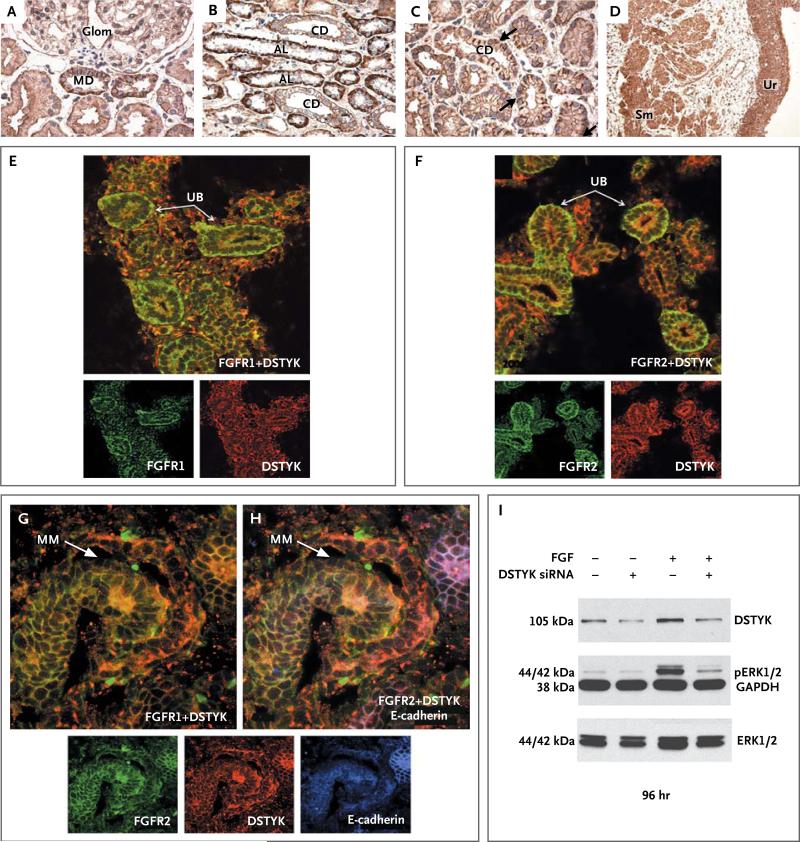
Linkage analysis identified five regions of the genome that were shared among all affected family members. Exome sequencing identified a single, rare, deleterious variant within these linkage intervals, a heterozygous splice-site mutation in the dual serine-threonine and tyrosine protein kinase gene (DSTYK). This variant, which resulted in aberrant splicing of messenger RNA, was present in all affected family members. Additional, independent DSTYK mutations, including nonsense and splice-site mutations, were detected in 7 of 311 unrelated patients. DSTYK is highly expressed in the maturing epithelia of all major organs, localizing to cell membranes. Knockdown in zebrafish resulted in developmental defects in multiple organs, which suggested loss of fibroblast growth factor (FGF) signaling. Consistent with this finding is the observation that DSTYK colocalizes with FGF receptors in the ureteric bud and metanephric mesenchyme. DSTYK knockdown in human embryonic kidney cells inhibited FGF-stimulated phosphorylation of extracellular-signal-regulated kinase (ERK), the principal signal downstream of receptor tyrosine kinases.
We detected independent DSTYK mutations in 2.3% of patients with congenital abnormalities of the kidney or urinary tract, a finding that suggests that DSTYK is a major determinant of human urinary tract development, downstream of FGF signaling. (Funded by the National Institutes of Health and others.).
肾脏和泌尿道先天异常是小儿肾衰竭的最常见原因。这些疾病具有高度异质性,病因尚未完全阐明。
我们对一个常染色体显性遗传型肾脏或泌尿道先天异常的家系(7 名受影响的家庭成员)进行了全基因组连锁分析和外显子组测序。我们还对 311 名无亲缘关系的患者进行了序列分析以及组织学和功能研究。
连锁分析确定了 5 个与所有受影响家庭成员共享的基因组区域。外显子组测序在这些连锁区间内发现了一个单一的罕见有害变异,即双重丝氨酸-苏氨酸和酪氨酸蛋白激酶基因(DSTYK)的杂合剪接位点突变。该变异导致信使 RNA 的剪接异常,存在于所有受影响的家庭成员中。在 311 名无亲缘关系的患者中,还检测到 7 名患者存在独立的 DSTYK 突变,包括无义突变和剪接位点突变。DSTYK 在所有主要器官的成熟上皮中高度表达,定位于细胞膜。在斑马鱼中敲低 DSTYK 会导致多个器官的发育缺陷,提示成纤维细胞生长因子(FGF)信号丢失。与这一发现一致的是,观察到 DSTYK 与输尿管芽和后肾间充质中的 FGF 受体共定位。在人胚肾细胞中敲低 DSTYK 会抑制 FGF 刺激的细胞外信号调节激酶(ERK)磷酸化,这是受体酪氨酸激酶下游的主要信号。
我们在 2.3%的肾脏或泌尿道先天异常患者中检测到独立的 DSTYK 突变,这表明 DSTYK 是 FGF 信号下游的人类泌尿道发育的主要决定因素。(由美国国立卫生研究院等资助)。