Medical Biodynamics Program, Division of Sleep Medicine, Brigham and Women's Hospital, Harvard Medical School, Boston, MA 02115, United States.
Sci Rep. 2013;3:2229. doi: 10.1038/srep02229.
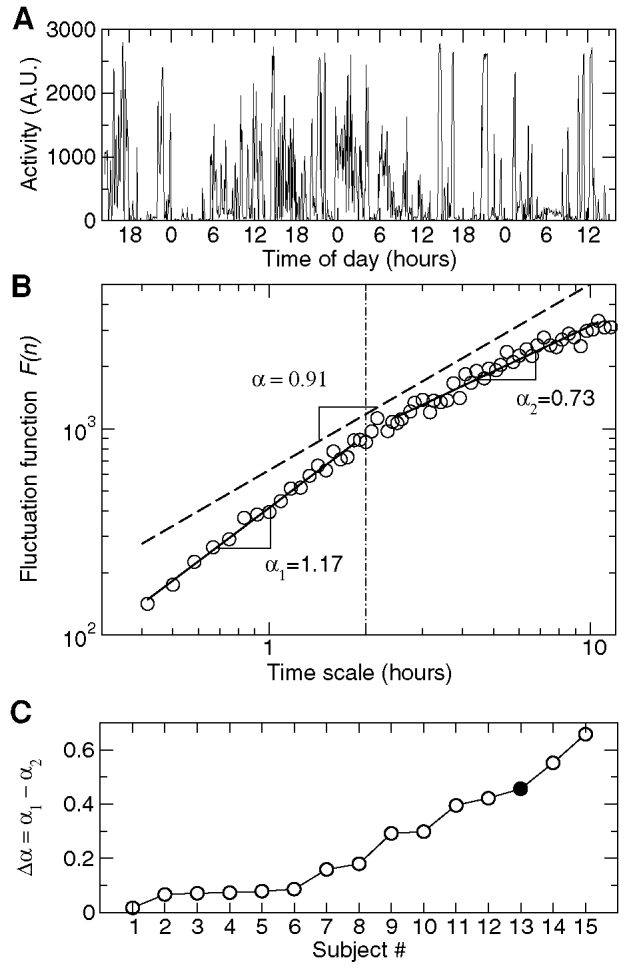
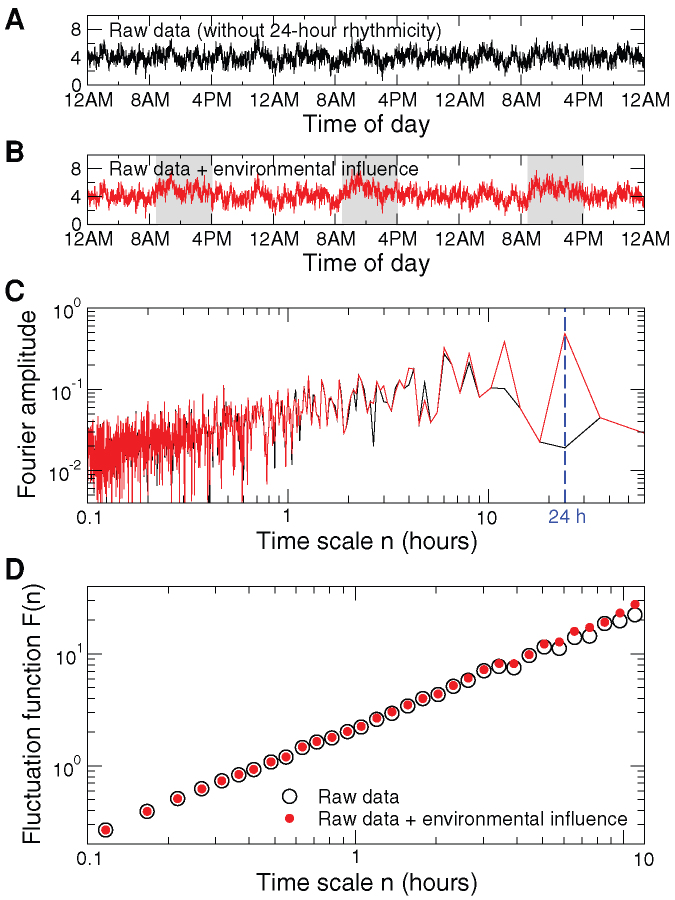
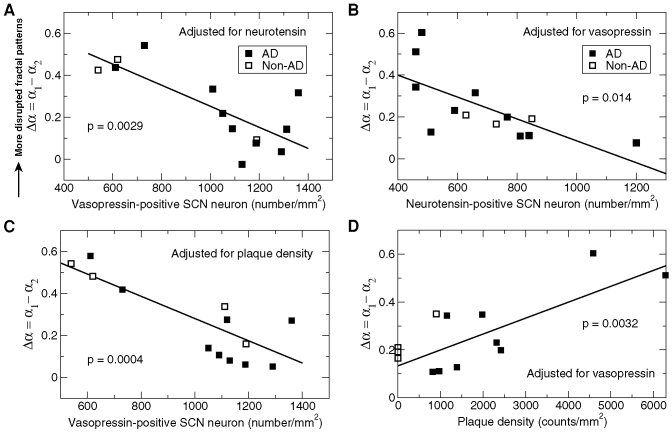
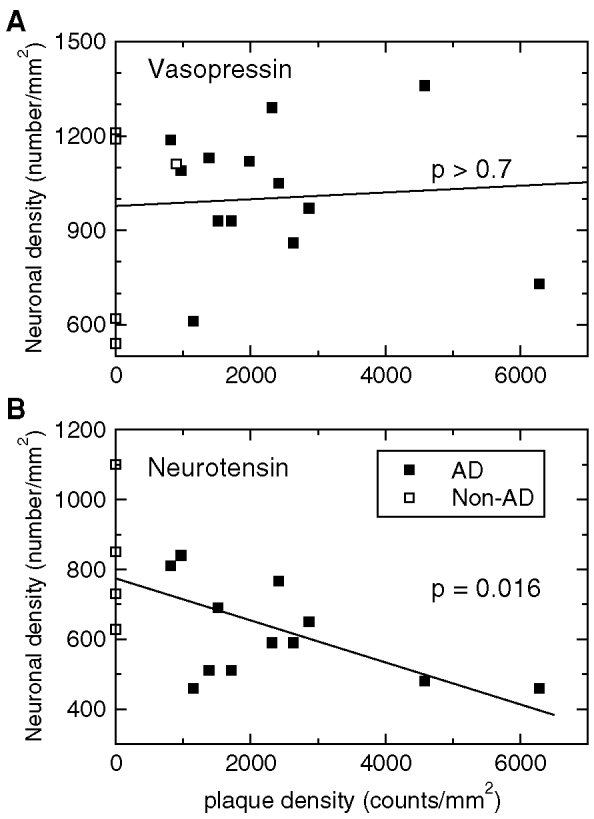
Human motor activity has a robust, intrinsic fractal structure with similar patterns from minutes to hours. The fractal activity patterns appear to be physiologically important because the patterns persist under different environmental conditions but are significantly altered/reduced with aging and Alzheimer's disease (AD). Here, we report that dementia patients, known to have disrupted circadian rhythmicity, also have disrupted fractal activity patterns and that the disruption is more pronounced in patients with more amyloid plaques (a marker of AD severity). Moreover, the degree of fractal activity disruption is strongly associated with vasopressinergic and neurotensinergic neurons (two major circadian neurotransmitters) in postmortem suprachiasmatic nucleus (SCN), and can better predict changes of the two neurotransmitters than traditional circadian measures. These findings suggest that the SCN impacts human activity regulation at multiple time scales and that disrupted fractal activity may serve as a non-invasive biomarker of SCN neurodegeneration in dementia.
人类的运动活动具有稳健的内在分形结构,其模式从分钟到小时都相似。分形活动模式似乎具有生理重要性,因为这些模式在不同的环境条件下仍然存在,但随着衰老和阿尔茨海默病(AD)的发生会显著改变/减少。在这里,我们报告说,已知存在昼夜节律紊乱的痴呆症患者也具有紊乱的分形活动模式,并且在具有更多淀粉样斑块(AD 严重程度的标志物)的患者中这种紊乱更为明显。此外,分形活动破坏的程度与尸检视交叉上核(SCN)中的加压素能和神经降压素能神经元(两种主要的昼夜节律神经递质)强烈相关,并且比传统的昼夜节律测量更能预测这两种神经递质的变化。这些发现表明,SCN 会在多个时间尺度上影响人体活动的调节,而分形活动的破坏可能是痴呆症中 SCN 神经退行性变的非侵入性生物标志物。