
一种用于生物网络可视化的多级伽马聚类布局算法。
A multilevel gamma-clustering layout algorithm for visualization of biological networks.
作者信息
Hruz Tomas, Wyss Markus, Lucas Christoph, Laule Oliver, von Rohr Peter, Zimmermann Philip, Bleuler Stefan
机构信息
Institute of Theoretical Computer Science, ETH Zurich, 8092 Zurich, Switzerland.
出版信息
Adv Bioinformatics. 2013;2013:920325. doi: 10.1155/2013/920325. Epub 2013 Jun 26.
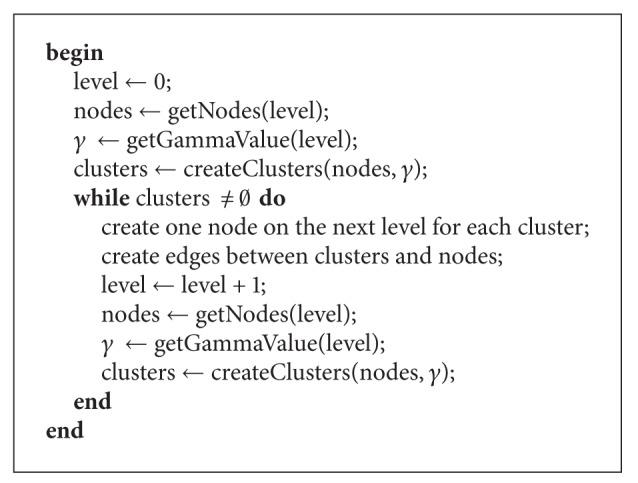
Visualization of large complex networks has become an indispensable part of systems biology, where organisms need to be considered as one complex system. The visualization of the corresponding network is challenging due to the size and density of edges. In many cases, the use of standard visualization algorithms can lead to high running times and poorly readable visualizations due to many edge crossings. We suggest an approach that analyzes the structure of the graph first and then generates a new graph which contains specific semantic symbols for regular substructures like dense clusters. We propose a multilevel gamma-clustering layout visualization algorithm (MLGA) which proceeds in three subsequent steps: (i) a multilevel γ -clustering is used to identify the structure of the underlying network, (ii) the network is transformed to a tree, and (iii) finally, the resulting tree which shows the network structure is drawn using a variation of a force-directed algorithm. The algorithm has a potential to visualize very large networks because it uses modern clustering heuristics which are optimized for large graphs. Moreover, most of the edges are removed from the visual representation which allows keeping the overview over complex graphs with dense subgraphs.
大型复杂网络的可视化已成为系统生物学中不可或缺的一部分,在系统生物学中,生物体需要被视为一个复杂系统。由于边的数量和密度,相应网络的可视化具有挑战性。在许多情况下,使用标准可视化算法会导致运行时间过长,并且由于许多边交叉,可视化效果难以阅读。我们提出一种方法,该方法首先分析图的结构,然后生成一个新图,该新图包含用于密集簇等规则子结构的特定语义符号。我们提出了一种多级伽马聚类布局可视化算法(MLGA),该算法分三个后续步骤进行:(i)使用多级γ聚类来识别基础网络的结构,(ii)将网络转换为一棵树,(iii)最后,使用力导向算法的一种变体绘制显示网络结构的结果树。该算法有潜力可视化非常大的网络,因为它使用了针对大型图进行优化的现代聚类启发式算法。此外,大部分边从视觉表示中移除,这使得能够保持对具有密集子图的复杂图的整体概览。


 Zotero 插件