Oyeyipo Ibukun P, Raji Yinusa, Bolarinwa Adeyombo F
Department of Physiology, College of Health Sciences, Osun State University, Osogbo, Osun State, Nigeria ; Laboratory for Reproductive Physiology and Developmental Programming, Department of Physiology, College of Medicine, University of Ibadan, Ibadan, Oyo State, Nigeria.
J Hum Reprod Sci. 2013 Jan;6(1):40-4. doi: 10.4103/0974-1208.112380.
The use of nicotine through smoking remains a serious health problem. It has been associated with reduced fertility, although the mechanism responsible is still unclear. The present study was designed to investigate whether nicotine-induced infertility is associated with altered male reproductive hormones in male albino rats.
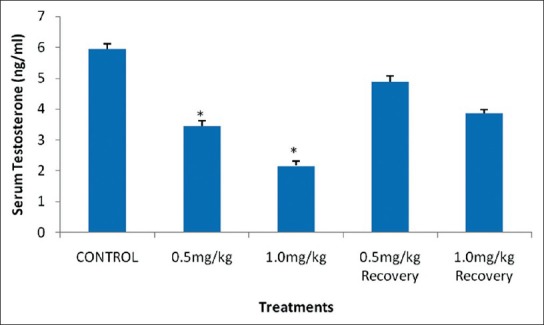
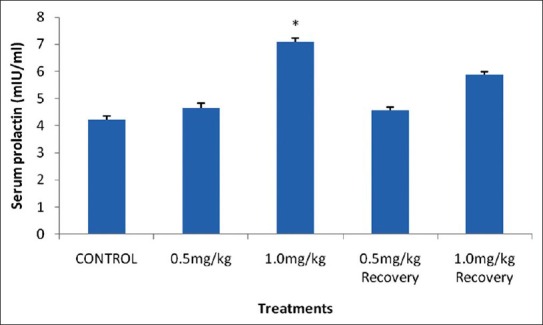
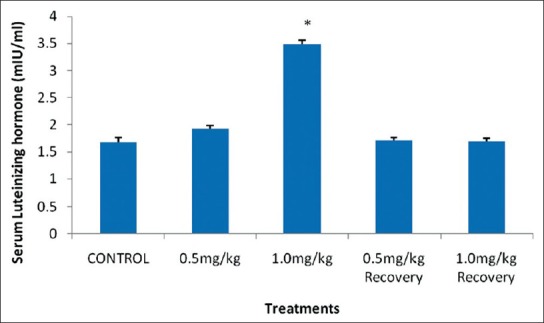
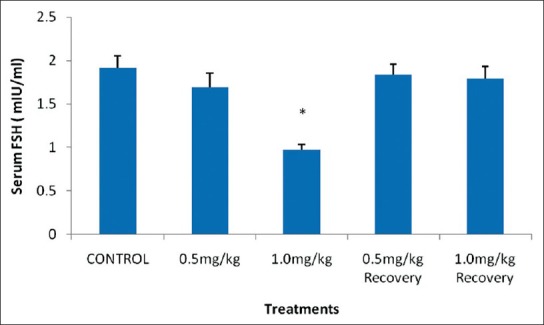
Forty male rats were divided equally into five groups and treated orally for thirty days. Group I, which served as the control received 0.2 ml/kg normal saline, Group II and III received 0.5 mg/kg (low dose) and 1.0 mg/kg (high dose) body weight of nicotine, respectively. The fourth and fifth groups were gavaged with 0.5 mg/kg and 1.0 mg/kg body weight of nicotine but were left untreated for another 30 days. These groups served as the recovery groups. Serum was analyzed for testosterone, luteinizing hormone (LH), follicle stimulating hormones (FSH), and prolactin using radioimmunoassay.
Results showed that nicotine administration significantly decreased (P < 0.05) testosterone in the low and high treated groups and FSH in the high dose treated group when compared with the control group. There was a significant increase (P < 0.05) in mean LH and prolactin level in the high dose treated group when compared with the control. However, the values of the recovery groups were comparable with the control.
The findings in this study suggest that nicotine administration is associated with distorted reproductive hormones in male rats although ameliorated by nicotine cessation. It is plausible that the decreased testosterone level is associated with testicular dysfunction rather than a pituitary disorder.
通过吸烟使用尼古丁仍然是一个严重的健康问题。它与生育力下降有关,尽管其作用机制尚不清楚。本研究旨在调查尼古丁诱导的不育是否与雄性白化大鼠雄性生殖激素的改变有关。
40只雄性大鼠平均分为五组,进行为期30天的口服治疗。第一组作为对照组,接受0.2 ml/kg生理盐水,第二组和第三组分别接受0.5 mg/kg(低剂量)和1.0 mg/kg(高剂量)体重的尼古丁。第四组和第五组分别灌胃0.5 mg/kg和1.0 mg/kg体重的尼古丁,但在另外30天内不进行处理。这些组作为恢复组。使用放射免疫分析法分析血清中的睾酮、促黄体生成素(LH)、促卵泡激素(FSH)和催乳素。
结果显示,与对照组相比,低剂量和高剂量处理组的尼古丁给药显著降低了睾酮水平(P < 0.05),高剂量处理组的FSH水平也显著降低。与对照组相比,高剂量处理组的平均LH和催乳素水平显著升高(P < 0.05)。然而,恢复组的值与对照组相当。
本研究结果表明,尼古丁给药与雄性大鼠生殖激素紊乱有关,尽管戒烟后有所改善。睾酮水平降低可能与睾丸功能障碍有关,而非垂体疾病。