Department of Clinical Studies, Shiraz University, Shiraz, Iran.
Poult Sci. 2013 Aug;92(8):1989-96. doi: 10.3382/ps.2012-02902.
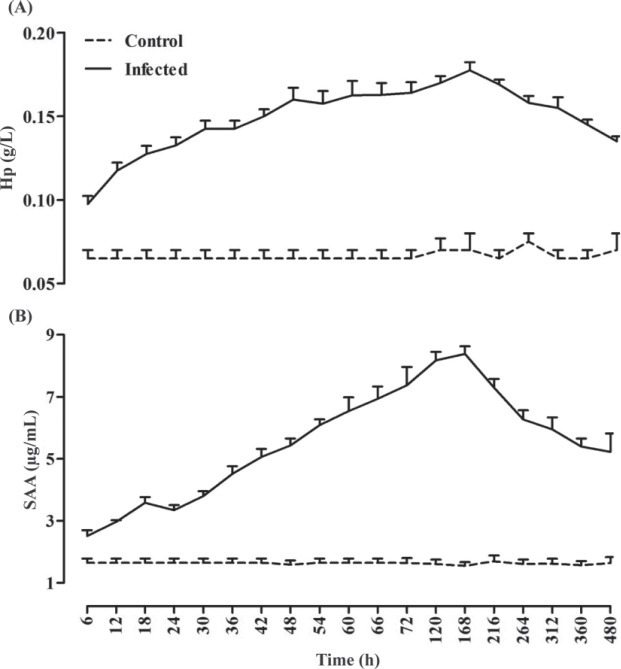
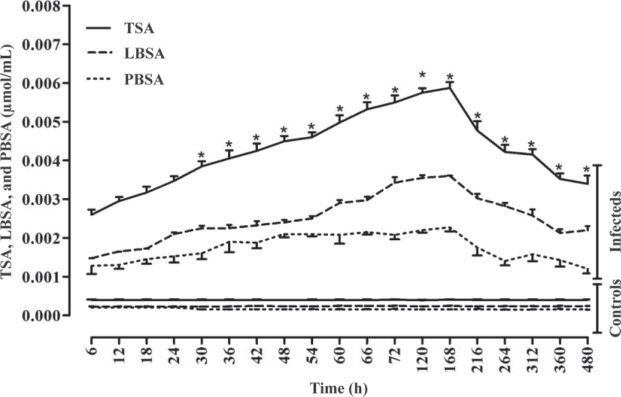
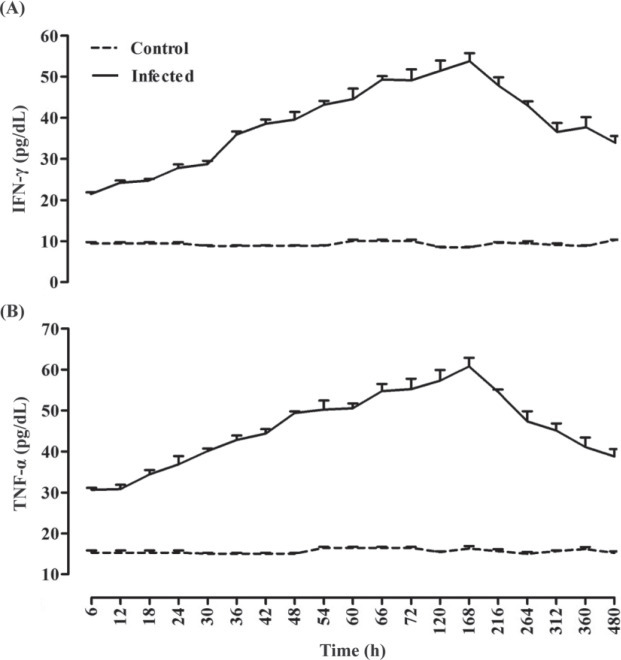
This study was performed to clarify the acute phase response following infectious bronchitis virus inoculation. Ninety clinically healthy 1-d-old Ross chicks were randomly assigned into 2 groups: control (n = 20) and infected group (n = 70). At the age of 20 d, all birds in the infected group were challenged intranasally with allantoic fluid containing 10(5) embryo lethal dose (ELD50)/0.1 mL of the infectious bronchitis virus. Blood samples were collected from 20 clinically healthy and 70 infected chicks at prior and 1, 2, 3, 5, 7, 11, 13, 15, and 20 d postinoculation. On d 1, 7, and 11 postinoculation 4 chickens from the experimental group and 2 chickens from the control group were randomly selected. Their trachea, lungs, and cecal tonsil were collected for virus detection and quantitation by real-time reverse-transcription PCR assay. In the serum the acute phase proteins (haptoglobin and serum amyloid A), pro-inflammatory cytokines (interferon-γ and tumor necrosis factor-α), and serum sialic acid (total, TSA; lipid-bound, LBSA; and protein-bound, PBSA) concentrations were measured using validated standard procedures. All variables were significantly higher in the infected birds after virus inoculation compared with the healthy group (P < 0.05). There were positive correlations between all variables in the infected group. Correlation coefficients were significantly positive between haptoglobin and interferon-γ, LBSA and TSA, and TSA and LBSA (P < 0.05). There were positive correlations among viral RNA and all studied variables; however, these correlations were not statistically significant (P > 0.05).
本研究旨在阐明传染性支气管炎病毒接种后的急性期反应。90 只临床健康的 1 日龄罗斯小鸡被随机分为 2 组:对照组(n = 20)和感染组(n = 70)。在 20 日龄时,感染组的所有鸟类均通过鼻腔内接种含有 10(5)胚胎致死剂量(ELD50)/0.1 毫升传染性支气管炎病毒的尿囊液进行挑战。在接种前和接种后 1、2、3、5、7、11、13、15 和 20 天,从 20 只临床健康和 70 只感染的小鸡中采集血液样本。在接种后第 1、7 和 11 天,从实验组中随机选择 4 只鸡和对照组中的 2 只鸡。通过实时逆转录 PCR 检测,收集其气管、肺和盲肠扁桃体进行病毒检测和定量。在血清中,使用经过验证的标准程序测量急性期蛋白(结合珠蛋白和血清淀粉样蛋白 A)、促炎细胞因子(干扰素-γ 和肿瘤坏死因子-α)和血清唾液酸(总唾液酸、LBSA;和蛋白结合唾液酸、PBSA)浓度。与健康组相比,感染组所有变量在病毒接种后均显著升高(P < 0.05)。感染组中所有变量之间均呈正相关。在感染组中,结合珠蛋白和干扰素-γ、LBSA 和 TSA 以及 TSA 和 LBSA 之间的相关系数呈显著正相关(P < 0.05)。病毒 RNA 与所有研究变量之间存在正相关;然而,这些相关性没有统计学意义(P > 0.05)。