Department of Pharmacology, University Medical Centre of the Johannes Gutenberg University, Mainz, Germany.
PLoS One. 2013 Jul 9;8(7):e67707. doi: 10.1371/journal.pone.0067707. Print 2013.
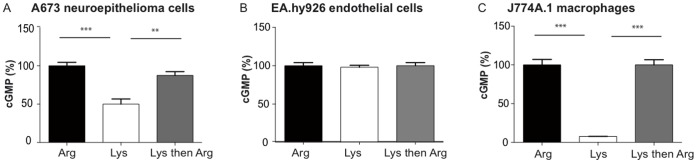
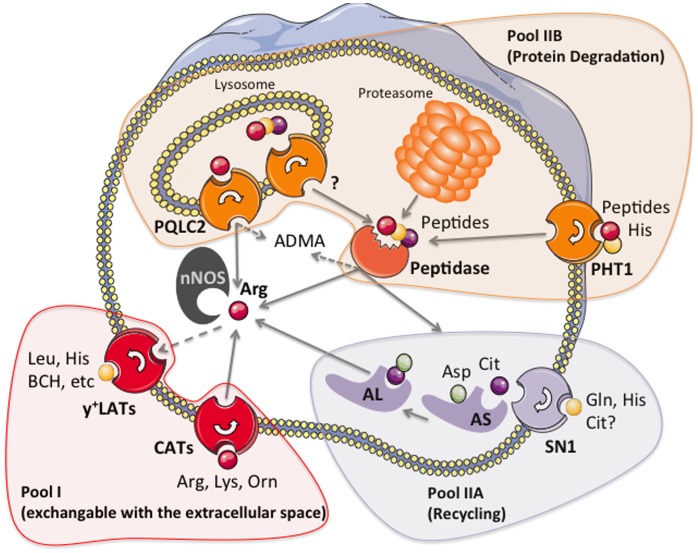
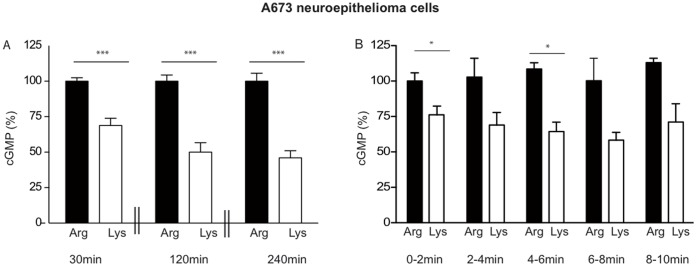
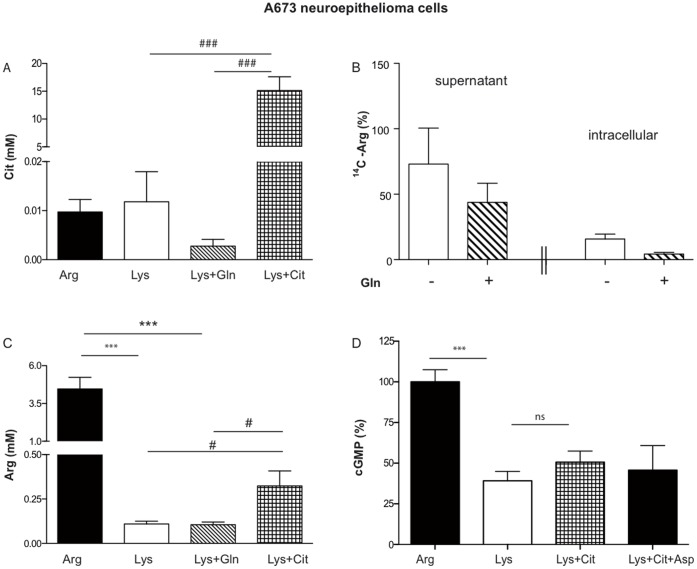
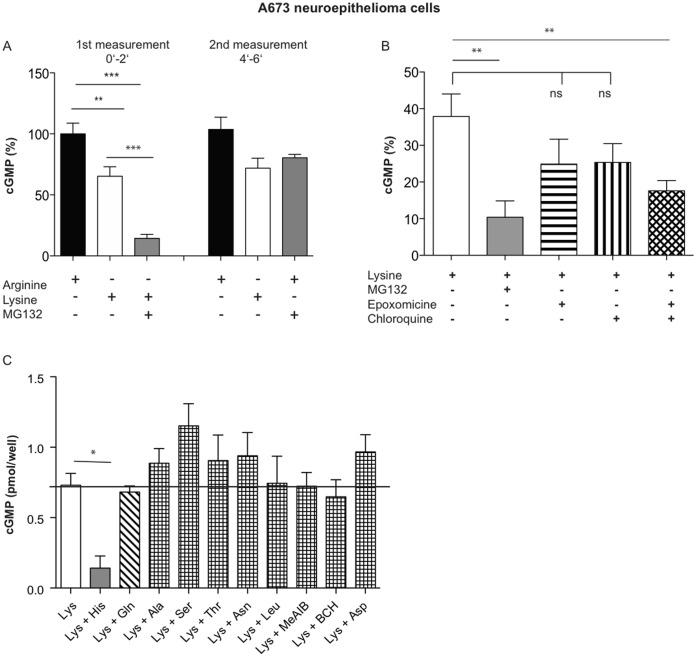
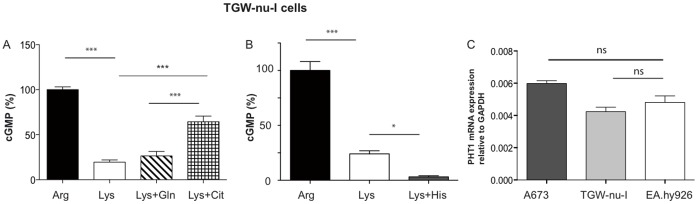
Nitric oxide, produced by the neuronal nitric oxide synthase (nNOS) from L-arginine is an important second messenger molecule in the central nervous system: It influences the synthesis and release of neurotransmitters and plays an important role in long-term potentiation, long-term depression and neuroendocrine secretion. However, under certain pathological conditions such as Alzheimer's or Parkinson's disease, stroke and multiple sclerosis, excessive NO production can lead to tissue damage. It is thus desirable to control NO production in these situations. So far, little is known about the substrate supply to human nNOS as a determinant of its activity. Measuring bioactive NO via cGMP formation in reporter cells, we demonstrate here that nNOS in both, human A673 neuroepithelioma and TGW-nu-I neuroblastoma cells can be fast and efficiently nourished by extracellular arginine that enters the cells via membrane transporters (pool I that is freely exchangeable with the extracellular space). When this pool was depleted, NO synthesis was partially sustained by intracellular arginine sources not freely exchangeable with the extracellular space (pool II). Protein breakdown made up by far the largest part of pool II in both cell types. In contrast, citrulline to arginine conversion maintained NO synthesis only in TGW-nu-I neuroblastoma, but not A673 neuroepithelioma cells. Histidine mimicked the effect of protease inhibitors causing an almost complete nNOS inhibition in cells incubated additionally in lysine that depletes the exchangeable arginine pool. Our results identify new ways to modulate nNOS activity by modifying its substrate supply.
一氧化氮由神经元型一氧化氮合酶(nNOS)从 L-精氨酸生成,是中枢神经系统中一种重要的第二信使分子:它影响神经递质的合成和释放,在长时程增强、长时程抑制和神经内分泌分泌中发挥重要作用。然而,在某些病理条件下,如阿尔茨海默病或帕金森病、中风和多发性硬化症,过量的 NO 生成可导致组织损伤。因此,在这些情况下控制 NO 生成是可取的。到目前为止,人们对人类 nNOS 的底物供应作为其活性的决定因素知之甚少。通过在报告细胞中形成 cGMP 来测量生物活性的 NO,我们在这里证明,人类 A673 神经上皮瘤和 TGW-nu-I 神经母细胞瘤中的 nNOS 都可以通过细胞膜转运蛋白(与细胞外空间可自由交换的池 I)快速有效地从细胞外精氨酸中得到滋养。当这个池耗尽时,NO 合成部分由与细胞外空间不可自由交换的细胞内精氨酸源(池 II)维持。在这两种细胞类型中,蛋白水解占池 II 的绝大部分。相比之下,瓜氨酸到精氨酸的转化仅在 TGW-nu-I 神经母细胞瘤中维持 NO 合成,但在 A673 神经上皮瘤细胞中则不然。组氨酸模拟了蛋白酶抑制剂的作用,导致在另外孵育赖氨酸的细胞中 nNOS 几乎完全抑制,赖氨酸耗尽了可交换的精氨酸池。我们的结果确定了通过修饰其底物供应来调节 nNOS 活性的新方法。