Institute for Psychoacoustics and Electronic Music, Department of Musicology, Ghent University, Ghent, Belgium.
PLoS One. 2013 Jul 10;8(7):e67932. doi: 10.1371/journal.pone.0067932. Print 2013.
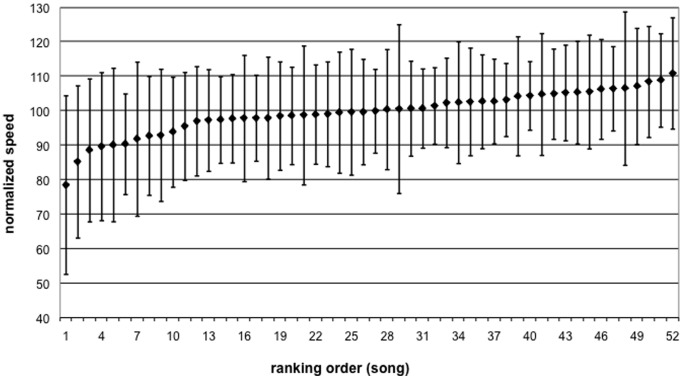
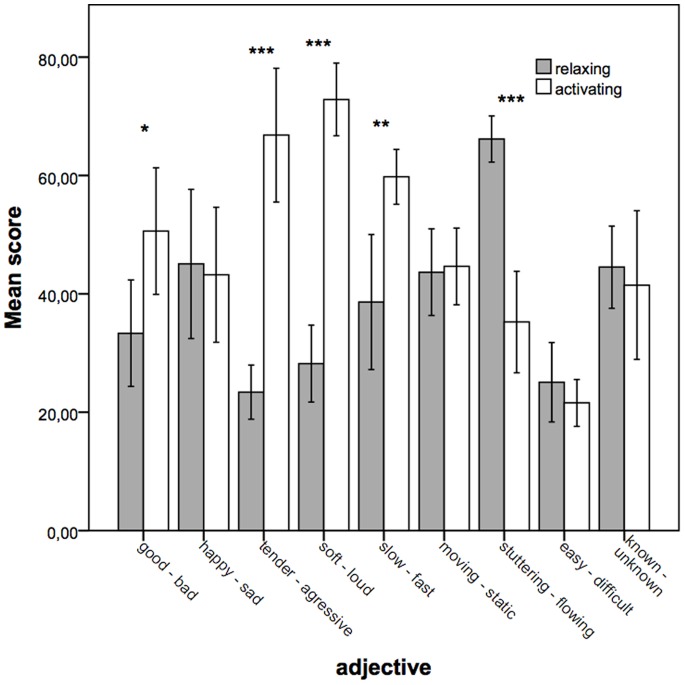
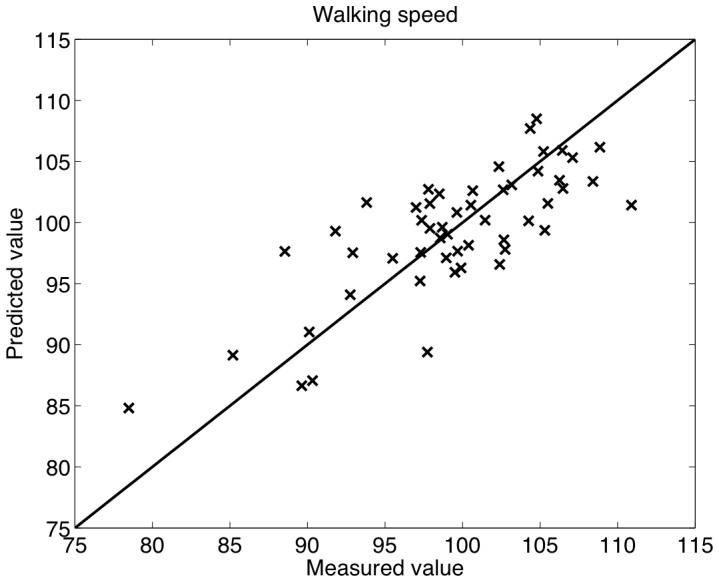
Inspired by a theory of embodied music cognition, we investigate whether music can entrain the speed of beat synchronized walking. If human walking is in synchrony with the beat and all musical stimuli have the same duration and the same tempo, then differences in walking speed can only be the result of music-induced differences in stride length, thus reflecting the vigor or physical strength of the movement. Participants walked in an open field in synchrony with the beat of 52 different musical stimuli all having a tempo of 130 beats per minute and a meter of 4 beats. The walking speed was measured as the walked distance during a time interval of 30 seconds. The results reveal that some music is 'activating' in the sense that it increases the speed, and some music is 'relaxing' in the sense that it decreases the speed, compared to the spontaneous walked speed in response to metronome stimuli. Participants are consistent in their observation of qualitative differences between the relaxing and activating musical stimuli. Using regression analysis, it was possible to set up a predictive model using only four sonic features that explain 60% of the variance. The sonic features capture variation in loudness and pitch patterns at periods of three, four and six beats, suggesting that expressive patterns in music are responsible for the effect. The mechanism may be attributed to an attentional shift, a subliminal audio-motor entrainment mechanism, or an arousal effect, but further study is needed to figure this out. Overall, the study supports the hypothesis that recurrent patterns of fluctuation affecting the binary meter strength of the music may entrain the vigor of the movement. The study opens up new perspectives for understanding the relationship between entrainment and expressiveness, with the possibility to develop applications that can be used in domains such as sports and physical rehabilitation.
受具身音乐认知理论的启发,我们研究音乐是否能使节拍同步行走的速度同步。如果人类的行走与节拍同步,并且所有音乐刺激都具有相同的持续时间和相同的节奏,那么行走速度的差异只能是音乐引起的步长差异的结果,从而反映出运动的活力或体力。参与者在一个开阔的场地上,与节奏为 52 种不同音乐刺激的节奏同步,这些音乐刺激的节奏均为每分钟 130 拍,每米 4 拍。行走速度是通过 30 秒时间间隔内行走的距离来测量的。结果表明,与节拍器刺激引起的自发行走速度相比,一些音乐具有“激活”的作用,即增加了速度,而一些音乐具有“放松”的作用,即降低了速度。参与者在观察放松和激活音乐刺激之间的定性差异时是一致的。使用回归分析,仅使用四个可以解释 60%方差的声音特征就可以建立一个预测模型。这些声音特征捕捉了三拍、四拍和六拍周期内的响度和音高模式的变化,表明音乐中的表达模式是产生这种效果的原因。其机制可能归因于注意力转移、潜意识音频-运动同步机制或唤醒效应,但需要进一步研究才能确定。总的来说,该研究支持了这样一种假设,即影响音乐二进制节奏强度的波动模式可能会使运动的活力同步。该研究为理解同步和表现力之间的关系开辟了新的视角,有可能开发出可用于体育和物理康复等领域的应用程序。