Department of Medicine, Division of Hematology, The Ottawa Hospital, Ottawa, Ontario, Canada.
PLoS One. 2013 Jul 16;8(7):e68820. doi: 10.1371/journal.pone.0068820. Print 2013.
The duration of storage of transfused red blood cells (RBC) has been associated with poor clinical outcomes in some studies. We sought to establish whether prolonged storage of transfused RBC in cancer patients influences overall survival (OS) or cancer recurrence.
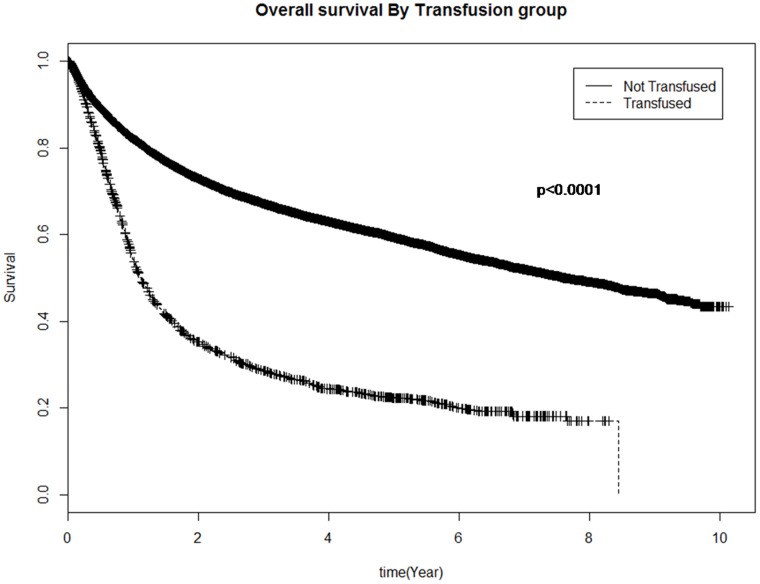
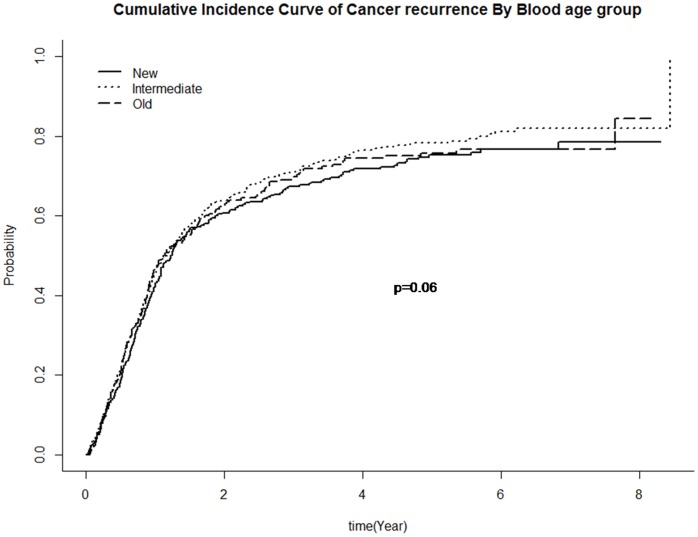
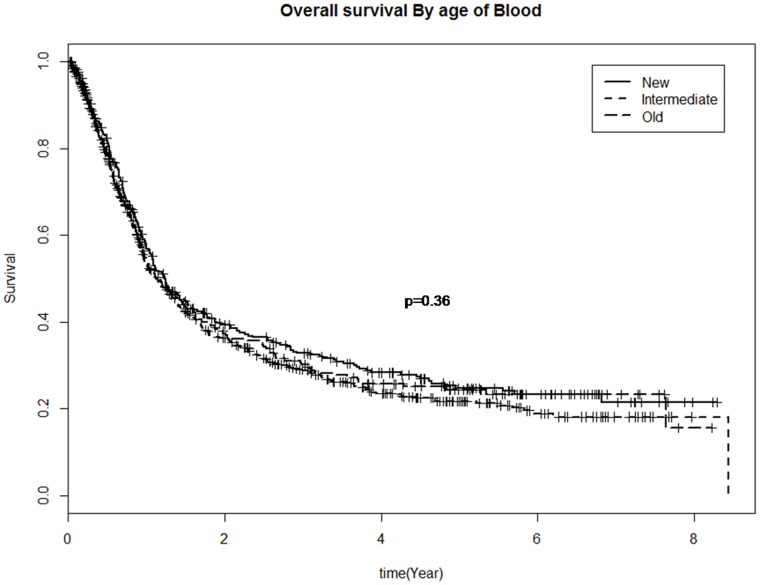
Patients diagnosed with cancer at The Ottawa Regional Cancer Centre between January 01, 2000 and December 31, 2005 were included (n = 27,591) where 1,929 (7.0%) received RBC transfusions within one year from diagnosis. Transfused RBC units were categorized as "new" if stored for less than 14 days, "intermediate" if stored between 14 and 28 days and "old" if stored for more than 28 days. Baseline characteristics between the comparative groups were compared by ANOVA test. Categorical variables and continuous variables were compared using Chi-squared and Wilcoxan rank-sum tests respectively. Overall survival was not associated with duration of storage of transfused RBC with a median survival of 1.2, 1.7, 1.1 years for only new, intermediate and old RBC units respectively (p = 0.36). Cancer recurrence was significantly higher in patients who received a RBC transfusion than those who did not (56.3% vs 33.0% respectively; p<0.0001) but was not affected by the duration of storage of transfused RBC (p = 0.06). In multivariate analysis, lung cancer, advanced stage, chemotherapy, radiation, cancer-related surgery and cancer recurrence were associated with inferior OS (p<0.05), while age, advanced stage, lung cancer, and more than 6 units of blood transfused were associated with cancer recurrence (p<0.05). The duration of storage of RBC before transfusion was not associated with OS or cancer recurrence in multivariate analysis.
In patients diagnosed with cancer, the duration of storage of transfused RBC had no impact on OS or cancer recurrence. This suggests that our current RBC storage policy of providing RBC of variable duration of storage for patients with malignancy is safe.
一些研究表明,输注的红细胞(RBC)的储存时间与临床结局不良有关。我们旨在确定癌症患者输注的 RBC 储存时间延长是否会影响总生存(OS)或癌症复发。
纳入 2000 年 1 月 1 日至 2005 年 12 月 31 日期间在渥太华地区癌症中心诊断为癌症的患者(n = 27591),其中 1929 例(7.0%)在诊断后一年内接受 RBC 输血。如果储存期少于 14 天,则将输注的 RBC 单位归类为“新”;如果储存期在 14 至 28 天之间,则归类为“中”;如果储存期超过 28 天,则归类为“旧”。通过方差分析比较比较组之间的基线特征。使用卡方检验比较分类变量,使用 Wilcoxan 秩和检验比较连续变量。与仅新 RBC 单位、中间 RBC 单位和旧 RBC 单位的中位生存期分别为 1.2、1.7 和 1.1 年相比,输注 RBC 的储存时间与总生存无相关性(p = 0.36)。与未接受 RBC 输血的患者相比,接受 RBC 输血的患者癌症复发率显著更高(分别为 56.3%和 33.0%;p<0.0001),但不受输注 RBC 储存时间的影响(p = 0.06)。在多变量分析中,肺癌、晚期、化疗、放疗、癌症相关手术和癌症复发与较差的 OS 相关(p<0.05),而年龄、晚期、肺癌和输注超过 6 单位的血液与癌症复发相关(p<0.05)。多变量分析中,输血前 RBC 的储存时间与 OS 或癌症复发无关。
在诊断为癌症的患者中,输注的 RBC 的储存时间对 OS 或癌症复发没有影响。这表明,我们目前为恶性肿瘤患者提供不同储存时间的 RBC 的储存政策是安全的。