Department of Kinesiology and Physical Education, McGill University, Montreal, Quebec, Canada.
PLoS One. 2013 Jul 16;8(7):e68866. doi: 10.1371/journal.pone.0068866. Print 2013.
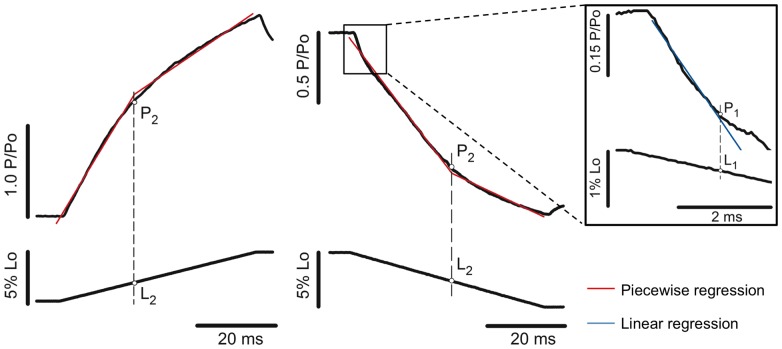
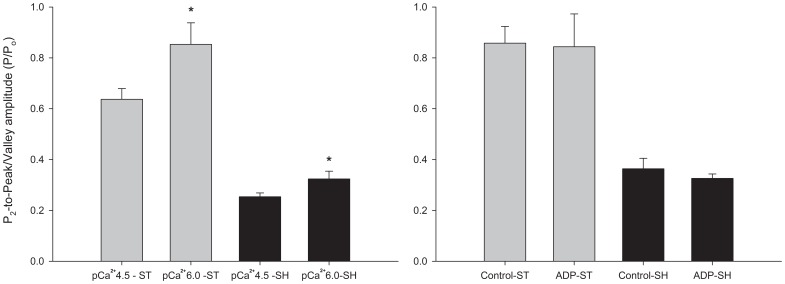
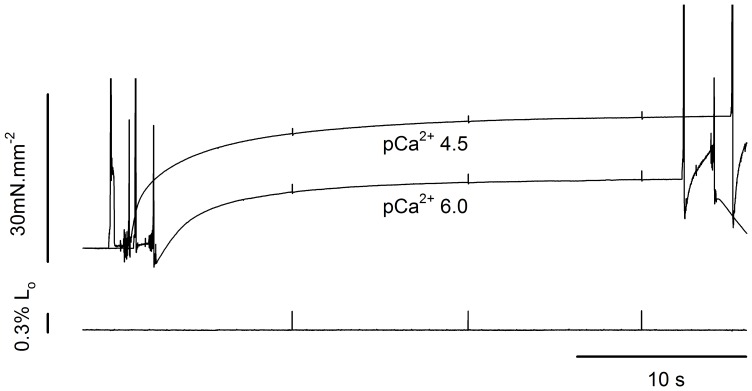
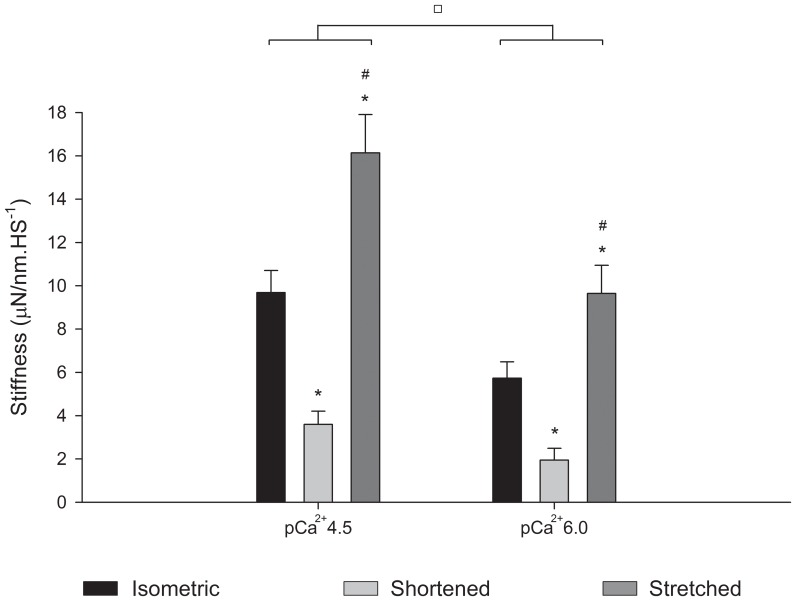
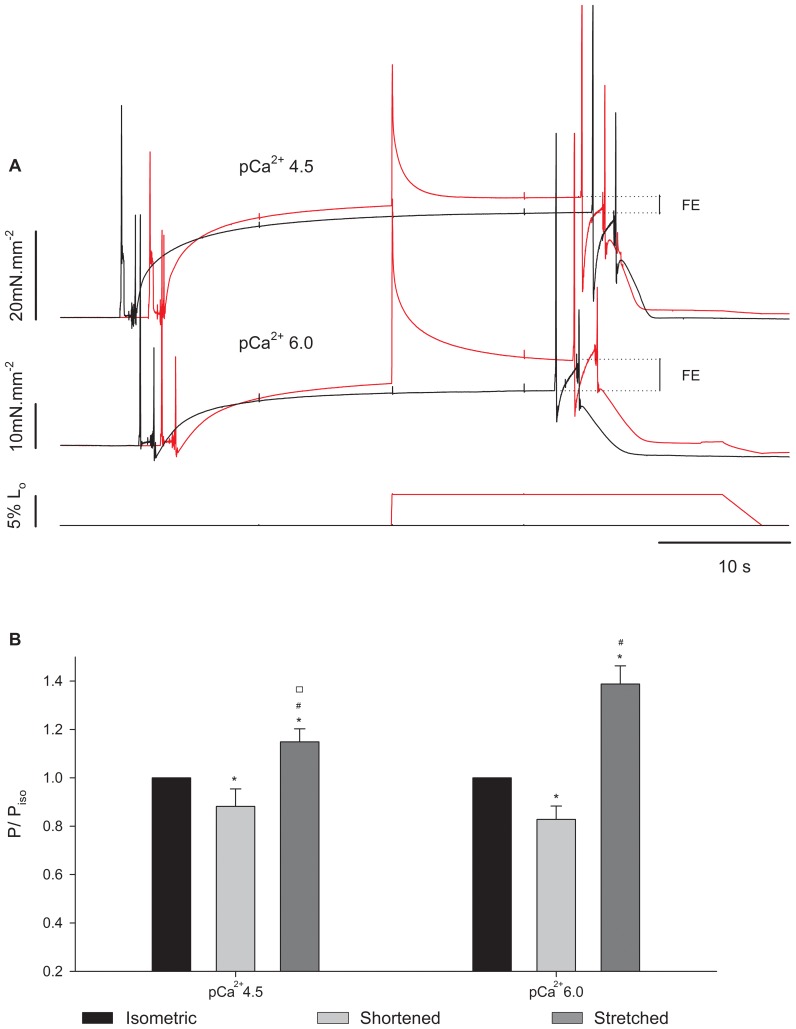
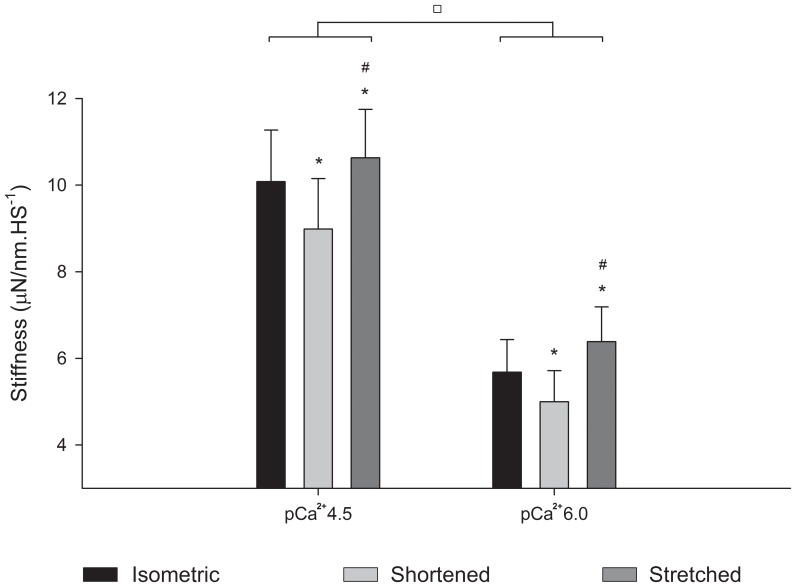
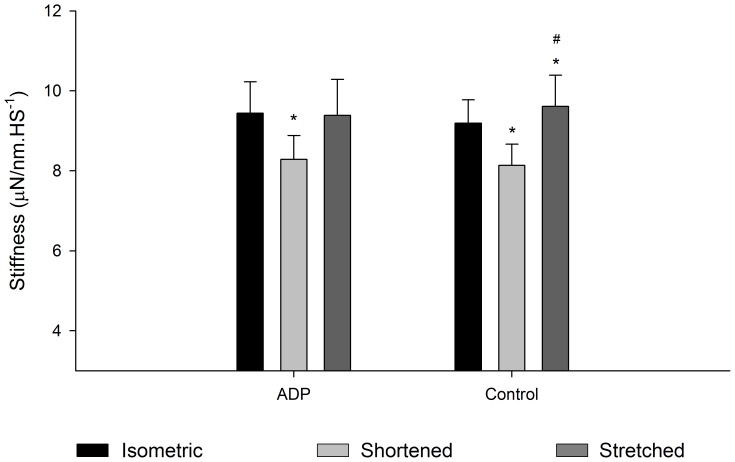
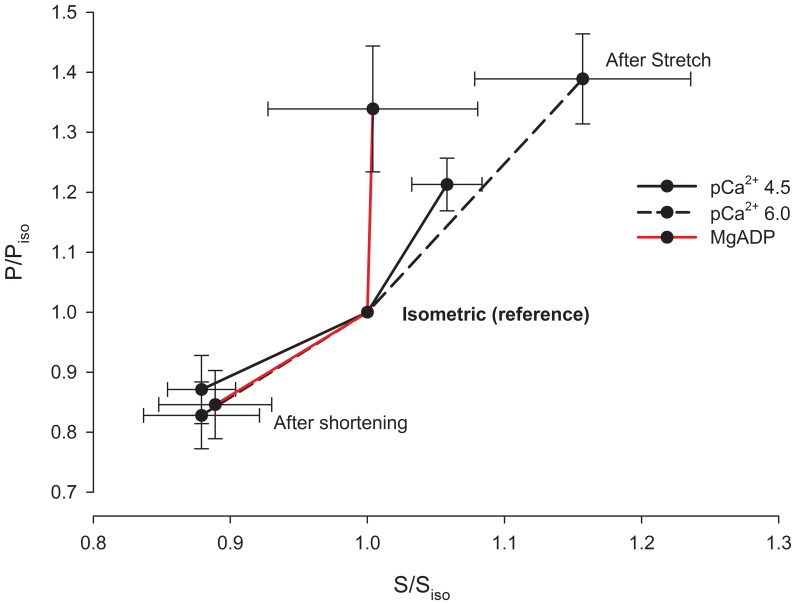
The goal of this study was to compare the effects of Ca(2+) and MgADP activation on force development in skeletal muscles during and after imposed length changes. Single fibres dissected from the rabbit psoas were (i) activated in pCa(2+)4.5 and pCa(2+)6.0, or (ii) activated in pCa(2+)4.5 before and after administration of 10 mM MgADP. Fibres were activated in sarcomere lengths (SL) of 2.65 µm and 2.95 µm, and subsequently stretched or shortened (5%SL at 1.0 SL.s(-1)) to reach a final SL of 2.80 µm. The kinetics of force during stretch were not altered by pCa(2+) or MgADP, but the fast change in the slope of force development (P1) observed during shortening and the corresponding SL extension required to reach the change (L1) were higher in pCa(2+)6.0 (P1 = 0.22 ± 0.02 Po; L1 = 5.26 ± 0.24 nm.HS(.1)) than in pCa(2+)4.5 (P1 = 0.15 ± 0.01 Po; L1 = 4.48 ± 0.25 nm.HS(.1)). L1 was also increased by MgADP activation during shortening. Force enhancement after stretch was lower in pCa(2+)4.5 (14.9 ± 5.4%) than in pCa(2+)6.0 (38.8 ± 7.5%), while force depression after shortening was similar in both Ca(2+) concentrations. The stiffness accompanied the force behavior after length changes in all situations. MgADP did not affect the force behavior after length changes, and stiffness did not accompany the changes in force development after stretch. Altogether, these results suggest that the mechanisms of force generation during and after stretch are different from those obtained during and after shortening.
本研究旨在比较 Ca(2+)和 MgADP 激活对骨骼肌肉在长度变化过程中和之后的力发展的影响。从兔子腰大肌中分离出的单纤维 (i) 在 pCa(2+)4.5 和 pCa(2+)6.0 中被激活,或 (ii) 在 pCa(2+)4.5 中被激活,然后施用 10 mM MgADP。纤维在 2.65 µm 和 2.95 µm 的肌节长度 (SL) 下被激活,随后被拉伸或缩短 (以 1.0 SL.s(-1) 的速度缩短 5%SL) 以达到最终的 SL 为 2.80 µm。在拉伸过程中,力的动力学不受 pCa(2+)或 MgADP 的影响,但在缩短过程中观察到的力发展斜率的快速变化 (P1) 和达到该变化所需的相应 SL 延伸 (L1) 在 pCa(2+)6.0 中更高 (P1 = 0.22 ± 0.02 Po;L1 = 5.26 ± 0.24 nm.HS(.1)) 而不是在 pCa(2+)4.5 中 (P1 = 0.15 ± 0.01 Po;L1 = 4.48 ± 0.25 nm.HS(.1))。MgADP 激活也增加了缩短过程中的 L1。在 pCa(2+)4.5 中,拉伸后的力增强较低 (14.9 ± 5.4%) 而在 pCa(2+)6.0 中较高 (38.8 ± 7.5%),而缩短后的力衰减在两种 Ca(2+)浓度下相似。在所有情况下,刚度都伴随着长度变化后的力行为。MgADP 不影响长度变化后的力行为,刚度也不伴随拉伸后的力发展变化。总之,这些结果表明,在长度变化过程中和之后的力产生机制与在长度变化过程中和之后的力产生机制不同。