Department of Human Health and Nutritional Sciences, College of Biological Sciences, University of Guelph, Guelph, Ontario, Canada.
Physiol Rep. 2021 Jan;9(2):e14725. doi: 10.14814/phy2.14725.
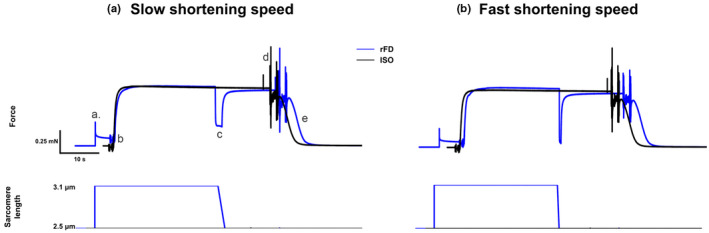
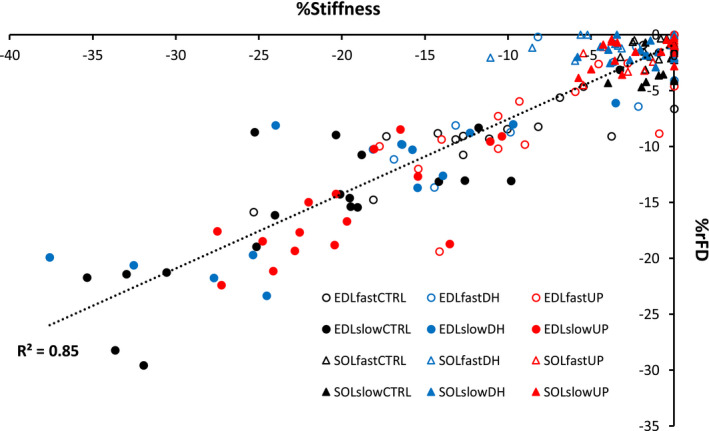
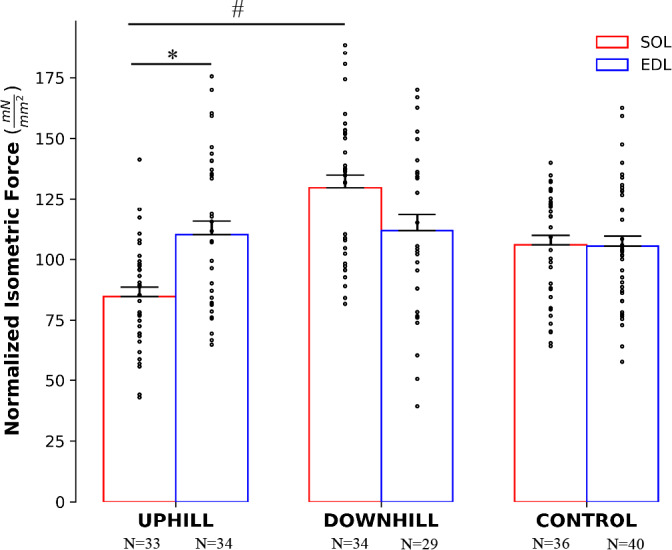
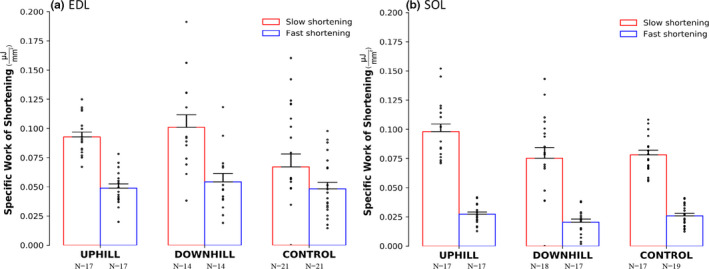
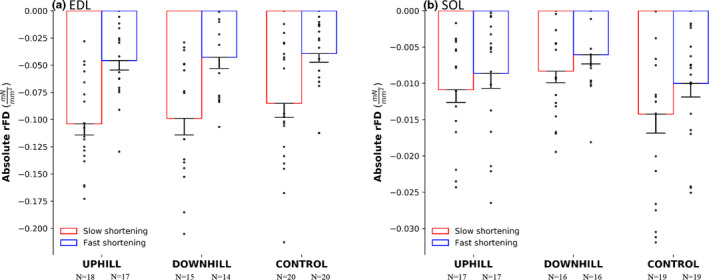
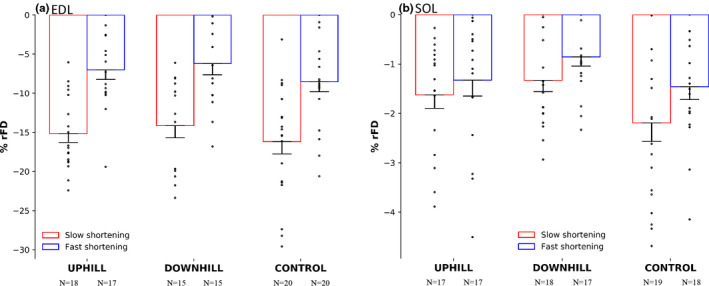
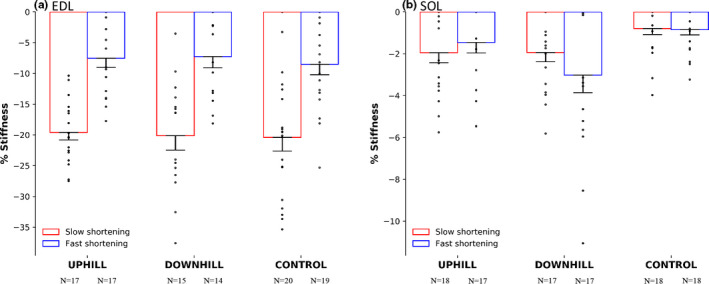
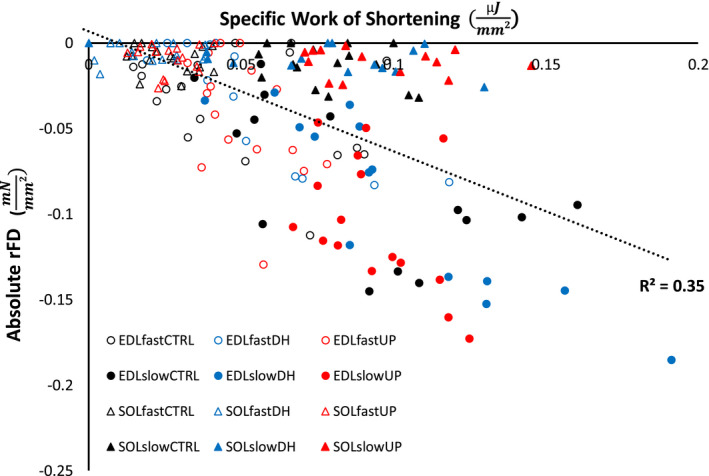
Following active muscle shortening, steady-state isometric force is less than a purely isometric contraction at the same muscle length and level of activation; this is known as residual force depression (rFD). It is unknown whether rFD at the single muscle fiber level can be modified via training. Here we investigated whether rFD in single muscle fibers is modifiable through downhill and uphill running in the extensor digitorum longus (EDL) and soleus (SOL) muscles in rats. Rats were run uphill or downhill 5 days/week for 4 weeks. After muscles were dissected and chemically permeabilized, single fibers were tied between a length controller and force transducer, transferred to an activating solution, with ATP and pCa of 4.2 for mechanical testing. rFD was quantified after active fiber shortening from an average sarcomere length (SL) of 3.1-2.5 µm at a relative speed of 0.15 fiber lengths/s (slow) and 0.6 fiber lengths/s (fast). rFD was calculated as the difference in force (normalized to cross-sectional area) during the isometric steady-state phase following active shortening and the purely isometric contraction. In addition to rFD, mechanical work of shortening and stiffness depression were also calculated. rFD was present for both the EDL (6-15%) and SOL (1-2%) muscles, with no effect of training. rFD was greater for the EDL than SOL which closely corresponded to the greater stiffness depression in the EDL, indicating a greater inhibition of cross-bridge attachments. These results indicate that while rFD was observed, training did not appear to alter this intrinsic history-dependent property of single muscle fibers.
在主动肌肉缩短后,等长稳态力小于在相同肌肉长度和激活水平下的纯等长收缩;这被称为剩余力抑制(rFD)。目前尚不清楚在单肌纤维水平上 rFD 是否可以通过训练来改变。在这里,我们研究了通过在大鼠伸趾长肌(EDL)和比目鱼肌(SOL)中进行下坡和上坡跑步,是否可以改变单肌纤维中的 rFD。大鼠每周跑 5 天,每天跑上坡或下坡 4 周。在肌肉被解剖和化学渗透后,将单根纤维系在长度控制器和力传感器之间,转移到激活溶液中,ATP 和 pCa 为 4.2,用于进行机械测试。rFD 在主动纤维缩短后进行量化,从平均肌节长度(SL)为 3.1-2.5μm 的平均肌节长度(SL)以 0.15 纤维长度/s(慢)和 0.6 纤维长度/s(快)的相对速度进行。rFD 定义为主动缩短后的等速稳态阶段和纯等长收缩期间力(归一化为横截面积)的差异。除 rFD 外,还计算了缩短的机械功和刚度抑制。EDL(6-15%)和 SOL(1-2%)肌肉均存在 rFD,且训练无影响。EDL 的 rFD 大于 SOL,这与 EDL 中较大的刚度抑制密切相关,表明横桥附着的抑制更大。这些结果表明,虽然观察到 rFD,但训练似乎并没有改变单肌纤维的这种内在的、依赖于历史的特性。