Kyoto University Graduate School of Medicine, Department of Orthopaedic Surgery, Sakyo, Kyoto, Japan.
PLoS One. 2013 Jul 18;8(7):e69118. doi: 10.1371/journal.pone.0069118. Print 2013.
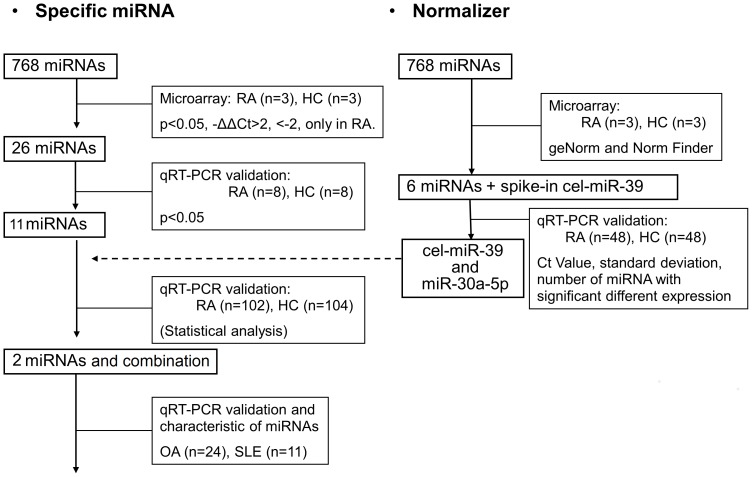
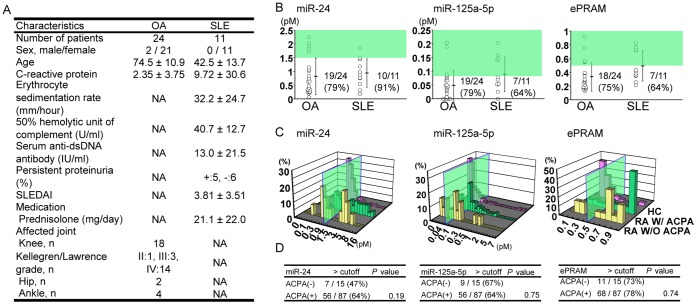
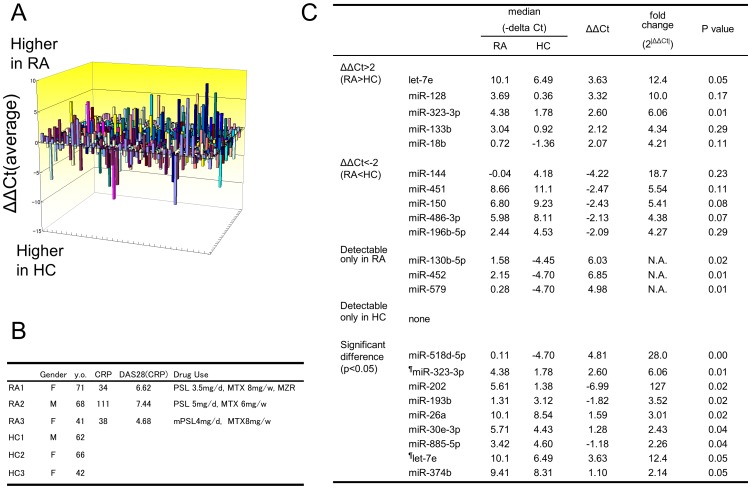
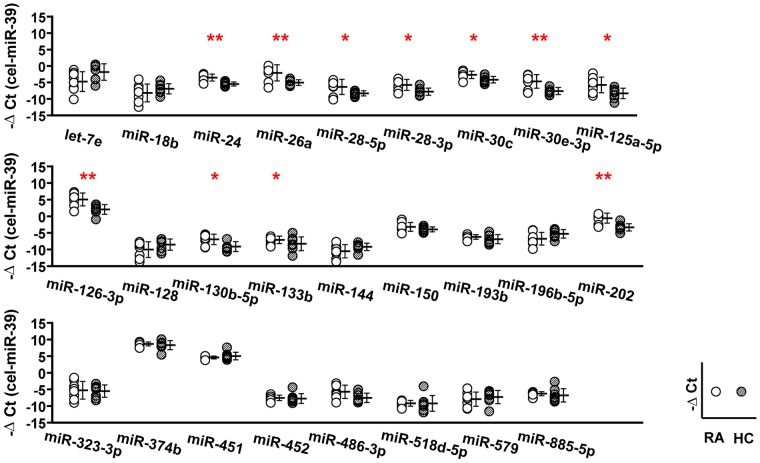
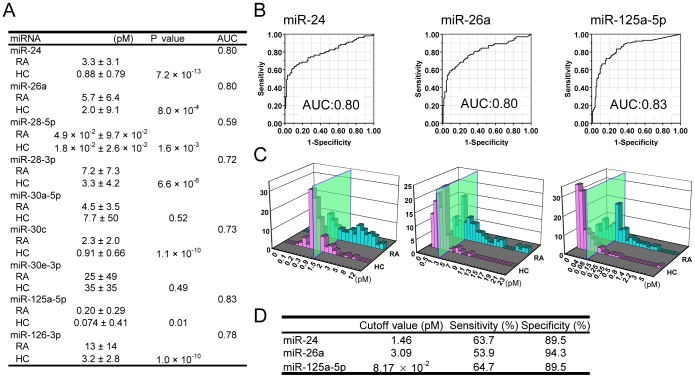
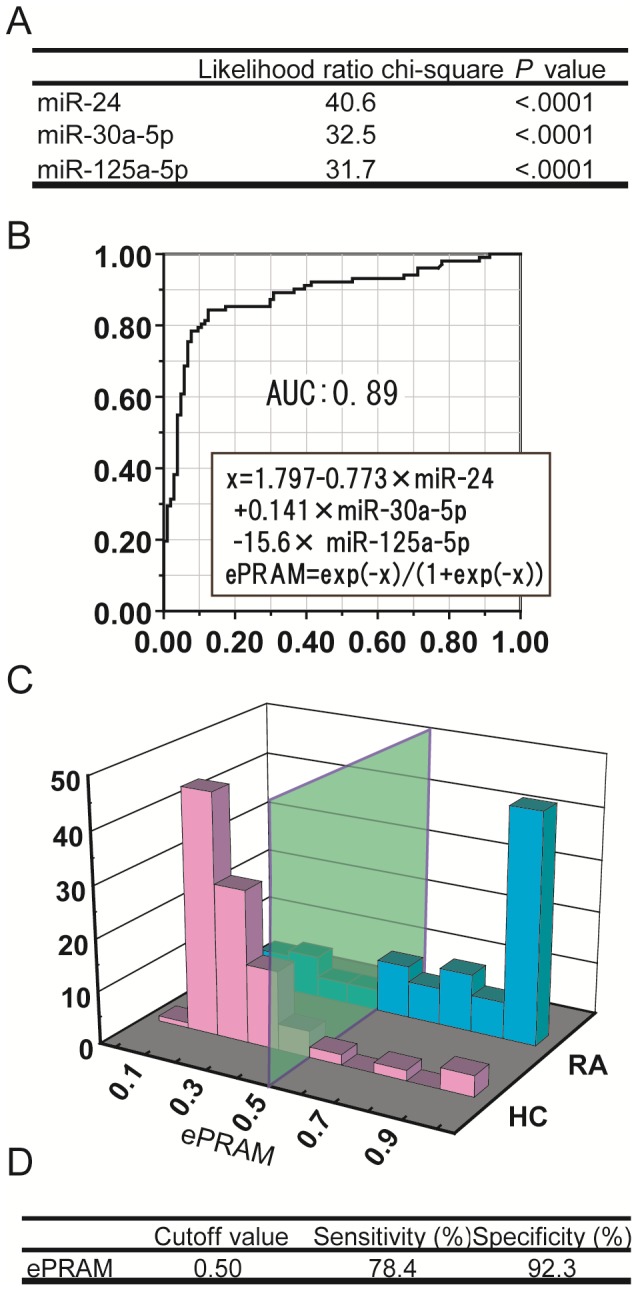
MicroRNAs (miRNAs) are present in human plasma and known as a non-invasive biomarker for cancer detection. Our study was designed to identify plasma miRNAs specific for rheumatoid arthritis (RA) by a comprehensive array approach. We performed a systematic, array-based miRNA analysis on plasma samples from three RA patients and three healthy controls (HCs). Plasma miRNAs with more than four times change or with significant (P<0.05) change in expression, or detectable only in RA plasma, were confirmed with plasma from eight RA patients and eight HCs using real-time quantitative PCR. Consistently detectable miRNAs that were significantly different between RA patients and HCs were chosen for further validation with 102 RA patients and 104 HCs. The area under curves (AUC) were calculated after plotting the receiver operating characteristic (ROC) curves. To determine if these miRNAs are specific for RA, the concentrations of these miRNAs were analyzed in 24 patients with osteoarthritis (OA), and 11 patients with systemic lupus erythematosus (SLE). The array analysis and the subsequent confirmation in larger patient cohort identified significant alterations in plasma levels of seven miRNAs. The highest AUC was found for miR-125a-5p, followed in order by miR-24 and miR-26a. Multivariable logistic regression analysis showed that miR-24, miR-30a-5p, and miR-125a-5p were crucial factors for making detection model of RA and provided a formula for Estimated Probability of RA by plasma MiRNA (ePRAM), employing miR-24, miR-30a-5p and miR-125a-5p, which showed increased diagnostic accuracy (AUC: 0.89). The level of miR-24, miR-125a-5p, and ePRAM in OA and SLE patients were lower than that in RA. There was no significant difference in detection for anti-citrullinated protein antibody (ACPA)-positive and ACPA-negative RA patients. These results suggest that the plasma concentrations of miR-24 and miR-125a-5p, and ePRAM are potential diagnostic markers of RA even if patients were ACPA-negative.
microRNAs (miRNAs) 存在于人类血浆中,被认为是癌症检测的一种非侵入性生物标志物。我们的研究旨在通过全面的阵列方法鉴定出类风湿关节炎 (RA) 特异性的血浆 miRNAs。我们对来自 3 名 RA 患者和 3 名健康对照者 (HCs) 的血浆样本进行了系统的、基于阵列的 miRNA 分析。使用实时定量 PCR 对 8 名 RA 患者和 8 名 HCs 的血浆样本进行了确认,结果显示表达水平变化超过 4 倍或具有显著变化 (P<0.05) 或仅在 RA 血浆中检测到的血浆 miRNAs。选择在 RA 患者和 HCs 之间具有显著差异的一致可检测 miRNAs 进行进一步验证,共对 102 名 RA 患者和 104 名 HCs 进行了验证。绘制接收者操作特征 (ROC) 曲线后计算曲线下面积 (AUC)。为了确定这些 miRNAs 是否特异于 RA,我们分析了 24 名骨关节炎 (OA) 患者和 11 名系统性红斑狼疮 (SLE) 患者的这些 miRNA 的浓度。通过对较大患者队列进行的阵列分析和随后的确认,发现七种 miRNAs 的血浆水平发生了显著改变。miR-125a-5p 的 AUC 最高,其次是 miR-24 和 miR-26a。多变量逻辑回归分析显示,miR-24、miR-30a-5p 和 miR-125a-5p 是 RA 检测模型的关键因素,并提供了一种基于血浆 miRNA 的 RA 估计概率 (ePRAM) 的公式,使用 miR-24、miR-30a-5p 和 miR-125a-5p,显示出更高的诊断准确性 (AUC:0.89)。OA 和 SLE 患者的 miR-24、miR-125a-5p 和 ePRAM 水平低于 RA 患者。ACPA 阳性和 ACPA 阴性 RA 患者的检测结果无显著差异。这些结果表明,即使患者为 ACPA 阴性,miR-24 和 miR-125a-5p 的血浆浓度和 ePRAM 是 RA 的潜在诊断标志物。