Centers for Disease Control and Prevention, Atlanta, Georgia 30333, USA.
Emerg Infect Dis. 2013 Aug;19(8):1239-44. doi: 10.3201/eid1908.121511.
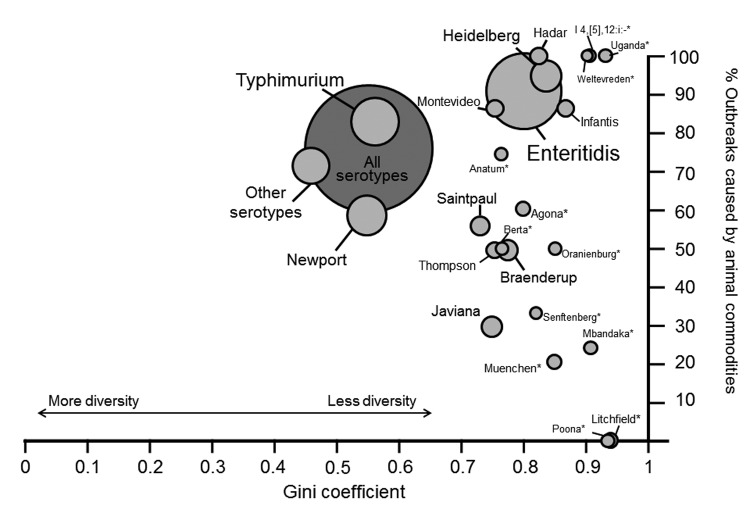
Salmonella enterica infections are transmitted not only by animal-derived foods but also by vegetables, fruits, and other plant products. To clarify links between Salmonella serotypes and specific foods, we examined the diversity and predominance of food commodities implicated in outbreaks of salmonellosis during 1998-2008. More than 80% of outbreaks caused by serotypes Enteritidis, Heidelberg, and Hadar were attributed to eggs or poultry, whereas >50% of outbreaks caused by serotypes Javiana, Litchfield, Mbandaka, Muenchen, Poona, and Senftenberg were attributed to plant commodities. Serotypes Typhimurium and Newport were associated with a wide variety of food commodities. Knowledge about these associations can help guide outbreak investigations and control measures.
肠沙门氏菌感染不仅通过动物源性食品传播,还通过蔬菜、水果和其他植物产品传播。为了阐明沙门氏菌血清型与特定食品之间的关系,我们研究了 1998 年至 2008 年期间沙门氏菌病爆发中涉及的食品商品的多样性和优势。肠沙门氏菌血清型肠炎、海得堡和哈达尔引起的暴发中,超过 80%归因于鸡蛋或家禽,而 50%以上由雅万那、利兹菲尔德、曼巴达卡、慕尼黑、浦那和森滕贝格血清型引起的暴发归因于植物商品。伤寒血清型和纽波特与各种各样的食品商品有关。了解这些关联可以帮助指导暴发调查和控制措施。