Latus Joerg, Roesel Meike, Fritz Peter, Braun Niko, Ulmer Christoph, Steurer Wolfgang, Biegger Dagmar, Alscher M Dominik, Kimmel Martin
Department of Internal Medicine, Division of Nephrology, Robert Bosch Hospital, Stuttgart, Germany.
Int J Nephrol Renovasc Dis. 2013 Jul 8;6:131-7. doi: 10.2147/IJNRD.S47179. Print 2013.
Secondary hyperparathyroidism develops in nearly all patients with end-stage renal disease. Parathyroidectomy is often performed when medical therapy fails. The most common postoperative complication, hungry bone syndrome (HBS), requires early recognition and treatment.
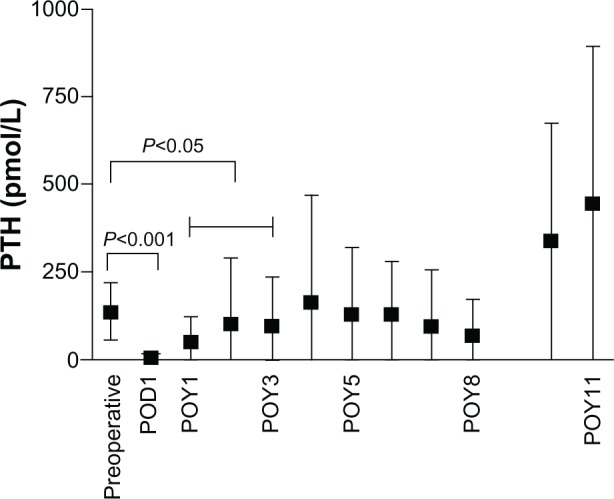
A total of 84 patients who underwent parathyroidectomy because of secondary hyperparathyroidism were investigated. Detailed analysis of laboratory parameters (calcium, phosphate, parathyroid hormone, hemoglobin, and urea levels) and baseline characteristics (age at time of surgery, duration of renal replacement therapy, and medication) was performed to detect preoperative predictors for the development of HBS.
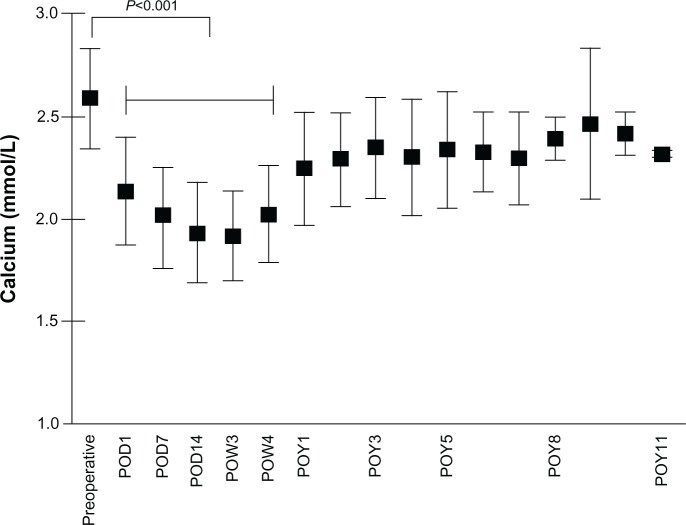
Average overall follow-up of the cohort was 4.7 years. Within this time frame, 13 of 84 patients had to undergo a second surgery because of recurrent disease, and HBS occurred in 51.2%. Only decreased preoperative calcium levels and younger age at time of surgery were significant predictors of HBS. Minimal levels of calcium were detected 3 weeks after surgery. Preoperative vitamin D therapy could not prevent HBS and could not shorten the duration of intravenous calcium supplementation.
HBS is a very common complication after parathyroidectomy. Younger patients and patients with low preoperative calcium levels were at higher risk for the development of HBS. Remarkably, preoperative vitamin D therapy could not prevent HBS and had no impact on the length of intravenous calcium supplementation. Intensive monitoring of calcium levels must be performed for at least 3 weeks after surgery.
几乎所有终末期肾病患者都会发生继发性甲状旁腺功能亢进。当药物治疗失败时,常进行甲状旁腺切除术。最常见的术后并发症——饥饿骨综合征(HBS),需要早期识别和治疗。
对84例因继发性甲状旁腺功能亢进接受甲状旁腺切除术的患者进行了调查。对实验室参数(钙、磷、甲状旁腺激素、血红蛋白和尿素水平)和基线特征(手术时年龄、肾脏替代治疗持续时间和用药情况)进行详细分析,以检测HBS发生的术前预测因素。
该队列的平均总随访时间为4.7年。在此时间段内,84例患者中有13例因疾病复发而不得不接受二次手术,HBS发生率为51.2%。仅术前血钙水平降低和手术时年龄较小是HBS的显著预测因素。术后3周检测到最低血钙水平。术前维生素D治疗不能预防HBS,也不能缩短静脉补钙的持续时间。
HBS是甲状旁腺切除术后非常常见的并发症。年轻患者和术前血钙水平低的患者发生HBS的风险更高。值得注意的是,术前维生素D治疗不能预防HBS,对静脉补钙的时长也没有影响。术后必须对血钙水平进行至少3周的密切监测。