Department of Internal Medicine, section of Geriatric Medicine, Academic Medical Center, University of Amsterdam, Amsterdam, The Netherlands.
BMC Health Serv Res. 2013 Jul 26;13:286. doi: 10.1186/1472-6963-13-286.
Little is known about the prevalence of modifiable risk factors of falling in elderly persons with a fall-history who do not visit the Accident and Emergency (A&E) Department after one or more falls. The objective of this study was to determine the prevalence of modifiable risk factors in a population that visited the A&E Department after a fall (A&E group) and in a community-dwelling population of elderly individuals with a fall history who did not visit the A&E Department after a fall (non-A&E group).
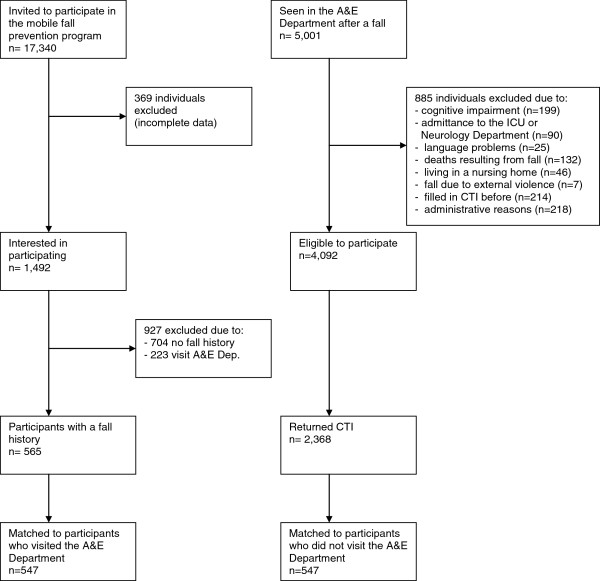
Two cohorts were included in this study. The first cohort included 547 individuals 65 years and older who were visited at home by a mobile fall prevention team. The participants in this cohort had fall histories but did not visit the A&E Department after a previous fall. These participants were age- and gender-matched to persons who visited the A&E Department for care after a fall. All participants were asked to complete the CAREFALL Triage Instrument.
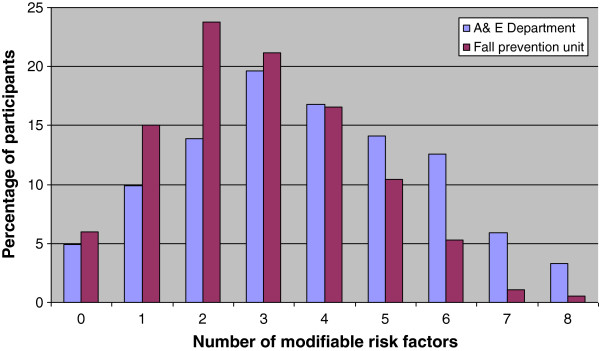
The mean number of modifiable risk factors in patients who did not visit the A&E Department was 2.9, compared to 3.8 in the group that visited the A&E Department (p<0.01). All risk factors were present in both groups but were more prevalent in the A&E group, except for the risk factors of balance and mobility (equally prevalent in both groups) and orthostatic hypotension (less prevalent in the A&E group). The risk factors of polypharmacy, absence of orthostatic hypotension, fear of falling, impaired vision, mood and high risk of osteoporosis were all independently associated with visiting the A&E Department.
All modifiable risk factors for falling were found to be shared between community-dwelling elderly individuals with a fall history who visited the A&E Department and those who did not visit the Department, although the prevalence of these factors was somewhat lower in the A&E group. Preventive strategies aimed both at patients presenting to the A&E Department after a fall and those not presenting after a fall could perhaps reduce the number of recurrent falls, the occurrence of injury and the frequency of visits to the A&E Department.
对于有跌倒史但在跌倒后未到急症室就诊的老年人,其跌倒相关可修正风险因素的流行情况知之甚少。本研究旨在确定在跌倒后到急症室就诊(A&E 组)和跌倒后未到急症室就诊的社区居住的有跌倒史的老年人群中可修正风险因素的流行情况。
本研究纳入了两个队列。第一个队列包括 547 名年龄在 65 岁及以上的在家中接受移动跌倒预防小组家访的患者。这些患者有跌倒史,但在之前的跌倒后未到急症室就诊。这些患者与因跌倒到急症室就诊的患者进行年龄和性别匹配。所有参与者均被要求完成 CAREFALL 分诊工具。
未到急症室就诊的患者的平均可修正风险因素数量为 2.9,而到急症室就诊的患者为 3.8(p<0.01)。两组均存在所有风险因素,但在 A&E 组更为常见,除了平衡和移动能力(两组患病率相同)和体位性低血压(A&E 组较少见)以外。药物滥用、无体位性低血压、恐摔、视力受损、情绪低落和骨质疏松高危等风险因素与到 A&E 就诊独立相关。
在有跌倒史且未到急症室就诊的社区居住的老年人和到急症室就诊的老年人中,发现所有可修正的跌倒风险因素均存在,但 A&E 组的这些因素的流行率略低。针对跌倒后到急症室就诊和未到急症室就诊的患者的预防策略,或许可以减少复发性跌倒、受伤发生和到 A&E 就诊的频率。